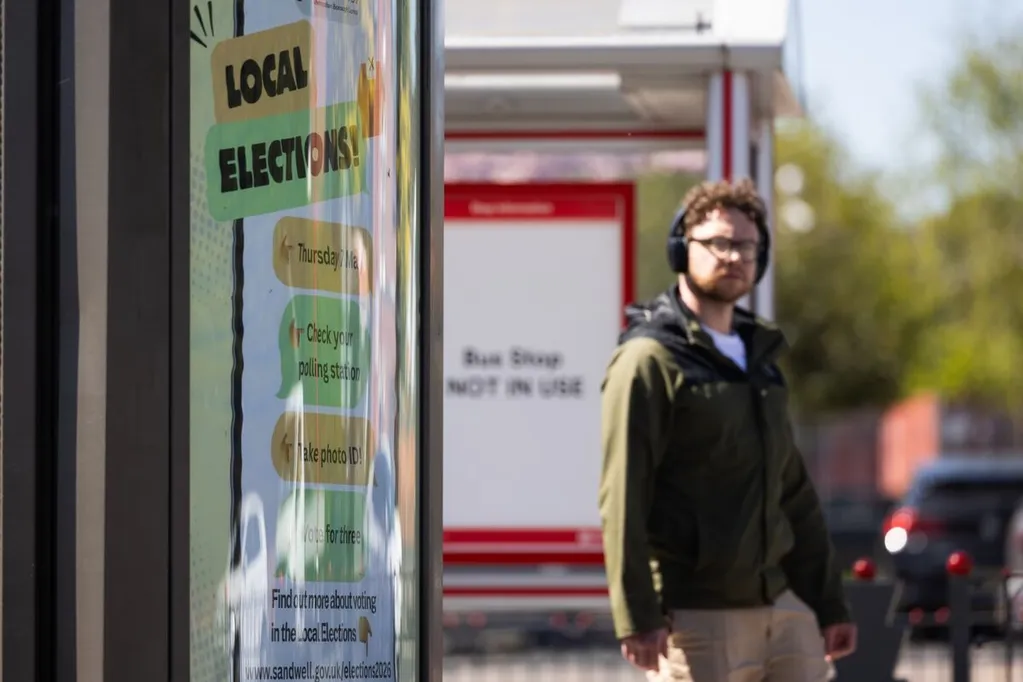
Local elections this week are expected to lay bare a new reality: the two-party system that has dominated British politics since World War II has broken down.
Polling ahead of the May 7 vote suggests the traditional Labour and Conservative duopoly is set to cede hundreds of council seats to populist rivals in a brutal demonstration of the challenges they face to reconnect with voters before the next general election.
The following charts tell the story of a fractured political landscape as Britain -- a nation that has long prided itself on moderation and stability -- experiences an anti-establishment revolt of the sort that has gripped countries from the US and Argentina to Germany.
The Great Fragmentation
Last year's local elections marked a turning point for fragmentation as Nigel Farage's insurgent Reform UK won seats at the expense of mainstream parties. Those losses left Labour and the Conservatives controlling just over half of all local council seats, the lowest proportion in at least half a century.
Since then, the Green Party has also emerged as a worthy rival on the left, and in February captured a parliamentary seat in traditionally Labour-leaning Manchester.
Power Shift
Pollsters are looking at the upcoming elections "as a test of really just how bad is it for Conservatives and Labour," according to John Curtice, professor of politics at Strathclyde University.
Reform and the Greens are set to win the most seats, with some projections suggesting each could secure more than 1,000, according to modeling by More in Common. Even in a relatively strong showing for Labour and the Conservatives, the two parties could still lose more than 1,000 seats between them.
Such a power shift would reinforce insurgents' local networks and party organizations across the country, helping to forestall any restoration of the two-party system by the next general election.
Five-Party Politics
Britain's fractured local politics is mirrored at the top. On a national level, Labour and the Conservatives have been losing voters to the fringes due to a mix of scandals, unpopular measures and the cost-of-living crisis. That has created a situation where five parties -- Labour, the Conservatives, Reform, the Greens and the Liberal Democrats -- all poll in the double figures.
That backdrop will shape the outcome of local contests. Over 60% of voters said party policies on national issues will influence their vote at the locals, outnumbering those who plan to decide based on their local council's performance or parties' promises in their local area, Ipsos said.
No Clear Winner
Voters overwhelmingly blame Labour for the decline of public services, but there's little consensus on who would do better. Ipsos polling shows that a quarter of voters say they don't know which party would be best at running their local council, while the rest are split across the five main parties.
It's symptomatic of the UK's new multi-party reality "where no one convinces the majority," according to Giddeon Skinner, senior director of UK politics at Ipsos.
From Locals to Westminster
Power shifts at local elections tend to highlight national mood swings before they translate into changes of government. The Conservatives went from controlling almost a third of all council seats in the early 1970s to about half before Margaret Thatcher's party won the general election in 1979. More recently, Labour expanded its share of local seats to 35% in 2024, up from around 30% before Covid, ahead of Keir Starmer's general election victory in July 2024.
Pollsters will be watching these local results for clues about what party, or parties, may rise to the top of a crowded field at the next general election.