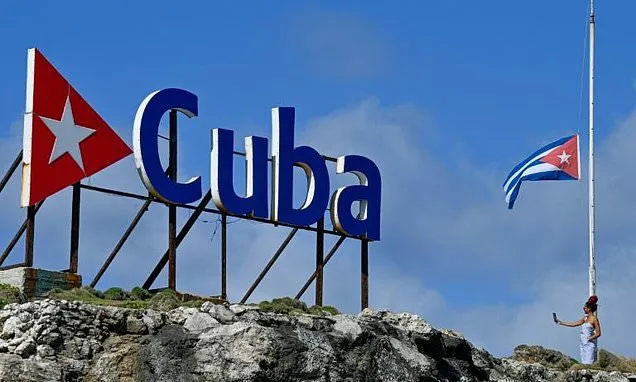
Cuba declared two days of national mourning over the deaths of 32 of its nationals -- mostly intelligence agents and security guards -- in the US operation to capture Venezuelan leader Nicolas Maduro.
The capture by US forces of Venezuelan leader Nicolas Maduro and the killing in the operation of 32 Cubans assigned to protect him represent a major blow for the island's revered intelligence services, experts say.
Fearful of betrayal by dissenters within Venezuela's ranks, the leftist Maduro -- like his late mentor Hugo Chavez -- sourced his security detail in communist-ruled Cuba.
But the Cubans proved little match for the US special forces sent by helicopter to snatch Maduro from a military compound after US jets had pummeled Venezuela's air defenses.
Of the 32 Cubans killed - along with 23 Venezuelan troops -- 21 were from the Cuban interior ministry, which oversees the intelligence services, officials said.
The remaining 11 were from Cuba's military.
Experts consulted by AFP agreed that the key to the seamless execution of the US operation -- meticulously prepared for months, in complete secrecy -- was the element of surprise.
But former Venezuelan military officer Jose Gustavo Arocha of the Center for a Secure Free Society, a US think tank specializing in defense issues, also suggested that Cuba had misjudged the threat.
Cuban intelligence "convinced the Maduro regime and its security agencies that the United States would never attack on Venezuelan territory," Arocha said.
Former US intelligence officer Fulton Armstrong, who is now a Latin America researcher at American University in Washington, also pointed to intelligence failures.
Chief among them, he said, was the failure to anticipate the attack and then to detect helicopters entering Venezuela's airspace.
"Even a five- or 10-minute warning would have made a massive difference for the guards and for Maduro," the former CIA agent said.
US forces however had a major advantage in the form of stealth drones, used to monitor the Venezuelan leader's movements in real time, as well as more advanced weapons and combat gear.
Paul Hare, a former British ambassador to Cuba and Venezuela, argued that Cuban intelligence underestimated US access to "insider cooperation in Venezuela" -- an informant within Maduro's camp.
Citing sources close to the operation, The New York Times reported that a CIA source within the Venezuelan government revealed Maduro's location.
The United States had issued a reward of $50 million for information leading to his capture.
Aura of invincibility
For decades, the Cuban secret service, trained during the Soviet era by the KGB, enjoyed a reputation for invincibility.
Besides having foiled some 600 assassination attempts against late leader Fidel Castro, Cuba was reputed for its ability to infiltrate foreign intelligence services and recruit high-ranking informants, particularly Americans.
The most recent case to come to light was that of Victor Manuel Rocha, a former US diplomat sentenced in 2024 to 15 years in prison after working for over four decades for the Cuban state.
But Cuba "didn't adequately read the Trump administration," said Arocha, noting that the administration’s National Security Strategy unveiled in December clearly articulated Trump’s goal of asserting US dominance over Latin America.
Washington had regularly denounced Cuba’s role, since the 2000s, in the Venezuelan security apparatus.
The routine response from Caracas and Havana was that Cuba, in return for Venezuelan oil supplies, provided its ally with doctors and humanitarian workers.
Arocha argued that "so many years... doing the same thing successfully" blinded the Cubans to Trump's willingness to defy diplomacy and international law, so they did not see him coming.
The Republican leader stunned the world by ordering the capture of the Venezuelan president in what his administration said was a law enforcement operation that did not require authorization from Congress.
"All the capabilities of Cuban intelligence were blocked for the first time in the region... because their traditional methods became irrelevant against this new decision-making style," Arocha said.