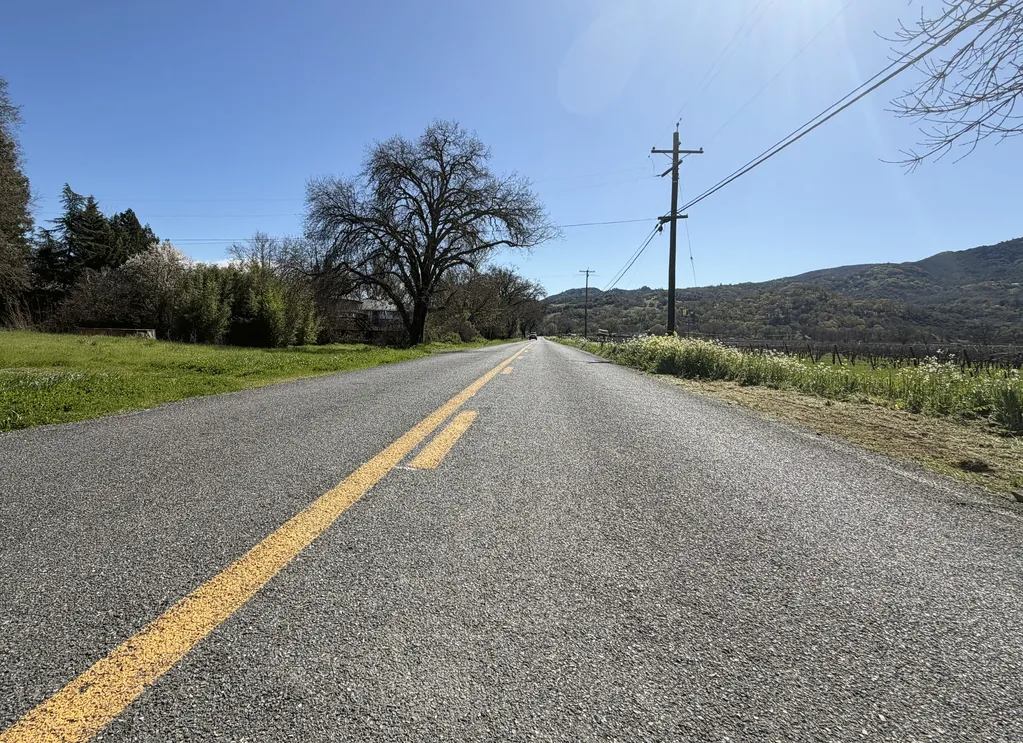
MENDOCINO CO., 3/27/26 - It's a sad truth known to those who drive in Mendocino County: the unincorporated county roads are typically a mess.
Residents say the roads are often riddled with potholes and broken pavement. Driving them can be like navigating an obstacle course, making commutes maddingly slow and damaging to cars.
"If you've never driven out here, it's an experience," said Su Silva, who moved to the county a dozen years ago and lives in the Potter Valley region. "I was here for a year and a half, and then I had to have the entire front end of my truck rebuilt. And we're all accustomed to having front-end alignments once a year -- sometimes more often."
The problem isn't confined to county roads. Some cities and towns - and even state highways - struggle to keep their roads in good condition. But the situation is particularly acute for county roads, where the need for maintenance seems routinely to far outstrip the county's ability to provide it.
"The massive potholes on Old River Road right after you exit 101 (just south of Ukiah) are deeper than a soda can," local community member Sara Hagan said in a post on Facebook. "Every winter they re-open."
And as with so many things, the matter boils down to economics.
Mendocino County just doesn't have enough money to maintain its infrastructure, which is especially - and painfully - apparent when it comes to roads and the people who drive them.
Nobody understands that better than Howard Dashiell, who for more than 25 years has been director of the Mendocino County Department of Transportation. He said he can't attend a local event or social activity without hearing some kind of comment about county roads.
Dashiell said the county has a total of 694 miles of unincorporated paved roads, and it typically has between $5 million to $10 million to spend each year on upkeep. In contrast, he said, Orange County has only half as many miles of unincorporated roads as Mendocino County, but it reported spending $82 million on them in 2021.
Why the difference? Fundamentally, it's an issue of population size.
Although counties draw from their own general funds for some road repairs, county roads are significantly funded by the state, using a combination of gas and diesel tax revenue, registration fees and vehicle weight fees established in 2017 under Senate Bill 1, the Road Repair and Accountability Act. But the state funds are in effect allocated to counties based on population, since the more people there are, the more they pay the state in taxes and fees.
So Mendocino County, with a population of only 89,000 in 2024, gets far less funding than Orange County, with a population of almost 3.2 million. This is true even though Mendocino County has far more miles of unincorporated roads to maintain.
This leaves the department between the proverbial rock and a hard place. It is inundated with requests for road projects across the county but is hard-pressed to focus on more than one section at a time. Dashiell has to decide which roads get funding and which do not - a decision that can sometimes be almost arbitrary.
"That is the thing I get the most criticism about," Dashiell said while showing off a recent project along Mountain House Road in Hopland, which the department resurfaced last year. "I picked an area and focused on it instead of making a contractor run all over the county. It really was random on my part," he said.
Actually, the process isn't entirely haphazard. The DOT works with the Mendocino Council of Governments (MCOG) to plan and manage transportation projects in the county. Among other things, MCOG has a rating system called the Pavement Condition Index that ranks roads on a scale of 0 to 100, with lower scores meaning worse road conditions. The last publicly released score gave the entire county an average score of 46, which puts it in the poor category. The average PCI for the state is 67, and the latest score for, once again, Orange County was 81.
With no additional help in sight from the state, it may fall to the county - and its residents - to address the funding gap if it wants to improve the roads.
At its March 10 meeting, the county Board of Supervisors voted 4-1 to advance a proposed ballot measure that would raise the sales tax by one cent (1%). Before the vote, Dashiell, MCOG and Oakland consulting firm FM3 discussed whether county residents would support the tax increase for local roads. They pointed to a survey last year in which 660 people in the county were asked if they would vote for such a measure. Roughly two-thirds said yes; this is also the percentage of votes needed for passage.
Madeline Cline, who represents District 1 (which includes Potter Valley), opposed the measure. She stated at the meeting that state funding shortchanges rural areas like Mendocino County and she would not support new taxes on residents.
"All of this funding is being collected by the state through gas tax; we're not receiving our fair share so county's getting blamed for not keeping up with road maintenance and being derelict in that duty," Cline said.
But a majority on the board appears to think voters should at least consider the option.
Supervisor Ted Williams, an advocate for more funding for county roads, said a sales tax measure would be a way to ask voters if they want collectively "to buy better roads."
"If the answer is no, we live with what we have. But when was the last time we asked the public if they want to buy better roads?" Williams asked.
Supervisor John Haschak, who also supported moving the measure forward, said in a statement that although many residents are struggling economically, they should still have the choice to vote on the tax.
"I understand that an additional one cent tax is a burden on everyone suffering through this economy, but the people should have the right to vote up or down on this proposal," Haschak wrote.
Meanwhile, for Silva and some other locals, there is skepticism about the county's efforts, with some saying that, even if approved, the money might not be allocated to the places that need it the most.
Silva said that East Road in Potter Valley (sometimes known as Pothole Valley) is one of the roads that badly needs more attention.
"They have promised Potter Valley that they're going to redo that road in about three to four years. But then a couple of years goes by, and that date gets extended. Then it goes out six years, and you get closer to that, and it gets pushed out again," Silva stated. "This is an old issue before the board, and they have been putting it off for about 40 years."