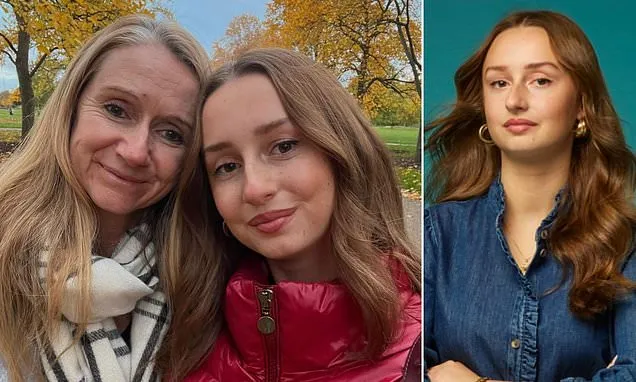
Like every mother of a teenage girl, Sara Trunchion worried about the amount of time her 15-year-old daughter Eloise spent online.
Lockdown hadn't helped; suddenly, a nation of happy, healthy children including Eloise - a girl whose life revolved around dancing, swimming and hanging out with her friends - retreated indoors, their only interaction with the outside world through her phone.
But Sara reassured herself that at least Eloise's online 'influences' seemed to be positive.
Sitting beside her on the sofa in their home in West Sussex, Sara could see Eloise flicking through TikTok and Instagram, pouring over images of beautiful, toned women and studying their recipes and tips for their happy, healthy lives.
What harm could there be in that?
Quite a lot, it turned out.
Within months, Eloise's desire to be 'fit' and 'healthy' spiralled into a dangerous obsession, one that would leave her hair falling out, her periods stopping and her body so weak with anorexia she could barely walk.
Eloise had become hooked on so-called 'Skinnytok' and 'Fitspo' social media posts and vlogs. Such content comprises workout routines, 'what I eat in a day' clips, and weight-loss transformation videos.
While it may - as Sara initially believed - appear harmless, in fact they push the message that your worth depends entirely on how thin you are. And the message was clear: extreme thinness was best.
'As a parent, you tend to worry about strangers on the internet talking to your children, or them being groomed, but only now I realise what other dangers lurk on there,' says Sara, now 57.
At just 15, Eloise Trunchion became hooked on so-called 'Skinnytok' and 'Fitspo' social media posts and vlogs over lockdown
The content Eloise was consuming pushed the message that self-worth depends entirely on how thin you are
'I hate to think how much of that content Eloise watched during her darkest time. That constant comparison is dangerous, especially when people with eating disorders will never feel validated, no matter what.'
Sadly, Eloise's experiences are not unique.
Ofcom figures released last year showed that over a four-week surveyed period, 16 per cent of teenagers had seen material that stigmatises body types or promotes disordered eating. Campaigners warn that, as with violent or explicit videos, such content can cause serious harm.
The rise of such issues is why the Government is carrying out a consultation into children's relationship with social media. One of the proposals being considered is a ban on social media for under-16s, a move that has already been backed by the House of Lords last month following the introduction of an under-16s ban in Australia last year.
'I would definitely be in support of such a ban,' Eloise says. 'I could have done without social media in my life when I was 16. Perhaps then my eating disorder wouldn't have unravelled as badly as it did.'
Eloise, now 19, remembers how gradually these videos took over her life, and completely changed the way she saw food.
'The girls I saw online were tiny and they'd proudly show meals that looked more like snacks, all accompanied by captions or voiceovers like "so full after this" or "staying on track today",' she recalls.
'I became terrified of eating the wrong thing. If I cooked with Mum, I’d stand over her shoulder, demanding to know every ingredient being used.
'If she added oil or cheese, I’d panic. When I was really bad, I’d throw plates of food on the floor, and I remember once walking into the kitchen and seeing Mum cooking pasta and running out the door. She literally had to chase me down the street and persuade me to come home.
'I thought I was being "disciplined" but really, I was ill.'
Since the age of six Eloise had suffered from emetophobia - a fear of vomiting - after being hospitalised with a particularly nasty norovirus.
Her anxiety levels had ebbed and flowed over the years as she worried about foods that might make her ill. But it was in 2021, compounded by the stress of lockdown and more and more time spent online, that her eating problems really began.
Yet at first, when she stumbled upon posts of beautiful slim young women sharing exercise and healthy eating tips, Eloise felt like she’d been allowed access into a perfect world.
These women looked so happy. So in control. Everything Eloise felt she wasn't. And so, she tried to emulate them.
'I started cutting certain foods out - and started to lose weight. Not that I needed to, I was just a normal, healthy teenager, but I couldn't see myself that way. All I saw was the perfection online.'
Such is the pernicious way internet searches work; as soon as Eloise watched one video about 'detoxing', suddenly the algorithm was feeding her dozens of variations nudging her into extreme content.
'Every time I opened TikTok or Instagram, I'd be bombarded with girls showing off their toned stomachs and the tiny meals they were apparently getting by on,' she says.
'Even if I unfollowed accounts, new ones came up on my feed with endless posts about "low-calorie hacks" or "how to eat under 1,200 calories a day".'
'I was just a normal, healthy teenager,' says Eloise. 'But I couldn't see myself that way. All I saw was the perfection online'
'It was so hard,' remembers her mum Sara. 'I was desperate for her to eat but I couldn't force her. We would sit at the table together for hours and there was both anger and tears'
'I hate to think how much of that content Eloise watched during her darkest time,' says Sara. 'That constant comparison is dangerous'
It made Eloise feel like eating anything normal was greedy.
'I started to see food as numbers, not nourishment,' she explains. 'I would be deliberating over which contained fewer calories, a small banana or an apple, and I'd count down to the single blueberry.
'I became obsessed with the calorie-counting app, logging every bite, terrified of going "over" my calorie deficit.'
'One day, pro-ana accounts started popping up on my feed - people actually promoting anorexia and giving tips on how to lose weight unhealthily.
'As a teenager, you're vulnerable anyway You want to fit in, look good and feel in control. Those videos made me feel anything but. They made me hate my body. I would tell myself I'd feel better when I lost a bit more weight.'
'It was a constant battle between having those dark thoughts and trying to ignore them.'
Sara did her best to be patient in the face of Eloise’s increasingly unpredictable behaviour, assuming her daughter was going through a bad patch with her anxiety.
But by January 2022, aged 16, Eloise knew this was something far worse.
'I really wasn't well. I was falling apart. While all my friends were meeting up, having fun and having a great social life post lockdown, I was confined to the sofa watching TV because I was freezing cold and drained of energy.'
Sara's terrifying wake-up call as to how ill her daughter came one day that summer when they went to the beach.
'I saw her in a bikini, and I was shocked. I had no idea she was that underweight, so I took her to the doctors where they weighed her and explained she was way down on the BMI percentile.
'When they said the word anorexia, I was stunned. I knew she was getting thinner, but I'd just thought it was a child being difficult about what they ate. I never thought she had an eating disorder.'
For Eloise, however, the diagnosis brought mixed feelings; fear that she might die but also validation - she was actually ill.
But getting help wasn't easy; the administrative wheels ground painfully slowly.
'It was so hard,' remembers Sara. 'I was desperate for her to eat but I couldn't force her. We would sit at the table together for hours and there was both anger and tears.'
'What helped me in the end was separating the eating disorder from Eloise, seeing them as two separate things. We called the anorexia "Ed" and honestly, it was like she was possessed by it.'
In October 2022, Eloise was admitted to an eating disorder day unit five days a week for three months. She admits this chapter in her life was mostly a blur, with her mum taking the lead in organising her recovery, but she remembers the process being quite daunting.
'I had to eat meals in front of other people and every instinct in my body screamed not to,' she remembers.
But slowly, with support from the doctors, therapists and other patients, Eloise began to rebuild her relationship with food.
'We didn't just talk about calories or weight; we talked about feelings, fears and control,' she explains. 'I realised that anorexia wasn't really about wanting to be thin. It was about wanting to feel safe, and to have something I could manage when everything else felt overwhelming.'
Leaving the unit after 13 weeks, her battle to change her relationship with food continued.
'It's taken another two years of hard work, therapy, support from my family and re-learning what healthy actually means,' she says.'But I've come so far.'
'The best advice I ever received was that recovery isn't about gaining weight; it's about gaining life. And that's exactly what I've done.'
At her thinnest, all Eloise could do was sit on the sofa, too tired to move.
'Now I travel, go out with friends, and live a full, busy life,' she says.'I've even gone back to the day unit,this time to work there helping other young people in recovery.It feels surreal to be on the other side,but I love knowing that my story can give others hope.'
One of the biggest steps Eloise took in recovery was deleting the calorie-counting app that had ruled her life. 'I can't stand them now,' she says. 'I would never recommend them to anyone, especially teenagers. They can be so dangerous because they turn food something that's supposed to nourish us into something to fear.'
'I still have the odd down day when old thoughts creep back in. But I recognise them for what they are lies my illness told me. I've learned to listen to my body instead of an app.'
Eloise stresses that it's important for parents to understand what their children might be seeing online.
'It's not always easy to tell what's dangerous some are disguised as health advice. But they can be incredibly triggering,' she warns.
Now in her own social media content,Eloise focuses 'on how much better life is now and the joy and connection food can bring us'.
'I show what a healthy body looks like and how freeing it feels to go out for dinner,to travel and to laugh again,'she says.
'I get messages [from other girls] saying things like,"You're the reason I started recovery",and "I showed your videos to my mum and now I'm getting support".Those words mean the world to me.'
Yet while she's proud to help others with her content,Eloise still limits her own time online.
While social media companies promise that more protections are coming into place to protect vulnerable users,the reality is that progress is slow—and tech-savvy teens are finding it easy to work around stricter community guidelines.
Eloise's message to teens still transfixed by social media content is: 'You don't have to earn your worth through numbers on a screen. You're enough exactly as you are.'
And her message to parents? 'If you've noticed your child becoming anxious around food or constantly comparing themselves to people online, open up a conversation with them. Don't dismiss it as a phase. I'm so grateful Mum fought for me when she realised how bad it was.'