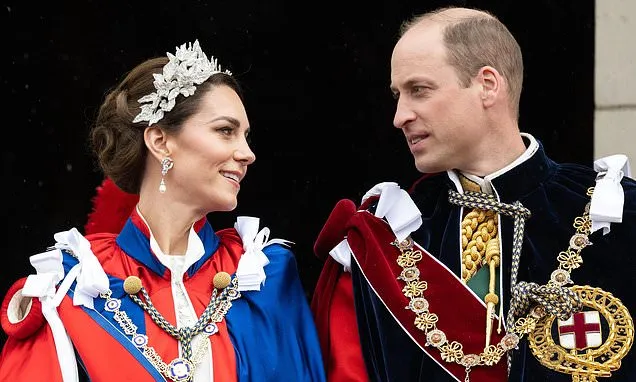
When his time comes, could Prince William choose Christmas Day for his Coronation? His namesake, William the Conqueror, did.
Our William could do worse than follow his ancestor - the man who created modern Britain, and a swashbuckling tough guy into the bargain.
It was William who built the original Windsor Castle, which the modern-day royal family - king and heir - have recently come to regard as Royal Central.
He too had a glamorous wife - Matilda of Flanders, an independently minded woman, devoted to her children and with strong similarities to Catherine.
William's 1066 Coronation took place on Christmas Day in Westminster Abbey. And such is the powerful legacy the king left behind that virtually every other enthronement has take place in the abbey ever since - over 1,000 years of history rooted in one location.
Our current William has made it clear that when it's his turn for the throne, he intends to do things very differently - so why not make the start of his reign a right royal Christmas cracker?
While the logistics of staging a world-class event like the Charles's 2023 crowning on a Christmas Day seem almost impossible, William is already making a reputation for thinking outside the box.
With costs for state events spiralling out of control - Charles's coronation cost a minimum £72 million and maybe as much as £100 million, while Queen Elizabeth's funeral cost £170 million - he may think twice about summoning squadrons of soldiers, sailors and airmen from across the world to line the processional route.
What better way to maintain the dignity of his accession at a fraction of the cost than to stage the ceremony in and around Windsor Castle itself?
Some observers are already reading into the recent announcement that the Royal Mews, responsible for all the gilded royal carriages as well as the ceremonial horses, is to move to the Castle as a sign that big changes are ahead.
Located in Buckingham Palace for the past 200 years, the relocation's an acknowledgement that Windsor, 22 miles to the west, is the royal family's new headquarters. And small-scale ceremonial , starting with Prince Philip's 2021 funeral and including President Trump's state visit last September, has been proved to work in just as dignified and magnificent a way as the bigger set pieces which have gradually grown to breaking point in London.
The town of Windsor can easily handle larger-scale events, as demonstrated by the 1901 funeral of Queen Victoria which attracted the largest-ever gathering of European royalty, as well as other dignitaries in a spectacular send-off.
So maybe in William's thinking is the idea that a Windsor Coronation is a definite possibility. And - why not on Christmas Day?
Here, though, he should maybe take a quick look at history. Because when his namesake the Conqueror chose that day, what should have been a magnificent state occasion turned into a shambolic riot.
The ceremony took place just months after the Battle of Hastings, and Britain was still in confusion with the Anglo-Saxons now at the mercy of the victorious Normans. Still, William had conquered - and wanted the crown plonked on his head.
Plans were laid for a huge and lavish celebration - but on the day, a simple misunderstanding led to pandemonium.
Things started out happily enough, with crowds gathering outside the Abbey and the ceremony, remnants of which still remain in the present order of service - got under way.
But during what's known as the Acclamation and Recognition part of the ritual, "Norman soldiers outside Westminster Abbey, not familiar with the ceremony, were alarmed to hear all this cheering and shouting from inside", recalls Charles Farris, historian at Historic Royal Palaces.
"There is a bit of a panic. They are not sure if foul play is at hand. They start attacking people, setting fire to some buildings. There's a riot."
The ancient chronicler Orderis Vitalis takes up the tale:
"The people who had been rejoicing in the church were thrown into confusion, and a crowd of men and women of every rank and status, compelled by this disaster, rushed out of the church. Only the bishops and clergy along with the monks stayed, terrified, in front of the altar - and only just managed to complete the consecration rite over the king who was trembling violently."
By comparison with the 2,300 people who crowded Westminster Abbey for King Charles's enthronement, by the end of the proceedings there was almost nobody left inside the Abbey to see this unique moment in Britain's history of an invader being crowned.
Instead, blood was spilt, houses and shops were looted and set on fire, and the great day ruined - "Not many dead" might have run the headlines if there'd been newspapers back then.
One other crucial thing was missing from this historic moment - the presence of Queen Matilda. While our Prince William will insist on Catherine being crowned by his side, a thousand years ago Matilda was stuck in France. Her husband left her behind when he went off to conquer England - and with his victory at the Battle of Hastings only two months old, there was no time for her to pack up her court and join him for the ceremony.
There was no time for Queen Matilda to pack up her court and join him for the Coronation ceremony and she was finally crowned two years with the King by her side
Matilda was finally crowned two years later, and with her loving William by her side.
Three new phrases were incorporated into the re-coronation to cement the importance of a queen consort, stating that she was divinely placed by God, shared in royal power, and blessed her people with her power and virtue.
So as the day approaches it's intriguing to ponder on whether history will repeat itself - either at Westminster Abbey or Windsor - with a Christmas Coronation.