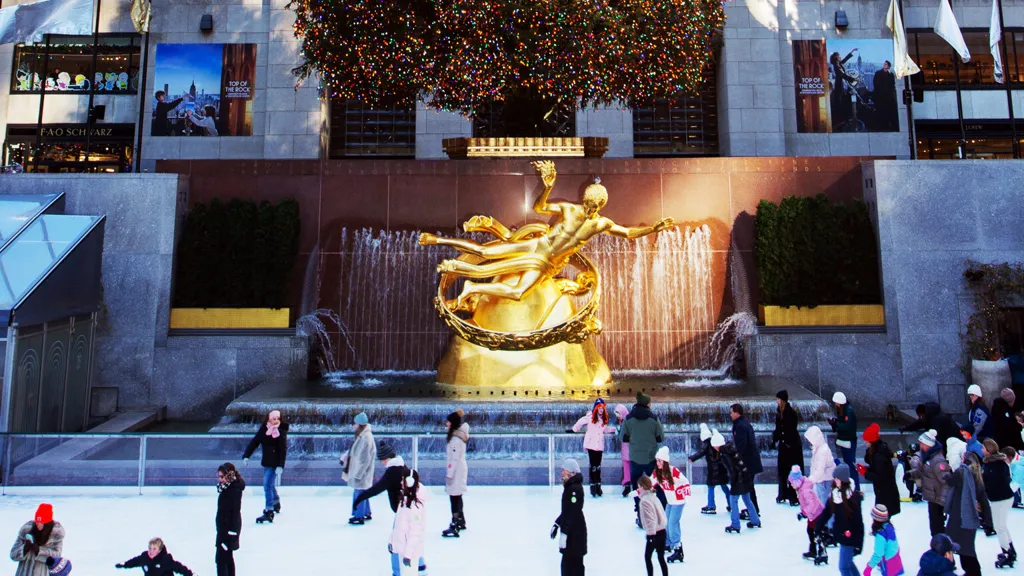
Reggie Nadelson, the author of 15 novels, grew up in Lower Manhattan and learned to ice-skate at the Rockefeller Center rink.
The 212 column revisits New York institutions that have helped define the city, from time-honored restaurants to unsung dives.
Every holiday season, set like a jewel among the somber limestone towers of Rockefeller Center, the ice rink commands the city's attention. On a cold morning a few weeks before Christmas, I stood on its perimeter, where 193 gold and silver flags snapped in the breeze as skaters glided by and "New York, New York" and "A Holly Jolly Christmas" played from the loudspeakers. The sun glinted off the bronze Prometheus, sculpted by the artist Paul Manship in 1934 and freshly regilded. Just behind it was the tree: a 75-foot-tall Norway spruce, trucked in from East Greenbush in upstate New York and now outfitted with 50,000 colored LED bulbs.
"Floating in river water like a diamond iceberg," Truman Capote wrote of Manhattan in his 1950 collection of essays, "Local Color." In 1959, the writer, perhaps recalling those words, was photographed skating at the rink, wearing a fetching Fair Isle sweater.
Between October and March, the rink is typically open from 7 a.m. until 1 a.m. for 60-minute sessions that you can book online. It's set between 49th and 50th Streets, at the west end of the Channel Gardens, a series of granite pools surrounded by greenery that changes with the seasons, and where, around the Christmas holiday, 12 angels (sculpted from wire by the British-born American artist Valerie Clarebout in 1955) blow their six-foot trumpets toward the tree and the skating rink.
For all its iconic status and enduring charm, the ice rink was an afterthought. Rockefeller Center, conceived of and built largely between 1931 and 1939 by John D. Rockefeller Jr., an heir to his family's fortune, was to be a monument to modernity—a collection of office buildings, theaters, restaurants and stores; some of them even air-conditioned. The 13 buildings became famous for their Art Deco style and the art inside and outside of them. My favorite is the 22-foot-tall stainless steel bas-relief sculpture by Isamu Noguchi called "News," on the facade of what was the Associated Press Building, built in 1938, at 50 Rockefeller Plaza.
Dutch and English settlers likely began skating in New York—mostly on frozen ponds in Lower Manhattan—in the 17th century. By the 1850s, there was a skating pond in Central Park, maintained by the city, and in the late 19th century an artificially frozen rink opened at Madison Square Garden. The historian and former public editor of The New York Times Daniel Okrent, who wrote "Great Fortune: The Epic of Rockefeller Center" (2003), noted that the original sunken plaza -- occupied mostly by shops -- was a flop. It was the Great Depression. No one was shopping. But then the developers "brought in a guy from Cleveland who had figured out a way to maintain artificially refrigerated [outdoor] skating rinks," said Okrent in 2020, in an interview by the New York Times architecture critic Michael Kimmelman. "People were only too happy to pay for the privilege of being the entertainment for passers-by, who loved to watch them."
The rink, or "skating pond," as it was then known, opened on Christmas Day 1936. It was a blow-away success. In the 1940s, Sonia Henie, the Norwegian Olympian who became an American movie star, organized and skated in elaborate shows at a theater inside Rockefeller Center. Over the years, any number of celebrities—from Jacqueline Kennedy Onassis to Lucille Ball—came to skate. In 2022, the composer Philip Glass celebrated his birthday at the rink.
On the morning I stopped by, among the toddlers clutching three-foot fiberglass penguins as they learned to steady themselves, and the teenagers monkeying around, I watched a couple of a certain age show off their ice-dancing chops. One of the guards suggested I talk to Gail Kennedy and Joey La Forgia, another couple of seasoned skaters. “You free yourself just skating and skating,” said Kennedy when we spoke by phone. A freelance artist and designer in her 60s who lives in Tribeca, Kennedy told me that’s she a regular at the Rockefeller Center rink.
I was, too, but that was some time ago. Skating was a big part of my childhood and teens. The only prize (third) I ever won was in the 1950s, at the annual Halloween costume competition on ice. I must have been about 9. I won dressed as a TV set.
On the north side was the English Grill. On the south was the Café Francais. Both were glass-fronted. As kids, we’d show off for the diners and then, with guards on our skates, go indoors for hot chocolate. It was a time when serious lady skaters wore thigh-length dresses or skirts, usually in wool and with twirly hems. My own outfit included a blue and gray plaid skirt from B. Altman that my mother had cut down to skating length.
In 2022, the rink and the area around it were renovated. It’s slicker now, with a shop for souvenirs and a row of heated chalets that you can rent for 40-minute increments. I have a nostalgia for the old “skate house” and its ramshackle charm. The floors were wet with drippings from skates left unguarded while we ran around to see which of our friends were there.
Regulars were tight back then and, improbably, there’s still a community. Nelson Corporan, who’s originally from the Dominican Republic and who runs the WM Compact ice resurfacer (commonly called a Zamboni, though that is another brand) to refresh the ice at 90 minute intervals, has been at the rink for 36 years; he always brought his kids when they were off from school. As grown-ups, he says,“they’re still skating.”He feels like he knows everyone at the rink.
"We love the camaraderie," said Kennedy, echoing the sentiment. "The other season pass holders, the guards -- we're like a family."
She and La Forgia, 71, had been skating and dating for about five years when he decided to propose a few years ago. La Forgia, who was also on the call, told me that after he got the ring he thought,“‘What more beautiful and iconic place than the rink?’ So I got down on one knee on the ice.”
“I said yes,” Kennedy adds.
If the wait to skate on the rink this Christmas is too long, I might find myself singing that tune from “Shall We Dance” (1937), my favorite Fred Astaire and Ginger Rogers film: “They all laughed at Rockefeller Center / Now they’re fighting to get in.”