You're reading the Businessweek Daily newsletter.
You're reading the Businessweek Daily newsletter.
You're reading the Businessweek Daily newsletter.
Fresh perspectives on business, economics, politics and tech.
Fresh perspectives on business, economics, politics and tech.
Fresh perspectives on business, economics, politics and tech.
Bloomberg may send me offers and promotions.
By submitting my information, I agree to the Privacy Policy and Terms of Service.
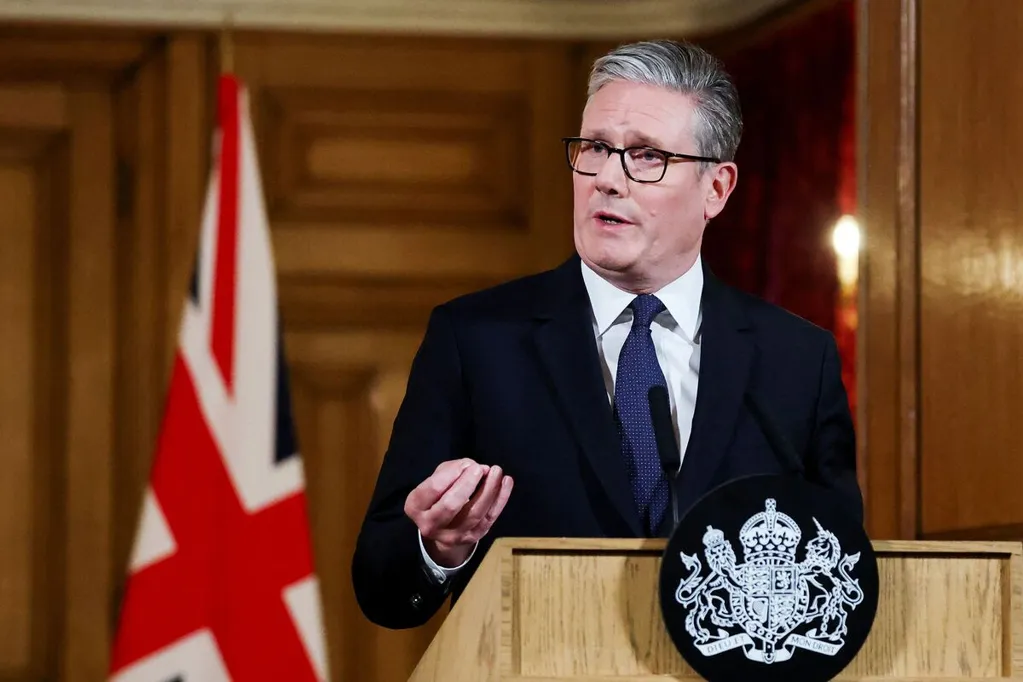
The fallout from Jeffrey Epstein's files continues to shake up politics in multiple countries. Perhaps the most serious reverberations have hit the UK, where Prime Minister Keir Starmer is increasingly at risk, not because he was a friend of the convicted sex criminal, but because one of his appointees was. Bloomberg UK politics editor Alex Morales explains. Plus UPS's future involves more than Amazon deliveries, why taxing the wealthy makes economic sense, and colostrum supplements are on the rise.
Keir Starmer's name barely comes up in the millions of documents relating to Jeffrey Epstein that have been released by the US Department of Justice. But the convicted pedophile's papers nonetheless threaten the UK prime minister's job -- because the man Starmer chose to represent his government in Washington is mentioned almost 6,000 times.
Starmer fired US Ambassador Peter Mandelson in September, after just seven months in the post, when an initial release of Epstein's files showed the envoy's ties with the disgraced financier were far deeper than previously known. Worse, they continued for years after Epstein's Florida conviction in 2008 on state charges relating to child prostitution -- though there's no suggestion that Mandelson participated in any such activities.
That move kept the pressure off Starmer for a while, but the Justice Department's Jan. 30 data dump of 3 million files contained far more shocking details. Among them: Mandelson appears to have leaked sensitive government information to Epstein at the height of the financial crisis while serving in the cabinet of Prime Minister Gordon Brown. It didn't help that British newspapers plastered their front pages with a picture -- also from Epstein's files -- of Mandelson in his underwear. "Mandelson betrayed our country, our Parliament and my party," Starmer told the House of Commons last week. "He lied repeatedly to my team when asked about his relationship with Epstein." But in the same session, Starmer conceded that when vetting Mandelson he already knew the appointee hadn't broken with Epstein after the Florida conviction. For the opposition -- and more than a few internal party critics -- that was a damning admission.
The rationale for appointing Mandelson had been clear. He's a canny political operator and had served as business secretary and European commissioner for trade. That experience would be useful when confronted with the White House return of Donald Trump, who was ramping up tariffs on anyone he didn't like. And the appointment did bear fruit when the UK secured better trading terms with the US than its European neighbors could manage.
But there was always a risk in choosing a man who had twice resigned from government under a cloud and had earned the nickname Prince of Darkness because of his mastery of political manipulation. Some Starmer critics refused to believe the prime minister -- once the nation's chief prosecutor -- when he said he'd believed Mandelson's lies. Surely, they insisted, a lawyer with his pedigree should have been more skeptical.
Last weekend Starmer's chief of staff quit, saying he took "full responsibility" for recommending Mandelson’s appointment. Critics again wondered why the man who actually hired the envoy should get a free pass. Then on Monday the premier’s communications chief resigned, and Anas Sarwar, Labour’s leader in Scotland (and a longtime Starmer ally), called for the premier’s departure.
But within an hour of Sarwar’s announcement, every member of Starmer’s cabinet had voiced support for him—as did his former deputy, Angela Rayner, who’s considered one of his most likely challengers. On Monday evening he told his party’s Members of Parliament that he would stay in the fight “as long as I have breath in my body.” Afterward it was hard to find critical MPs, so it appears Starmer has won himself a reprieve.
There are plenty of pitfalls ahead, including a special election this month for a seat in Manchester that should be a Labour stronghold. Both the Greens and the far-right, Trump-loving Reform UK party are mounting strong challenges there. Local and regional elections in May represent an even bigger threat. Labour has trailed Reform for 10 months in the polls, pointing to big losses for Starmer's party. Labour even appears set to lose control of the Senedd (the Welsh Parliament) for the first time since its establishment in 1999.
Starmer will also have to comply with a House of Commons resolution passed last week requiring disclosure of all documents surrounding Mandelson's vetting, as well as the envoy's communications with ministers and aides in the run-up to his appointment and during his tenure as ambassador. Starmer's team hasn't said when it will publish those papers as it must examine them to ensure their release won't compromise national security. For Starmer, the risk is that the material contains further embarrassing details -- and makes him another casualty of the misdeeds of a man he never knew.
In Brief
- US retail sales unexpectedly stalled in December, suggesting more tempered consumer spending as the year drew to a close.
- Discount retailer Dollar Tree is moving into higher-income neighborhoods, a sign of an economy increasingly catered to wealthy people.
- Paramount Skydance enhanced its hostile offer for Warner Bros. Discovery by saying it will pay the $2.8 billion termination fee that Warner Bros. would owe Netflix if it terminates its already agreed-upon deal with the streaming giant.
- The dismantling of diversity programs on Wall Street is a source of frustration and confusion, according to the more than two dozen Black and other minority bankers Bloomberg Businessweek spoke to.
The Road Less Certain for UPS
Tucked away in an Atlanta suburb amid seemingly endless industrial sprawl sits an unmarked two-story building that people at UPS call the innovation lab. It's hushed inside one morning in September as nearly two dozen workers await their chief executive officer, Carol Tomé.
Tomé arrives—smiling, full of energy and recognizable by her trademark pixie cut and cat-eye glasses. She greets a Bloomberg Businessweek reporter for a tour, starting in the reception area where there's a minimuseum chronicling UPS’s 118-year history. The guide, an engineer, points to a timeline on the wall and highlights some early technology: a conveyor belt, cargo planes and barcoding system. “Innovation’s in our DNA,” Tomé says. “You can see that as you look at this.”
As the guide leads us down a corridor, there’s a moment that seems less scripted. He draws our attention to a slogan on the wall: “Be fearless. Because if you are fearless, we’ll be unstoppable.” James Casey, co-founder and longtime CEO of United Parcel Service Inc., was a font of such inspirational quotes, many of which are still recited with almost religious zeal at the company. But these aren’t his words. “That is from Carol Tomé,” the guide says. “I don’t think she even remembers.” She hasn’t forgotten. “Early days,” she says, sighing. “Early days.”
Cailley LaPara, Devin Leonard and Kiel Porter take a look at Tomé’s plan for the company now as its customers start making their own deliveries: UPS’s Missteps Have Made The Company’s Road Ahead Less Certain
AI Frenzy
$5.3 billion
That's the valuation of startup Runway AI after it clinched a new round of funding, as investors bet on increasingly lifelike artificial intelligence video technology for films, commercials and other projects.
Tax the Rich, Smartly
Over the past few decades, California has imposed its political will on the rest of America and much of the free world, driving social movements such as environmentalism, LGBTQ rights and criminal justice reform. So perhaps it was inevitable that the next phase in the long-running battle over income inequality -- how much tax the wealthy are required to pay and what responsibility they bear to preserve a fraying social safety net -- would start in the Golden State.
Last summer the largest health-care workers union in the state did the math on the Trump administration's legislative Ragnarok, the One Big Beautiful Bill Act, and concluded it would open a $150 billion hole in California's health-care sector over the next 10 years. To stave off the prospect of rural hospitals shuttering, nurses losing their jobs and millions of residents getting booted off their insurance plans, the group launched a ballot initiative it called the 2026 Billionaire Tax Act, a one-time 5% levy on the assets of residents with a net worth of $1.1 billion or more, payable in annual installments of 1% over five years. Then all hell broke loose.
Businessweek Editor Brad Stone writes in Remarks for the March issue of the magazine that it's time to move past the hysteria over wealth taxes and find a durable way forward: How to Tax a Trillionaire
The Tiny But Booming Colostrum Market
Celebrities are known to take questionable measures to maintain their exceptional hotness. Gwyneth Paltrow intentionally subjected herself to bee stings. Victoria Beckham smeared her face with a cream made from her own blood. Demi Moore used "highly trained medical leeches" for some purported detoxification effect.
The latest celebrity-backed beauty secret, though, is a product anyone can buy off the web or at a Target: powderized cow colostrum from the brand Armra. Jennifer Aniston takes a scoop with "room temperature water and a whole lemon squeezed into it" each morning, she told People in January 2025. In April, Selling Sunset star Chelsea Lazkani showed her hundreds of thousands of TikTok followers how she takes her Armra, which she called "the secret to my healthy glowy skin," in a video viewed more than 100,000 times. In June, Vogue published singer Dua Lipa’s pre-yoga routine of sipping Armra’s Immune Revival powder mixed with water and electrolytes. And lest anyone think Paltrow wasn’t in on this trend, she was in fact ahead of it: She interviewed Armra’s chief executive officer on the Goop podcast in August 2024.
In a new Going Viral column, Deena Shanker writes that those celebrity endorsements have driven the supplement to more than $22 million in US sales, a 3,000% increase from two years earlier: Colostrum Supplement Sales Are Booming, But The Science Is Thin
"We want to run our county in a proper way. We don't want a corporation with no skin in the game to come in and destroy our community and our way of living."Tim Estes
Chair of the Paulding County, Georgia, Commission
The Atlanta metro area has some of America's highest rates of institutional homeownership, and local governments are pushing back.