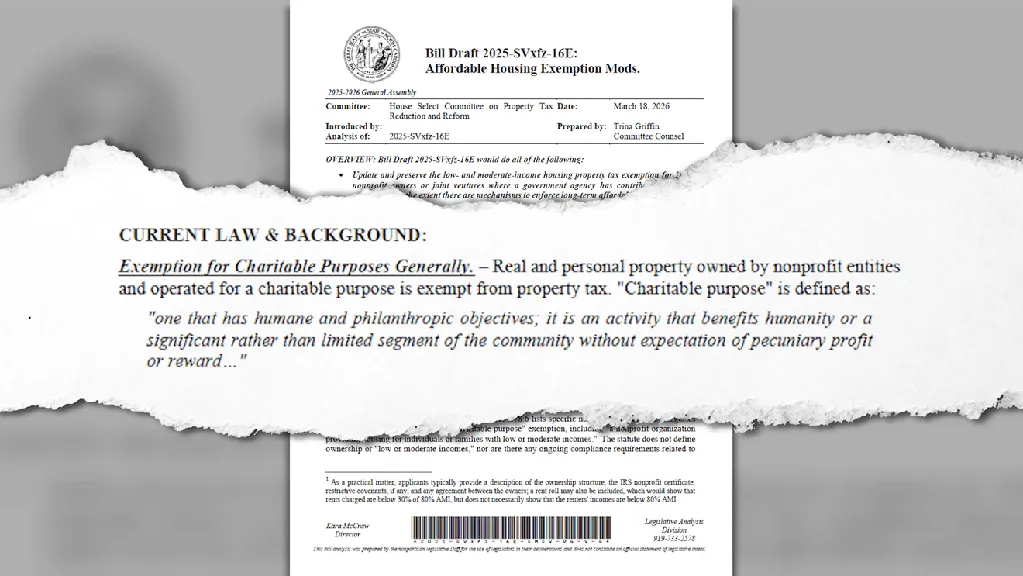
WLOS -- North Carolina lawmakers are moving to close what some call the "rent-a-nonprofit" loophole, a tax break critics say is allowing for-profit apartment owners to avoid paying property taxes without creating new affordable housing.
The proposal advanced Wednesday out of the House Select Committee on Property Tax Reduction and Reform and is expected to be taken up during the upcoming short session.
At the center of the debate is a decades-old law meant to support affordable housing. But lawmakers say in recent years, some investors have found a way to use it differently.
Rep. Eric Ager, D-Buncombe, says the strategy is simple.
"They have a nonprofit that will own a very small percentage of whatever property they buy," Ager said. "It's 99.9% owned by private equity folks and they can then buy a property where people are already living in affordable housing."
In some cases, that ownership stake can be less than 1%.
Ager says investors are often targeting older apartment complexes, places where rents are already low enough to qualify as affordable, then using that structure to qualify for a property tax exemption.
"They buy older properties that are already very affordable, and then they get the property tax exemption," he said. "And then they tend to even raise the rates after they do it."
The concern, Ager says, is what happens next.
"If these folks are getting lots of property tax benefits, somebody's going to have to pay for it," he said. "And the people that are going to pay for it are the people that aren't getting the benefits."
That could mean less money for schools, public safety and other local services, or higher taxes for homeowners.
To understand how this works, you have to go back more than a decade.
In 2013, a North Carolina Court of Appeals case involving Cane Creek Village in Mitchell County helped define how the law is applied today. In that case, a nonprofit owned just 0.1% of the property, while private investors owned the rest, and the court still allowed the tax exemption.
Christopher McLaughlin, a professor at the UNC School of Government, says the issue is that the law itself leaves a lot open to interpretation.
"The statute we're talking about here is really just about 11 words," McLaughlin said. "It does not give us a whole lot of guidance."
Because of that, courts focused less on ownership percentage and more on control—who is actually running the property and making decisions.
That worked in cases tied to federally backed affordable housing projects. But McLaughlin says in recent years, more investors have started applying that same logic to existing apartment complexes.
"What's happening is existing apartment complexes [where] the rents are already low enough to qualify," he said. "And then what happens is a law firm or investment group comes in and says, 'hey sell a tiny sliver to this nonprofit and your property just became 100% tax free.'"
He says that raises a key question:
Was the law meant to encourage new affordable housing, or apply to properties that were already affordable?
"That's ultimately a question for the General Assembly to answer," McLaughlin said.
The proposal moving through the legislature would tighten those rules.
It would still allow tax exemptions for projects that are fully nonprofit-owned or backed by government programs like low-income housing tax credits, known as LIHTC.
But it would limit the ability for private investors to qualify through small nonprofit partnerships and would require ongoing proof that properties are actually staying affordable.
Right now, Ager says, that oversight isn't always there.
"The way that it works now I don't think anybody is ensuring that," he said.
While many of the biggest examples have been seen in places like Wake County, Ager says the issue could spread.
"Once somebody figures out a loophole in one place, it tends to spread," he said."And it's very likely to come to places like Buncombe County."
For now, the proposal still has to pass the full legislature before becoming law.
But for Ager, the urgency is clear.
"I think anytime you find a loophole like this, you need to close it as quickly as possible," he said.