Welcome to CityLab Weekly. Sign up here to get the newsletter every Friday in your inbox, and please send us your feedback as we continue to refine our new format.
Last week we wrote about the legacy of outgoing Paris Mayor Anne Hidalgo. On Sunday, Emmanuel Gregoire won the race to succeed her as mayor, with just over 50% of the vote in a three-way run-off. Gregoire previously served as deputy mayor to Hidalgo and is expected to continue her decade-long push for a greener, less car-dependent Paris.
"The World Cup of Displacement"
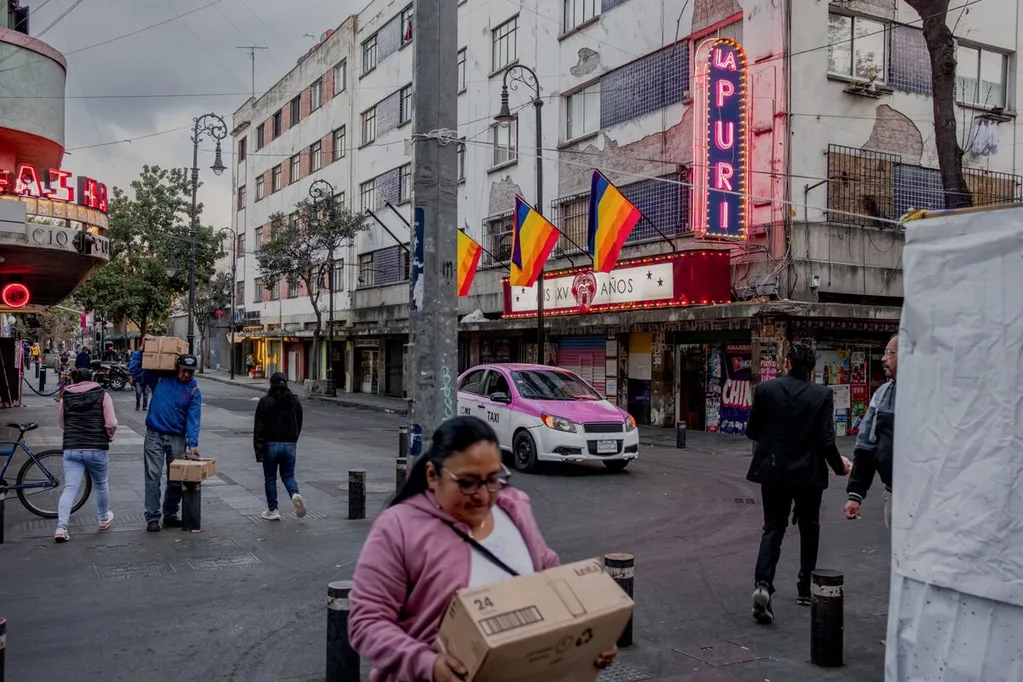
"Mexico is hot right now." The refrain comes from President Claudia Sheinbaum, referring to the country's rise as a hotspot for both travelers and international investors. But local renters are bearing the brunt of that heat. In Mexico City, landlords looking to capitalize on growing demands for short-term rentals and high-end apartments are increasingly evicting existing tenants -- of not just individual units, but entire buildings.
Evictions are often done without court orders; they can be sudden or become violent. One renter, Angélica Gómez, told Bloomberg she was given just minutes to vacate her apartment before men in uniform banged on her door with a battering ram and forced her to leave. Such removals are part of a broader trend that's pricing locals out of gentrifying neighborhoods. With the city now gearing up to host several matches for the upcoming FIFA World Cup, experts tell Alex Vasquez and Amy Stillman that tensions will only escalate.
Some protests over the last few years have already turned violent as housing costs spike across Mexico City. Rents have roughly doubled since 2015 in touristy neighborhoods like Condesa, Roma and Juárez, and have also shot up in places that absorb displaced locals. Officials are trying to limit platforms like Airbnb, but they're not the only culprit: The city also faces an affordable housing shortage, and private developers are focused on luxury.
As for Gómez, she and her neighbors have set up camp outside their building in the city's historic center, where they sleep, cook, work -- and protest. All the while, they're waiting on a court decision or government assistance that may not come anytime soon.
More on CityLab
- Are urban hives a buzzkill? Urban beekeeping is booming, with US cities from Chicago to Raleigh boasting hundreds of honeybee hives in backyards, public parks and commercial rooftops. But is it actually helping bees? In cities with limited native plants or greenery, some experts warn, honeybees stand to edge out wild bees. Others say beekeepers aren't necessarily doing any harm, but they're not a conservation activity, either.
- The futuristic cities of the past We chat with with Harvard scholar Bruno Carvalho, author of the new book The Invention of the Future, about how planners and thinkers of the past (from George-Eugene Haussmann in the 19th century to the creator of the 1960s cartoon The Jetsons) envisioned tomorrow's cities -- and how the urban places in real life defied those predictions.
- Would congestion pricing work in Chicago? Some officials want to follow NYC's lead, but a tolling scheme in the Second City would probably look very different. Congestion is not much of a problem in the post-pandemic downtown, but Chicagoland’s suburban highways are often jammed.
- Big dreams for an old rail hub $5 billion The cost of a massive project from Atlanta Hawks owner Tony Ressler to redevelop "The Gulch" -- a gritty former rail hub in downtown Atlanta -- with a star-studded list of investors. Here's what's in store.
- Steal this idea? Virginia could become the second US state, after Utah, to help residents lower electricity bills by allowing them to use portable, plug-in solar devices that can be set up on a deck or balcony. Newly passed legislation legalizing balcony solar is expected to be signed into law by the governor and take effect next January, despite pushback from utilities. It would prohibit landlords with more than four properties from blocking such installation. The idea, which is already popular with apartment dwellers in Germany, is catching on in the US amid rising energy costs, with more than two dozen related state bills in progress.
What we're taking in
- A robust EV charging network is key to a cleaner future, but people don't want chargers in their backyards. From New York to Kuala Lumpur, neighbors have rejected the infrastructure over everything from their aesthetics to fire risk. (Rest of World)
- Hotter temperatures and recent outbreaks of dengue fever have scientists racing to find ways to eradicate the world's deadliest creature: the mosquito. Scientists in Brazil and Peru may have found a way, and now, it's the US's turn to do the same. (Grist)
- Once dismissed as "flyover country," the US Midwest has become a desirable place to live. It's (mostly) about affordability. (Atlantic)
- While the United States Postal Service is running out of cash, billionaire-backed Amazon is planning to build 200 rural shipping hubs to bring fast delivery to the US hinterlands and loosen its already rocky relationship with the government agency. (Wall Street Journal)
- Waymo has a roadside assistance team, but an investigation shows that the company has had to rely on firefighters and first responders to get behind the wheels of stalled robotaxis, turning tax-funded emergency services into an "invisible safety net." (Tech Crunch)
- Staten Island wants to break away from the rest of New York City. Actually it has since at least the 1900s, but recently conservative lawmakers are reviving the borough's secession movement. (New Yorker)
Your weekend listen
Surging Gas Prices Are Driving EV Interest
As the war with Iran drags out and oil prices remain turbulent, it raises the question of whether -- and how -- prolonged conflict in the Middle East might impact global fossil fuel dependence and the future of renewable energy. On the Big Take podcast, Bloomberg reporters Todd Woody and Akshat Rathi join host Sarah Holder to discuss early signs that the high cost of oil is reigniting consumer interest in electric vehicles and other clean energy technologies, and how companies and countries are beginning to respond.