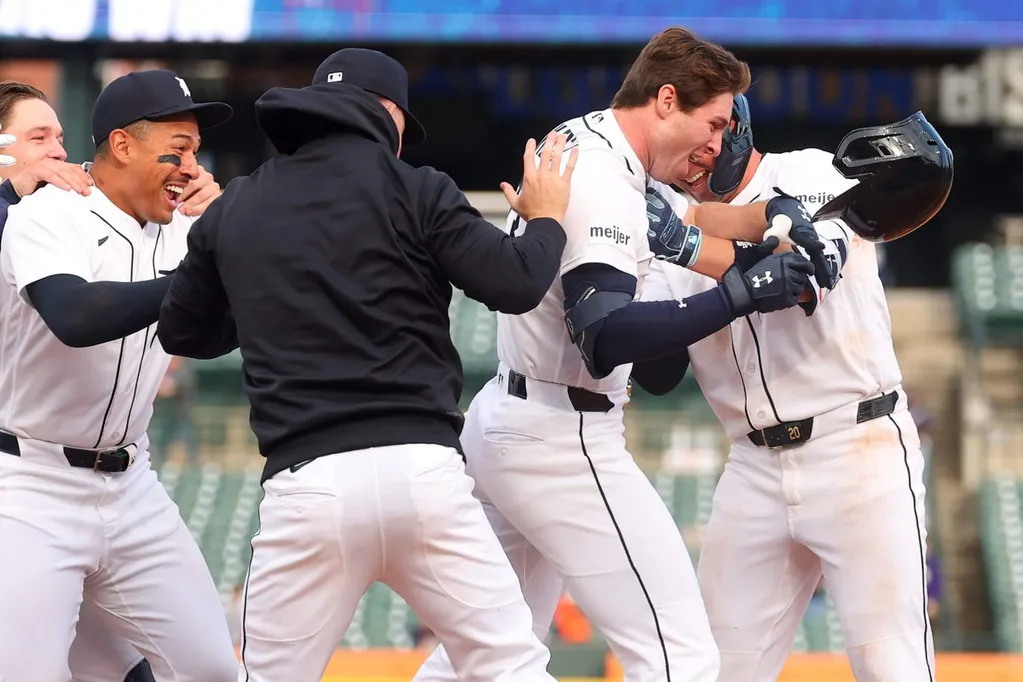
DETROIT -- A couple of days before his hair was covered in baby powder and the jersey was torn off his body, Colt Keith sat in front of his locker and talked about breathing.
There were many things Keith focused on this offseason. He dropped weight as he searched to become leaner, stronger and more athletic. He took grounders at three different infield positions and worked to hone his swing. But the biggest development between last season and this one might come with the help of Detroit Tigers director of sport psychology Paul Knackstedt.
"I put a lot of work into the mental side of the game this offseason and at the end of spring training," Keith said, "going out there and trying to be in more of a flow state instead of a panic, emergency state."
In his first two major-league seasons, Keith could often look tense and rigid. It showed up in stiff swings and slow movements. It was even apparent through his body language. Keith is a serious creature. That's just how he's wired. But often in games, he looked frozen in a frown, or tight to the point he seemed miserable. Keith's lack of smiles and emotion is even something his mother remarked on in an interview two years ago.
"We've tried to tell him, 'Hey, you got to be more fun when you're out there,'" Mary Keith had said. "But he's focused on what he's doing."
Keith was gifted a contract extension before he even made his MLB debut, hailed as one of the young players expected to lead the Tigers into the future. And don't get it wrong -- he had moments of success in each of his first two MLB seasons. Keith, though, also dealt with periods of prolonged drought, none more apparent than his frigid starts to each campaign. In 2024, Keith hit .152 in his first 30 MLB games. Last season, he hit .181 in March and April. Entering this year, he set a goal to get off to a better start. That meant unlocking his best from the get-go. And doing that meant finding ways to relax.
"Whenever I'm tapping my foot or biting my fingernails, just being mindful of why I'm doing that," Keith said. "Oh, it's because I'm stressed. Let's try to visualize me being relaxed, me being calm and get to that point."
With help from Knackstedt and hitting coach Michael Brdar, Keith dove into the world of breath work. It's something athletes across a multitude of sports talk about as a means to help stay calm in big-pressure moments. From afar, it's something Keith had never given much credence.
"I always thought that was, for lack of a better word, eyewash," Keith said. "Like, it doesn't really do anything."
But as Keith began reading some of the science behind breathing strategies for athletes, his mind opened up. Every now and then, you might see Keith step out of the batter's box and take a deep breath. But it's actually inward breaths through the nose that are making the difference. Keith is trying to breathe in carbon dioxide. The thought is that flooding the system with CO2 will signal the brain to send more oxygen to his tissues. It's a strategy that has been shown to promote better air exchange, tissue oxygenation and overall performance.
"Once I read the science behind it and how I was feeling, the symptoms, not being able to see the ball, the ball looked fast, muscles were tense, which slowed the swing down, or whatever it was ... well, scientifically you're in fight-or-flight mode," Keith said. "It was like, 'To get out of that, do this.' So I did that and went out, and it was amazing."
There are now times Keith will use a meditation app throughout the day. He's actively focused on his breath before and during at-bats.
"It helps get the tension out of my body but also my mind," Keith said,"so I can just focus on what's happening in that moment."
For proof of concept, look no further than what Keith is doing right now. In his third MLB season, Keith looks visibly looser at the plate, a slight wiggle in his hands before every pitch. He is feeling more calm and more confident than ever. And he happens to be playing well, too.
"I think it's maturation right in front of our eyes," Tigers manager A.J. Hinch said.
Keith is hitting .317 so far this season. Although he is still searching for his first home run, so much of the underlying data is encouraging. Entering Thursday, Keith’s average exit velocity was 94 mph, up from 90 mph last season. His average bat speed was also up noticeably, from MLB’s 27th percentile last season to the 62nd percentile so far this year.
"As you can see this year, I'm hitting balls harder," Keith said. "I'm better in the zone, swinging at pitches in the zone."
There was more proof on display Thursday as the Tigers battled back from an afternoon filled with delays related to the weather and an ill umpire. Keith started the game on the bench against Kansas City Royals left-hander Kris Bubic. The Tigers built an early lead, then watched it wilt in a nightmare seventh inning.
Keith entered as a pinch-hitter for Matt Vierling in the bottom of the seventh but rolled over to second. In the ninth, though, he was back up at the plate with two outs. The Tigers had clawed back into the game, and Riley Greene sliced a two-run, two-out double down the first-base line to tie the score.
On deck, Keith awaited the moment. He had yet to have a walk-off hit in the major leagues.
"I've had opportunities," he said. "It's in the back of my head every time. It's hard not to think about it."
But rather than getting overwhelmed, Keith stayed focused on a simple approach. He promptly ripped a 1-0 changeup from Lucas Erceg 103.2 mph into the right-field grass. Greene raced around third and slid in safe at home.
Coming off a difficult road trip against the Minnesota Twins, the Tigers won 10-9 and completed a 6-0 homestand for the first time since July 2021.
Out at first base, as his teammates rushed to celebrate, there was Keith doing something you might not have seen a year ago.