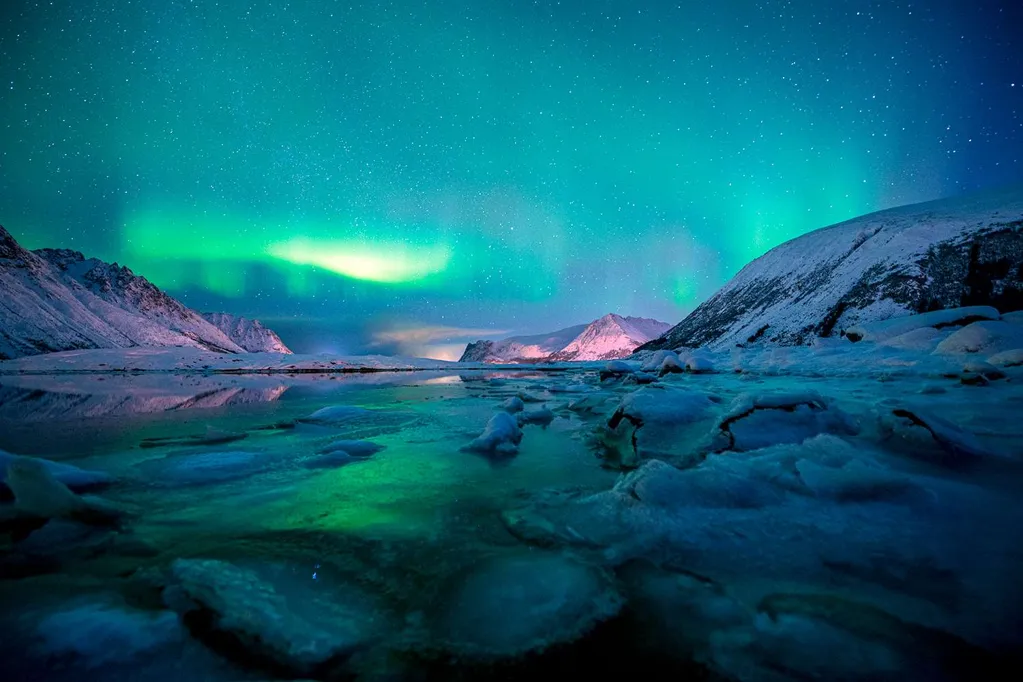
Viewing conditions improve significantly away from city lights with an open view of the northern horizon, and checking real-time aurora alerts.
If you've been craving a little magic to break up the winter monotony, you may want to step outside for a heavenly feast!
This week, heightened solar activity is stirring Earth's magnetic field, setting the stage for a northern lights sky show, with auroras visible farther south than usual.
The aurora borealis (northern lights) is a result of geomagnetic storms, which occur when charged particles from the sun collide with gases in the Earth's atmosphere, creating brilliant waves of light in the sky.
On Jan. 8 and 9, the northern lights could cast a glow across parts of the United States, giving stargazers in as many as 15 states a chance to witness one of nature's most mesmerizing phenomena, as forecasted by the National Oceanic and Atmospheric Administration's Space Weather Prediction Center.
With our planet responding to incoming charged particles, a G1-level geomagnetic storm is predicted "due to potential compounded effects of a CIR and a CME that left on Sunday, Jan. 6," as reported by NOAA.
As for the CIR, this is a plasma pile-up between fast and slow-moving streams of solar wind, much like a mini coronal mass ejection, per Spaceweather.com.
Are you ready for the cosmic spectacle? Whether you're a seasoned sky-watcher or someone who just wants an excuse to step outside and fall in love with the cosmos, this is your chance to do so.
The best time to look up is after sunset on Thursday, Jan. 8, through the early morning hours of Friday, Jan. 9, with peak visibility most likely between 10 p.m. and 2 a.m. local time.
Remember, darkness is key here -- the further away from city lights, the better your chances of catching the aurora's enchanting glow.
While Alaska offers the most reliable views, this cosmic event could extend aurora visibility across parts of the northern U.S. States, including Washington, Idaho, Montana, North Dakota, South Dakota, Minnesota, Wisconsin, Michigan, Maine, New York, Vermont, New Hampshire, Ohio and Pennsylvania, particularly in northern and rural areas.
Still, when considering NOAA's aurora view line, the northern lights are most visible in higher-latitude regions.
For the best experience, head far from city lights and pollution, with a clear, unobstructed view of the northern horizon. As always, it's important to be patient and give your eyes time to adjust. Dress warmly, and hope for the best.
Remember, auroras are fickle by nature, so don't let their initial faint shimmers fool you, as they can suddenly intensify without warning. Checking real-time aurora alerts and forecasts can also help you know when activity is peaking.
If you're hoping to make some magical memories, your smartphone is more than enough to do the trick! All you have to do is go to settings, turn on Night Mode and point your camera lens towards the sky.
If you're a more seasoned stargazer and happen to have a DSLR or mirrorless camera, grab a tripod and set your camera to manual mode. Remember, patience is key.