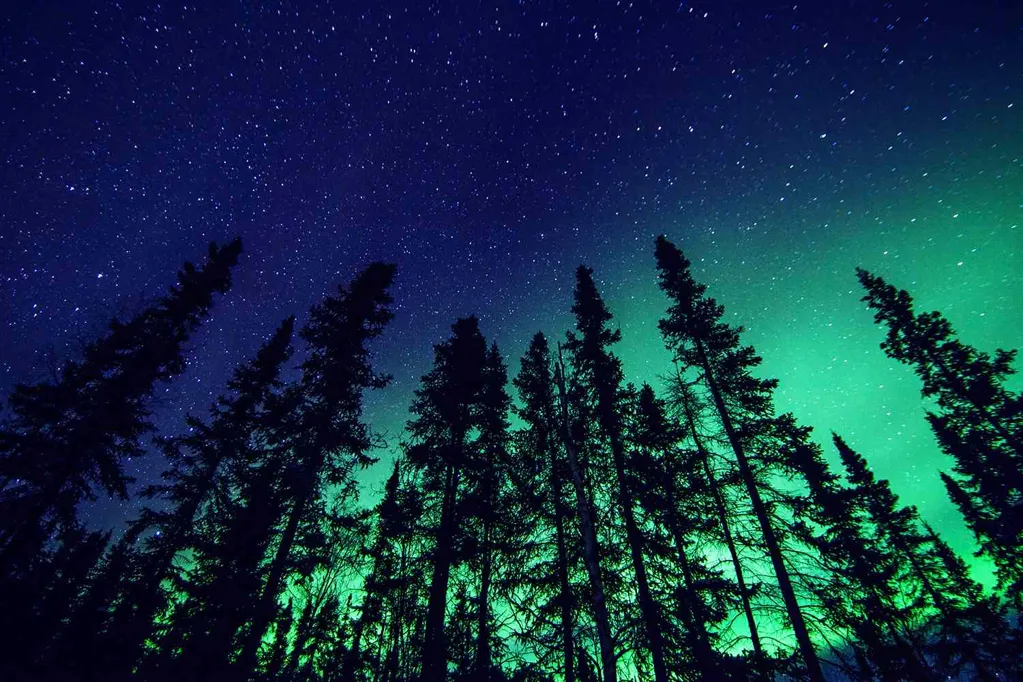
Look up, because the sky's about to put on a show!
If you've ever wanted to witness (or photograph) the northern lights without leaving the U.S., this could be your moment.
The aurora borealis (northern lights) is caused by geomagnetic storms, which occur when charged particles from the sun collide with gases in Earth's atmosphere, creating brilliant waves of light in the sky. Still, their visibility depends on several factors, including intensity and location.
A surge of intense solar activity arrives just in time for January's dark winter skies, setting the stage for auroras to push unusually far south across the country tonight, Jan. 19 and into the early hours of Tuesday, Jan. 20, according to the National Oceanic and Atmospheric Administration's Space Weather Prediction Center.
This isn't a subtle glow reserved for the Arctic Circle. This is a rare, high-impact space weather event that could bring auroras to mid-latitude regions just as the night sky reaches its darkest point.
According to NOAA forecasters, Earth is bracing for a strong to potentially severe geomagnetic storm as charged solar particles slam into our planet's magnetic field.
The trigger? A massive X1.9-class solar flare erupted from the sun, followed by an Earth-directed full halo (CME) coronal mass ejection, the kind that significantly increases the odds of intense auroral activity.
This is one of those nights where space weather, the lunar cycle and winter darkness conspire to create something extraordinary.
Here's exactly when to look, where to look and how to make the most of this stellar event.
The northern lights are expected overnight Monday, Jan. 19, into early Tuesday, Jan. 20, as Earth is impacted by a powerful geomagnetic storm.
Forecasters are predicting strong G3 conditions, with the potential for the storm to intensify to G4 (severe) on NOAA's five-level scale.
This activity is being driven by a full-halo coronal mass ejection (CME), a massive cloud of charged solar particles released after an X1.9-class solar flare erupted from the sun on Sunday, Jan. 18.
Given that the CME is directed towards Earth, it has a higher chance of disturbing its magnetic field once it arrives. According to NOAA, "Higher storm levels are possible as early as the end of the day" on Mondaym Jan. 19.
If conditions peak as forecasted, auroras could be visible across up to 24 U.S. states, extending from the Canadian border down into mid-latitude regions.
The best chances of viewing will be in northern areas, including Alaska, Northern Washington, Idaho, Montana, Wyoming, North and South Dakota, Minnesota, Wisconsin, Michigan, New York and Maine.
If the storm reaches G3 strength or higher, however, sighting could stretch further south into Oregon, Nebraska, Iowa, Illinois, Indiana, Ohio, Pennsylvania, Massachusetts, Connecticut, Rhode Island, Vermont and New Hampshire.
Space weather is notoriously difficult to predict, as everything depends on the speed and orientation of the solar wind.
For real-time updates, be sure to monitor NOAA's 30-minute aurora forecast, SpaceWeatherLive.com or aurora-tracking apps such as Aurora Now, My Aurora Forecast, SpaceWeatherLive or Glendale Aurora.
One key indicator is the Bz component of the interplanetary magnetic field. When Bz turns southward, solar energy can more easily penetrate Earth's magnetosphere. A sustained southward Bz of -5 nanoteslas or stronger often signals an imminent auroral display.
Dark skies will be especially favorable during this window, as the activity follows a new moon, meaning little to no moonlight to interfere with visibility.
From northern U.S. states, any auroras that appear may glow low along the northern horizon.
The best part about the northern lights is that you can also make fun memories in the process. Your smartphone is more than enough, too! All you have to do is go to settings, turn on Night Mode and point your camera lens towards the sky.
If you're a more seasoned skywatcher and happen to have a DSLR or mirrorless camera, grab a tripod and set your camera to manual mode. Don't forget to stay warm!