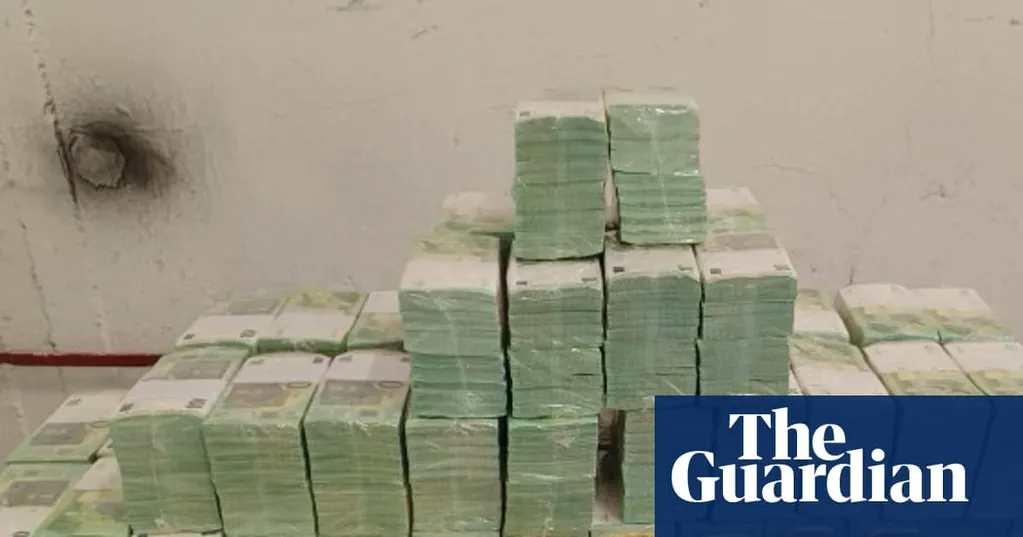
Kyiv sources say they think injection contained relaxant meant to make people more talkative in interrogations.
Hungarian security operatives administered a "forced injection" to one of the Ukrainians detained earlier this month during a dramatic raid on bank vehicles carrying gold bars and tens of millions of dollars and euros in cash, sources have told the Guardian.
Hungary's TEK anti-terrorism police detained seven Ukrainians from the state savings bank, Oschadbank, on 5 March. They were accompanying a convoy of two armoured cars from Vienna to Ukraine, as it transited Hungary in what Kyiv claims was a regular transfer of state funds. Hungarian officials have claimed it was money for the "Ukrainian war mafia", without giving details.
The men were held for more than 24 hours, much of which they spent blindfolded and in handcuffs, before they were deported to Ukraine. During that time, one of the men - a former employee of Ukraine's SBU security service - was given the forced injection, security sources in Kyiv said.
The sources added that they believed the injection contained a relaxant that was meant to predispose subjects towards becoming talkative during interrogations. However, the drug reportedly led the man, who is diabetic, to have a hypertensive crisis and lose consciousness. He was eventually taken to hospital.
One of the Ukrainian sources described the forced injection as a "Russian-style method" that harked back to so-called truth serums used in KGB interrogations in previous decades. Traces of a drug of this class were discovered during blood tests carried out after the men returned to Ukraine, said another source.
The Guardian has not seen the test results and could not verify the claims. However, Lóránt Horváth, the Hungarian lawyer for the individuals, confirmed that "one individual received an injection of unknown contents despite his objections". A Hungarian police source told the Guardian they had heard from colleagues that an injection had been administered, but did not know what it contained.
A spokesperson for TEK directed questions to NAV, Hungary's tax and customs agency, which did not reply, while a spokesperson for Oschadbank said the bank could not comment on the claims, citing medical privacy concerns. It did, however, confirm that one of the individuals arrested was "a person with a disability, [who] needs a special diet and regular medication". This person's health condition deteriorated, said the bank, and "medical care was provided only after he lost consciousness".
In recent days, Oschadbank had filed a criminal complaint against Hungarian authorities related to abuse of office, as well as criminal and civil claims on behalf of the seven staff members, seeking to overturn the decision to deport them and ban them from the Schengen zone, said Horváth. The bank is also seeking the return of the funds, which are still impounded in Hungary.
The raid came as a crucial parliamentary election approaches in Hungary. Polls suggest that nationalist leader Viktor Orbán is in danger of losing his grip on power after 16 years. Orbán, whose government has regular contact with Moscow, has been the EU's most pro-Russian leader, and before the election has sought to paint Ukraine and its president, Volodymyr Zelenskyy, as the biggest threat to Hungary. Numerous reports have alleged that Russia is actively working to support Orbán's campaign.
Ukrainian sources said that, with Russia's war shutting down Ukrainian airspace, transfers of government funds via land had become common practice. They accused Budapest of seeking a pretext to escalate a spat between the two countries. Many similar shipments had traversed Hungary previously, said one source, who claimed authorities in Budapest were always apprised of the route. Sometimes, a police escort was provided, though not on this occasion.
This time, officers from TEK lay in wait for the two-car convoy, and stopped it as it travelled down the highway, pointing weapons at the vehicles. The Ukrainians eventually got out of the cars and were arrested. Kyiv discovered the location of the convoy because a GPS tracker in one of the cars showed it was on TEK territory, but it took several hours before Hungary admitted it had captured the men. During questioning, the Ukrainians were kept in handcuffs for hours, and were not provided with a Ukrainian interpreter, only a Russian-speaking one.
The Hungarian police source said: "The whole operation was very unprofessional, and not everyone at TEK was happy about having to carry it out.
“They didn't even know there were GPS trackers in the car. They only realised the Ukrainians knew where the men were being held when they heard it on the news.”
Late the following evening, the seven men were driven to the border with Ukraine, deported and banned from entering the Schengen zone. The Hungarians kept their possessions, which were only sent to Ukraine later; Hungarian authorities still hold the money and gold.
Hungary has opened a money laundering case over the funds and claimed they were destined for Ukraine's "war mafia". The story has been covered extensively on state-controlled media, where Orbán's pre-election narrative is that Brussels and Kyiv are trying to drag Hungary into the Ukraine war, and that Ukraine is a corrupt black hole that is swallowing funds sent by Europe. On Thursday, Orbán refused to drop his veto on a €90bn (£78bn) EU loan for Ukraine.
Responding to earlier threats to veto the loan, a frustrated Zelenskyy said on the same day of the bank vehicle seizure that he might give Orbán's address to the Ukrainian army. "Let them call him and talk to him in their own language," he said. The comments were swiftly incorporated into the Hungarian government messaging on Ukraine, with Orbán claiming Ukrainians were now targeting his family.
Oschadbank said its priority now was securing the release of the funds. Horváth, the Hungarian lawyer for the Ukrainians, pointed to public comments by the transport minister and close Orbán ally, János Lázár, that appeared to suggest the money seizure was a politically motivated response to Kyiv's reluctance to fix a pipeline that transports Russian gas across Ukraine to Hungary. "If they're blackmailing us ... we won't give the money back. For now, the money stays here," said Lázár at a campaign event.