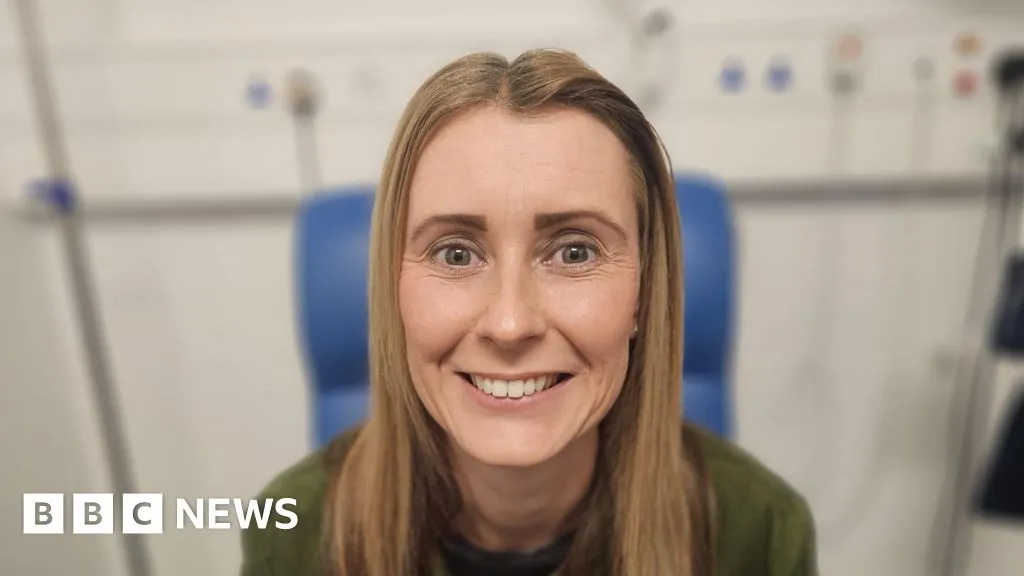
For a long time, everyday tasks like climbing the stairs or doing the washing left Natalie Rekowski breathless.
At 18 weeks pregnant with her second child, Natalie's airway closed significantly and she needed emergency surgery to allow her to breathe properly.
The mother of two has idiopathic laryngotracheal stenosis, a rare condition that affects one in 500,000 women and causes abnormal narrowing of the voice box and windpipe.
"It is really scary because it's a condition that you can't see, you don't really know what's going on - other than how you feel and how it affects your breathing," she said.
After having surgery at the Queen's Medical Centre (QMC) in Nottingham, Natalie said she felt like a "new woman".
The 37-year-old added: "It [her airway] opened wide open, and my pregnancy was great after that; it was like my first pregnancy; I got to actually enjoy it again."
The condition, which is often mistaken for asthma, involves inflammation and scar tissue build-up in the airway.
Before Natalie was diagnosed, she was prescribed multiple inhalers to try to treat her symptoms.
She said: "It was a scary time because you know there is something wrong with you but they [test results] keep coming back clear.
"You just had no idea what was going on."
She is one of a number of women who now travel to Nottingham to receive specialist treatment at the QMC.
It is one of three NHS centres in the country to offer a one-stop service for patients with the condition, which includes surgery to remove the affected tissue and steroid injections to slow down the regrowth.
Natalie, who lives in Cumbria, was diagnosed in 2021 and did receive some treatment at her local hospital.
But a friend from a support group then put Natalie in touch with surgeon Prof Reza Nouraei, consultant ear nose and throat surgeon at the QMC, after she started to find it very difficult to breathe.
"She said that I could come to Nottingham and he'd be willing to meet," Natalie said.
"I packed a bag and came down, and he came in to see me from home and he operated the next day."
Natalie credits Prof Nouraei with changing her life after her initial surgery in 2024.
"He's a hero, he really is; I'm really really grateful I've got to come here; it does really mean a lot because you feel so alone," she said.
"When I was at my previous hospital, they didn't have anybody that had this condition and I was kind of a guinea pig."
"Since coming here, I've met a great group of ladies; we've got a WhatsApp group and we talk all the time which is great in itself to just not feel so alone."
Prof Nouraei said it was unclear why the condition mainly affected women.
"We don't know why it happens; it just creeps up on them over a course of one or two years," he added.
"It can present itself in critical times like pregnancy where the respiratory demand goes up and suddenly the condition deteriorates.
"It can lead to problems like miscarriage - being pregnant is a demanding enough task as it is and if you're breathing through tiny straw trying to get oxygen to mother and baby that can be very very tricky."
Prof Nouraei developed a technique during the Covid-19 pandemic to perform awake endoscopies to give patients like Natalie steroid injections.
The method involves patients being coached through a variety of breathing techniques while a camera is inserted through their nose and into the throat. He then injects a steroid from the outside.
Prof Nouraei said: "The way that we are now doing it, is to do laser surgery through the mouth to do an extensive removal of the diseased tissue and then bring the patient back in and manage the scarring with steroids that dampen down the scaring."
He said the method avoided the risks of general anaesthesia and the subsequent recovery, meaning "you can treat these conditions more often".
Prof Nouraei added: "Of course it is cheaper, but it definitely is not a cost-cutting exercise because it means you can do more."
"We are not infinite resources so if we are able to be here doing 20 operations as opposed to doing five under general anaesthesia that means we are better able to deal with the increased demand."