How many tower beacon technicians does it take to screw in a light bulb? Just one with nerves of steel.
After years of teaching folk studies and anthropology at Western Kentucky University, Barry Kaufkins, 49, of Bowling Green, Kentucky, made a change that quite literally took his career to new heights.
In 2019, Kaufkins became a tower beacon technician - joining other daredevils who earn their living by scaling and repairing massive telecommunications towers, some 2,000ft tall.
Throughout his career, Kaufkins climbed towers in 45 US states, but he didn't love his life on the road.
According to Kaufkins, legend has it that tower beacon technicians could earn staggering sums every time they climbed.
'You know, fill in the blank, $10,000 or $50,000,' Kaufkins told the Daily Mail.
'If anybody out there is paying that much, then my gosh, I would love to get back on the road. In a heartbeat.'
He said that people would talk about a 2,000ft tower in 'North Dakota, Texas or wherever' with a light bulb at the very top. According to the story, every six months a guy climbed the tower, changed the light bulb and got paid a 'ridiculous' sum.
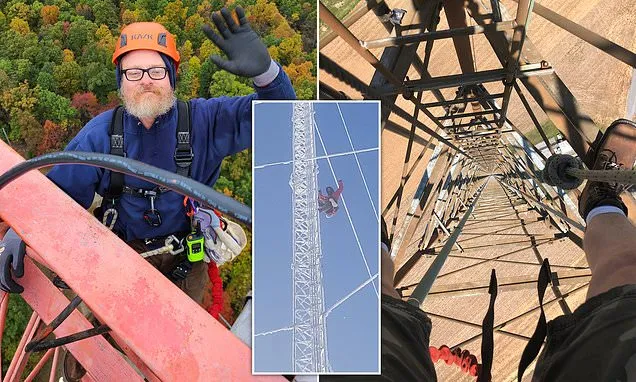
Kaufkins gears up to scale massive towers as a tower beacon technician based in Kentucky.
'I saw it on Instagram, and I heard about it when I was a kid, and I kind of believed it back then,' Kaufkins said. 'But I used to be a folklorist... and this little story is what we call an urban legend.'
The legend relates to a viral Facebook post which asserted climber Kevin Schmidt was paid $20,000 to scale a 1,500ft tower with only a harness and grit. The post claimed that Schmidt made his ascent twice a year, earning him $44,000 annually.
'I still hear it all the time, and people will argue with me about it,' said Kaufkins.
He was unaware of any tower technicians who earned close to that amount for a single climb.
How much do tower beacon technicians earn?
Here's the not-so-shocking truth: The social media stories about earning five figures per climb are myths.
Generally, tower technicians in the US make between $48,000 and $62,000 a year, with an average hourly rate of $23 to $26, according to industry sources. Some technicians may earn more depending on their experience and job location.
Industry veteran Will Stone shared his insight and the realities of how much tower beacon technicians can earn.
'You know, there's people out there that really think we get that kind of money to change a lightbulb,' Stone told Tommy Schuch Media in an interview. 'That's one of the jobs I do currently. That's nowhere near true.'
With rising costs and tight deadlines, Stone said companies don't pay climbers 'what they're worth,' claiming that most beginners make an hourly rate that's close to minimum wage.
Kaufkins went through training to become a tower beacon technician. He also learned a lot while on the job.
Kaufkins sometimes scaled towers that were 2,000ft tall - or taller than the Empire State Building.
'Lots of climbers are promised a raise or better position,' he added. 'It never happens. There's a lot of guys that they'll get told this... it's a lot of smoke and mirrors.'
The Daily Mail found a tower technician job posting in Jersey City, New Jersey, that offered an hourly rate of $18 to $30. According to the job post, candidates would maintain wireless telecom equipment and should be able to climb towers, poles and rooftops up to 500ft.
A separate job posting for an entry-level or mid-level tower climber in the state of New York offered $25 to $30 an hour to climb towers 'in excess of 300ft.'
In his first year, Kaufkins earned roughly $95,000. He said that overtime boosted his earnings, and that he worked 70, 80 or even 90 hours a week. Much of the overtime came from traveling to and from jobs and working on weekends.
'It's pretty easy to make a good amount of money when you're working seven days a week,' he told the Daily Mail.
Not a job for the faint of heart
Tower beacon technicians maintain and replace aviation warning lights - the blinking red lights atop steel towers and masts that help pilots avoid collisions with structures that are difficult to see at night.
They also repair telecommunication equipment, like antennas, on tall towers or roofs.
According to industry sources, there are more than 12,000 people employed as tower beacon technicians - also called 'tower riggers' or 'aerial technicians.'
Extensive safety training is necessary, with certification from the National Wireless Safety Alliance required for most professionals.
Facing dangerous working conditions, tower technicians are generally protected by rules and regulations enforced by the Occupational Safety and Health Administration (OSHA), industry groups and individual companies like AT&T.
Jobs are often postponed due to weather conditions. Thunderstorms are 'a big no-no,' Kaufkins said, as rain is a hazard when dealing with electrical equipment. Sometimes technicians get caught high up on a tower when a storm 'sneaks up' on them.
'Snow and ice are pretty routine,' Kaufkins said. 'We climbed in that all the time.'
There are some exceptions, though, and every company has a different policy. If possible, some jobs are completed with the crew entirely on the ground. A lot is also left up to the individual climber or supervisor to decide.
Kaufkins traveled to 45 US states during his time as a tower beacon technician - but didn't love his life on the road
REAL high flyers!
Tower technicians face some pressures to meet company deadlines, even if that means skirting safety precautions.
The mandatory, OSHA-compliant way to scale a tower is known as 'click climbing,' or using a cable device that locks in or 'clicks' as someone climbs higher.
But some technicians opt to 'free climb,' which is scaling a tower without a harness, rope or safety system.
'So you're a new guy, right? And you got to impress all these tough tower dudes, and don't want to be left behind because a click climb takes three times as long as a free climb,' Kaufkins said. 'You free climb, like the rest of them.'
For someone who might be interested in being a tower beacon technician, he reassures potential climbers that the job is 'a lot safer than it used to be' as companies are a lot more strict today about following rules.
Kaufkins walked away from the gig after a handful of years.
'Five years was about enough time,' he said. 'It started to get a little tedious.'
But he also found that the job was a massive time commitment, and one he no longer wanted to make.
The main reason Kaufkins said he switched careers yet again is that he was spending so many days away from his family. Today, Kaufkins works as a home inspector in Kentucky.
'I was only home a few days every month,' Kaufkins said. 'I had kids. I was tired of watching them grow up on FaceTime.'