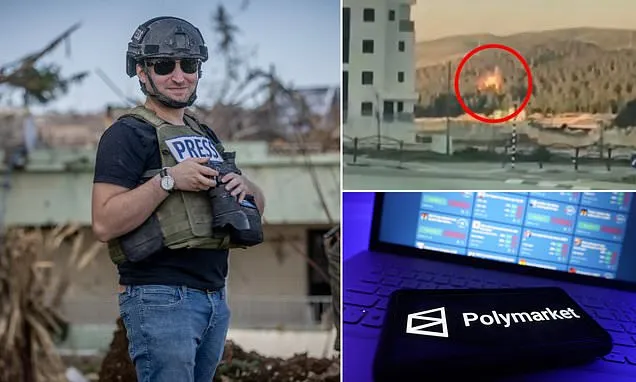
Polymarket gamblers have threatened to kill a journalist because his news report ruined their multi-million dollar wagers.
Emanuel Fabian told the Daily Mail that March 10 began like any other, as the journalist covered Iranian missile strikes on his homeland for The Times of Israel.
That day he wrote up a news brief on a ballistic missile that struck just outside a small Israeli city near Jerusalem, causing no injuries and only very minor damage - but through a wild turn of events it would drive an online mob to threaten his life.
'It's like an episode of Black Mirror,' said Fabian.
Polymarket bettors were wagering millions of dollars on whether Iran would strike Israel on given days since the beginning of the Iran war.
Nearly $14 million had been bet on whether Iranian munitions would successfully hit Israel on March 10 - including rules on what constituted a successful hit - an intercepted missile or drone wouldn't count.
Fabian reported that the missile hit a forested area outside the town of Beit Shemesh - not fragments of an intercepted missile - as proven by video footage and eye witness testimony from first responders.
After the story published, he began receiving the first of 'around 100' email, text and social media messages asking and then ordering him to change the narrative to suggest that the missile had been intercepted, with only fragments falling to earth.
And when Fabian held his ground, he told us, the messages turned very dark indeed.
Emanuel Fabian has worked as a military correspondent at The Times of Israel for more than five years
The magnitude of the explosions meant it was a missile strike, not interceptor wreckage
'Nothing remotely similar to this has ever happened to me before,' Fabian told the Daily Mail. 'I asked colleagues and nothing like this had happened to them, either.'
The first messages the anonymous bettors sent Fabian began innocently enough, starting with a note from someone calling himself Aviv.
'Regarding your Times of Israel report that described today's launch as an "impact" - Beit Shemesh Municipality and MDA (the Israeli equivalent of the Red Cross) later corrected their reports to clarify that what fell was an interceptor fragment, not a full missile,' wrote Aviv.
'I'd appreciate it if you could update your article, as in its current form it does not reflect reality,' he wrote.
Fabian told Aviv that his contacts in the Israeli military said the Beit Shemesh impact was a missile, not interceptor fragments. He added that the eyewitness video footage showed a massive explosion, something a missile or interceptor fragment would not have caused.
Next was an email from a guy named Daniel. ‘Sorry for reaching out without a prior introduction, but I assume we will get to know each other well,’ he wrote, threateningly, asking like Aviv for a ‘correction’ to the article.
Half an hour later, Daniel sent another message: ‘If one of you could change everything to interceptor debris, or missile fragments even tonight, it would help a lot.’
Fabian ignored these emails, but by the next day more and more messages started pouring in, from anonymous senders on platforms like X.com and Discord.
He quickly figured out that the social media posters were involved with gambling on Polymarket.
Polymarket calls itself a 'prediction market,' allowing users to bet money - via cryptocurrency, credit cards and bank transfers - on the likelihood of future events occurring or not occurring.
Just last month, the platform was roundly condemned for allowing wagers on when the kidnappers of Nancy Gutherie's mother would be arrested.
On the Israeli strike wager, the rules stated that 'This market will resolve to "Yes" if Iran initiates a drone, missile, or air strike on Israel's soil on the listed date in Israel Time (GMT+2). Otherwise, this market will resolve to "No".'
Fabian also discovered that there was an additional clause clarifying that 'Missiles or drones that are intercepted... will not be sufficient for a "Yes" resolution, regardless of whether they land on Israeli territory or cause damage.'
'Suddenly everything was clear,' said Fabian.
His minor report on a missile strike was in the middle of a betting war, with the people who bet 'no' on an Iranian strike on Israel on March 10 demanding that he alter his reporting to ensure they would win big.
By the time Fabian figured out what was really going on, the messages turned to death threats. Someone named Haim began threatening his life.
'You have exactly half an hour to correct your attempt at influence,' wrote Haim.
'Despite the fact that you received countless inquiries - you insist on leaving it that way.'
'If you do not correct this by 01:00 Israel time today, March 15, you are bringing upon yourself damage you have never imagined you would suffer,' he wrote.
Haim also attempted to call me via WhatsApp multiple times during the night, before sending me more messages.
Haim shared specific details about Fabian's neighborhood, parents and family.
"You made a fatal mistake and you'd better respond to us."
"I expect a response from you within 9 minutes from now."
"We will not give up on sums [of money] like these."
"One minute remains..."
At this point, Fabian went to the police and provided a full statement. He told the Daily Mail that law enforcement said the threats were real and credible, and promised to investigate.
As of writing, there has been no word on whether an investigation has begun or any suspects have been found.
In a statement to the Daily Mail, Polymarket condemned the threats to Fabian's life.
'Polymarket condemns the harassment and threats directed at Emanuel Fabian, or anyone else for that matter. This behavior violates our terms of service and has no place on our platform or anywhere else,' wrote a Polymarket spokesperson.
'Prediction markets depend on the integrity of independent reporting. Attempts to pressure journalists to alter their reporting undermine that integrity and undermine the markets themselves,' they wrote.