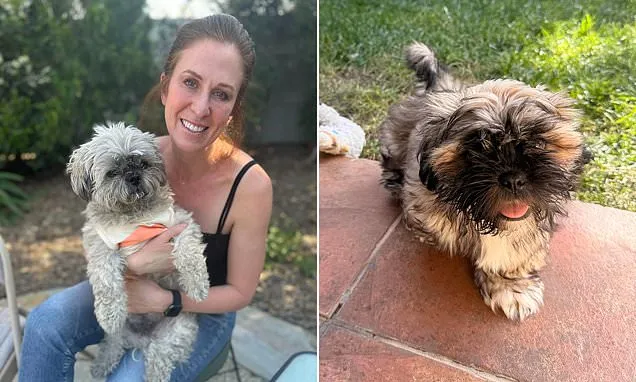
A woman who spent $50,000 cloning her late dog while she was 'deep in her grief' has lifted the lid on the harsh realities of the grueling and pricey process.
When Venessa Johnson, 48, from Claremont, California, fostered a six-year-old Shih Tzu named Oliver in 2013 to help out a friend, she wasn't actively looking for a pet.
But she instantly fell in love with him, and next thing she knew, she had adopted him.
'He was just the sweetest, most gentle boy. He climbed into the car, nuzzled into my chest, and I remember thinking, "This is my dog." And that was it,' she explained during a chat with the Daily Mail.
'Oliver had the best personality. He was stubborn, silly, opinionated, completely devoted to me and my constant companion.
'He was so well behaved that I took him everywhere with me. We were almost always together.'
When Oliver tragically passed away 11 years later in 2024 from kidney failure, Johnson struggled immensely to come to terms with his death.
While searching online for ways to cope with the grief, she came across an ad for pet cloning and was enticed by the idea of being able to preserve her beloved dog.
She ultimately forked over tens of thousands of dollars to get Oliver cloned, but what came next was a grueling and emotional process which ultimately left her questioning her decision.
'After Oliver passed, I was searching for ways to cope with the loss and my grief when I came across an article - or possibly an ad - about pet cloning,' she explained.
'While I had known cloning existed, I had never truly considered it as an option until that moment.
'Once I made that decision, the grief didn't disappear, but it softened. It gave me something to hold onto - something to look forward to - the possibility of another chance with a part of Oliver.'
Johnson explained that it took three attempts to clone Oliver, and each time it failed, it was extremely 'emotionally difficult.'
'The experience was a cycle of hope and disappointment,' she admitted.
It took 11 months in total but finally, a puppy was born. She named him Ollie, but she soon learned that 'having a puppy' is very different from taking care of an older dog.
She began to 'question her decision,' explaining that when she first opted to clone Oliver she was 'deep in her grief' but by the time Ollie came she 'was in a completely different emotional place.'
'Looking back, I can say that if I had waited until I was further along in my grief before starting the process, I probably wouldn't have cloned him,' she confessed.
'I likely would have gone to a shelter and adopted an older dog - and I can see now that I would have been able to open my heart to another dog, and that an older dog may have fit my lifestyle more easily than a puppy.
'That said, I love Ollie deeply, and he has - and continues to - heal my heart in ways I didn't anticipate. Two things can be true at once, and for me, both are.'
Johnson noted that since she never knew Oliver as a puppy it's hard to say how alike he and Ollie will be, but she said the two dogs 'look exactly the same' and their 'core personalities are very similar.'
'Ollie shares many of the same mannerisms, quirks, and overall temperament as Oliver which has been a really special and unexpected experience,' she said.
In response to those who may criticize her for cloning her dog rather than adopting a new one, she said: 'I've volunteered at shelters, been involved in rescue, and donated to multiple rescue organizations for many years. I've also had rescue dogs my entire life.
'Even now, having a cloned dog doesn't change that commitment. I continue to donate to rescues, help network shelter dogs, and I plan to foster again as soon as Ollie is older.
'I think what often makes people uncomfortable isn't the idea of helping animals, but the amount of money involved.
'Any disposable income - whether it's spent on travel, a car, a home, or something deeply personal like this - could theoretically be donated to a cause someone cares about. We all make choices about what matters most to us.'
In the end, she reminded others not to make any rash decisions in the midst of their grief.
'When you're grieving, it can compel you to do all sorts of things - it certainly did for me,' she stated.
'What I hope people take away is permission: permission to grieve fully, to honor that bond without minimizing it and to understand that love doesn't disappear when a pet is gone - it changes form.
'Sometimes grief leads us to unexpected choices, healing paths or even new beginnings, and that doesn't make it strange or wrong. It makes it human.'