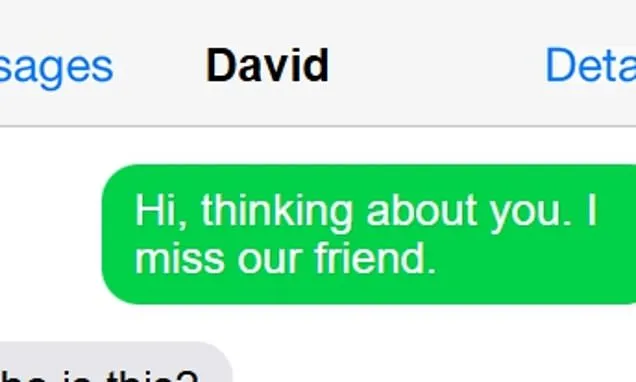
David Samuel Levinson felt compelled to reach out to an estranged friend for the first time in 10 years after a personal tragedy struck.
But the text exchange and its fallout have sharply divided opinions over whether people should ever attempt to resurrect a friendship that has long since fizzled out.
The American author shared a video recounting the events that led him to contact a long-lost mate after their mutual friend died recently.
'So last night I texted someone I hadn't spoken to in 10 years... We'd fallen out, but we'd had a mutual friend who died, and I just missed him,' David said in the video.
David explained that he decided the best way to reach out was via text message.
'So, I wrote, "Hi, thinking about you. I miss our friend."'
Hours later, David said he woke up at 3am, glanced at his phone and discovered that there was a reply message waiting for him.
It read: 'Hi, who is this?'
American author David Samuel Levinson recently shared a video recounting the events that led up to him contacting an estranged friend
'So I send a photo of myself and write: "It's me",' David explained.
'And then, nothing,' he continued. '"Left on read", as the kids say.'
David concluded the video by listing three 'important' lessons that he was 'reminded' of from this brief and fleeting interaction with someone from his past.
'One - don't reach out to old flames,' he said.
'Two - don't reach out to burnt out friendships.
'And three - don't reach out to people who are still angry about a version of you [that] you don't even remember being.'
The social media video, shared to his @theburningboy Instagram account, has been viewed over 320,000 times, with thousands of replies pouring in on the topic.
David himself later succinctly summarised the sharp dividing line among the responses to his video.
'Reading these comments is fascinating. Half of you say reach out, half say never do it,' reflected the author of Tell Me How This Ends Well.
On the one hand, there was a group of respondents who were firmly of the belief that it was 'good you reached out - regardless of the outcome'.
'I think it was wonderful you reached out, even though he didn't respond,' explained one reply. 'You can feel good about yourself, knowing you tried to build a bridge. Many times hearts do soften and others experience a healing. It's worth taking the risk.'
A similar response offered that 'if nobody reaches out the chances of good things happening are zero. I tend to think it's worth taking a chance sometimes.'
Another agreed: 'Sometimes you need to reach out just to satisfy the longing and settle it within yourself.'
Several replies in this vein agreed that while it takes courage to put yourself out there and attempt to re-establish a fractured friendship, you must do it while also being fully aware that the other person may not be open to reciprocating.
'Reach out if you value the friendship. But you should accept whatever response you get back, including no response.'
Another added: 'If you have the urge to reach out, reach out without expectations. No response is your confirmation. Now you know.'
On the other end of the scale, a few replies were firm followers of the 'three lessons' David espoused at the conclusion of the video, which were all about how you should essentially leave the past in the past.
'Never reach out to people you left behind years ago,' read one reply.
'I agree 100 per cent. The past is the past - let it be,' read another reply.
One poetic reply explained: 'Once the bridge of friendship is washed away, you can't go back. Stay strong and move forward.'
Another thoughtful response added: 'After 10 years, neither of you is the same person. Best to let it go and remember the good things.'
However, a separate group of replies took issue with the manner in which David had reached out to his former friend, claiming he didn't do one vital thing when he broke the communication stalemate: apologise.
'Too many people think time is the apology! No, it's not,' one explained. 'If you wrong somebody then own it.'
Another added: 'Acknowledge your part in the fallout. Whoever you were and whatever you did, it hurt your friend so deeply that after 10 years they don't want to reconnect.'
'If you are reaching out, let the apology lead the way,' urged another reply. 'Don't shove it under the carpet thinking the other party will have forgotten or that it has healed due to time... It's best to APOLOGISE first.'
One reply explained: 'The only reason to contact someone that you had a falling out with is if you feel that you need to make amends for your part. The only caveat is do it without expecting a response.'
Several respondents said that if you have wronged another person and they've since removed you from their life, the nicest thing you can do is respect that boundary by either not reaching out - or accepting the silence of no reply.
'If someone set a boundary with you it's for a reason and it doesn't matter how long. There's no expiration date on respecting people's boundaries,' one person replied.
'They don't have to respond. Maybe they're not mad but have no desire to talk to you.'
Ultimately the scenario sparked an online discussion that many people personally resonated with, with several respondents chiming in to share their own similar situations - both as the person who tried to reach out to a former friend, and as the person who had unexpectedly heard from someone many years later.
Although opinions were greatly divided about what was the appropriate way to handle an interaction with an estranged pal - or if it should even happen at all - ultimately, one person concluded that there was no final answer.
They insightfully explained: 'You did the right thing - and they did the right thing for them too.'