I have found my 96-year-old bedridden mother Beatrice under the covers, scooted down in the hospital bed as far as she can go.
She nods at me and points towards a corner of the ceiling, telling me a horde of strangers has invaded her room, people she doesn't recognize.
I look in the direction of her crooked finger but there's nothing there. Presumably the strangers have all skedaddled upon my appearance, so I dismiss her statement as a lot of hooey.
Mom is imagining things. It is April 2006, and I have returned from Europe to assume responsibility for her hospice care in Cape Cod.
Give me an A for Good Intentions but an F for End-of-Life Issues. As her primary caregiver, I must reach into that well of strength we all possess but rarely use. Flip a switch, turn off emotion, and do what needs to be done, be it changing diapers or serving food at odd times of the night when I would rather be asleep.
From May to July, I often hear the thumping theme song to Ghostbusters in my head because the mysterious visits continue. The visitors are her old friends or family members.
A few days later, it's her elder sister, Helen, who pays a visit with a little boy on a red tricycle. Helen predeceased Bea by two decades.
I hand mom another grape and assume this is yet another complication of growing old, a senior moment that has escalated into cognitive decline.
I pay no attention until voices resound in the bedroom; I realize she is arguing with somebody. Since I hear her mention needing 'Mom's approval,' I figure Helen has probably returned and hurry into the bedroom.
'Who were you talking to?' I ask.
'No one,' she replies like a naughty child unwilling to risk disapproval.
Our life becomes peppered with these strange visits.
When I phone my mom's doctor to ask what in the world is going on, he suggests an anti-psychotic for hallucinations. Politely I refuse. Mom does not have a psychosis, nor does she suffer from dementia.
For a while, I conclude that her imagination has spiraled into overdrive. If I remind her that we are alone in the bedroom, she corrects me, describing, for instance, what her former college roommate wore during her visit earlier in the day: 'A nice new blue dress with flowers.'
I indulge her, reluctant to point out that a recent alumnae magazine has published the roommate’s obituary. Why contradict? What’s more, the hospice nurse has told me to play along. Be patient, I tell myself. Squelch the reflex to judge.
I can’t explain her visitors, so I stop trying. They slip in through a corner of the ceiling as might a ghost. Not once do they come through the door or the window. I label them ‘my mom’s crazy visions.’ Today hospice professionals call this phenomenon, common prior to death, ‘visioning.’
It’s obvious Bea enjoys the ‘invisible people’ who keep her company. Their presence relieves the caregiving burden I carry and, for that, I feel grateful.
After a while, I get into the habit of eavesdropping from the bedroom threshold. Of course, I can only hear her side of the conversation, but from time to time she’ll pause to give a friend the opportunity to speak.
Mom, a great hostess, has always enjoyed entertaining, and often she asks me to serve her guests tea. I disengage from our normal day-to-day routine and let myself drift along with her, accepting that I am witnessing - or seem to be witnessing - some rather unconventional activity.
Her reality no longer matches mine, but that’s OK. We are both proceeding down a road with stupefying twists and turns. I love her and the best support I can provide is to hold on tight to her hand and see where she leads.
Toward the sixth month of hospice, the visits suddenly stop. The change is so abrupt that I can’t help but wonder what caused it.
I’ve fixed thousands of brains and seen proof we have souls... look at conjoined twins, even trees
‘What’s happened to your ‘invisible people’? I ask. ‘Don’t they come see you anymore?’
‘They keep calling,’ she says with a shudder. ‘But I don’t want to talk to them.’
No stream of words bursts from her lips now. Her mind does not invent any more tea parties. Even chocolate ice cream doesn’t interest her. She talks in monosyllables, breathing out short words through missing teeth and the yellowed stubs that remain, puffs of communication.
The day before her death in November, she tells me that my father and her beloved grandmother are hanging out in a corner of the ceiling. I wave at them with a simple open and close of my hand. I’m convinced that they have come to escort her away.
A moment of melancholy sweeps over me. I have such mixed emotions at losing my mother - sadness, grief, but also relief at what my daughters call 'being able to get your life back.'
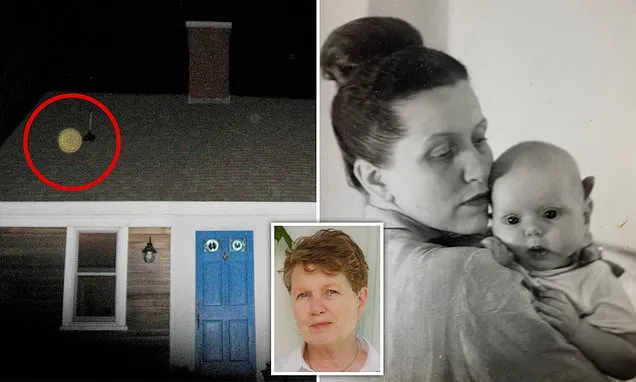
The next night, my husband places candles in all the windows. I decide to photograph our Cape Codder to announce, on my blog, that Mom has passed and we are in mourning.
The brick walkway feels uneven beneath my feet. The moon shines beyond the fir tree Bea planted one Christmas. Clouds race across the night sky.
I snap a first photo, then glance down at the tiny screen. It seems my new digital camera has malfunctioned. How can the lit candle in her window have appeared on the far side of the house and why is its glow so round?
Thinking the moon might work for our annual Christmas card, I snap one more image. In my haste, I don’t hold the camera straight. Half a fir tree won’t do, so I start over. This photo is blurry as if mist has obscured the view. Blurry makes no sense on such a clear night. I take yet another photo.
I transfer the digital photos to my computer. For a minute or two, I stare at the screen in disbelief. The first shot reveals a golden orb. The orb appears to have an outer ring. It looks exactly like images I have seen in books written by ghost-hunters; only this orb is in our yard, hovering over the roof of our house.
The Christmas card photo is even more astonishing. Mist swirls like arms seeking an embrace. Without meaning to, I seem to have captured an image of my mother's spirit. Perhaps she wants me to know that the spirit lives on after death. She has joined her friends.
I call to my husband and click through iPhoto. 'Check it out. Ectoplasm.'
He leans over my shoulder. 'Are you sure?' he says, slack jawed.
'Must be. There's no mist tonight.'
'Looks like what we saw in the A&E documentary last year,' he reminds me.'There was a man who could contact spirits.The guy walked around cemeteries,taking photos.Remember?'
'I do.You thought it was bogus.'
Perhaps it wasn't.Perhaps it was nothing more than light refracting through cold November air.A glitch in my new camera.A trick of mist and shadow.
I only know that the home care experience had already unsettled everything I thought I understood about control, about end-of-life, about the tidy border between the living and the dying.
By the time I sat in my office staring at that golden orb on my computer screen, I was no longer certain what counted as impossible.Caring for my mother had required me to loosen my grip on explanation.
Death, it seemed, was not a single moment but a gradual unmooring.And I was still trying to understand where, exactly,it had taken her - and where it had left me.