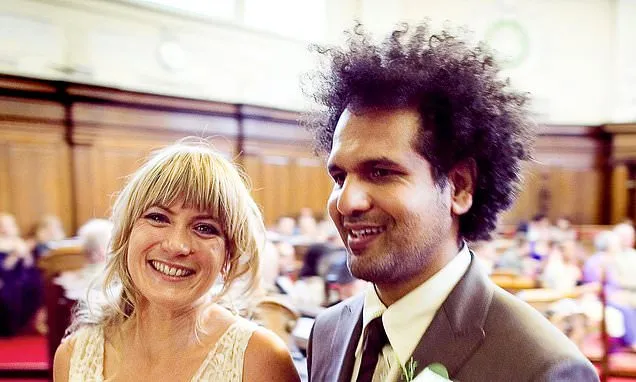
Marriage isn't a word, goes the old joke, it's a sentence. I married Bridget in 2010 so I am now 16 years into my term and, while I am not plotting a Shawshank-style escape, there are times when married life can feel rather draining. I met Bridget in 2008 in a scene straight from a romantic comedy - we were sitting opposite each other on a train from the Hay book festival. The early days of our relationship were blissful. I don't think I have ever been happier.
That was then: these days the romcom has given way to a rather grittier drama, as the pressures of parenthood and the consequences of overfamiliarity mean that I don't always appreciate the amazing woman I am lucky enough to call my wife. I get tetchy when she starts rearranging the dishes I am loading into the dishwasher; I get defensive and sulky when she criticises some of my parenting decisions. In short, I don't show the best version of myself, but I want to be better. I wanted some advice about where I was going wrong and what to do about it - and I knew just the person to speak to.
Stephen Grosz is an author and psychoanalyst who has worked with patients for more than 40 years. His 2014 book The Examined Life, which drew on case studies from the consulting room, was a number one bestseller. His new book, Love's Labour, recounts four decades of conversations with his patients about relationships. Surely he must have picked up a few insights, I thought to myself as I rang the bell to his home, a short walk from Hampstead Heath, North London. In his consulting room he tells me, 'Most of the people who are going to read this book won't ever have therapy, so I wrote it because I wanted to record some hard-won truths about love.'
Those truths are, he explained, about unlearning some of the stories we grow up being told. 'We accept a simple narrative about what love should be,' he says. 'The idea that love lasts forever, when I think the exact opposite. I think love is incredibly powerful because of its perishability. Love requires work.' This seemed a good time to talk about my marriage.
Bridget and I both work, and we have a 14-year-old daughter and nine-year-old son. The practical realities of juggling work and parenthood mean life often feels exhausting. There is never enough time for us as a married couple rather than parents. I am not great at managing my frustrations, and I tell Grosz that one of Bridget's most common complaints about me is that too often I say things using the wrong tone. A recent example was when our son kept kicking a football against the front door while indoors. 'Ezra, if you don't stop doing that I am going to take that ball and you won't see it again,' I said, not unreasonably. Bridget suggested that my direct, no-nonsense approach was not overly helpful and, in fact, led to our son kicking the ball even harder. It was not what I said that was the issue, but the way I said it. I find this 'tone policing' aggravating, and it often leads to arguments. Did Grosz have any advice?
SARFRAZ'S TOP MARRIAGE TIPS
- Don't stop talking. I have found that whatever challenges we have faced, it always helps to talk about them with each other - the issues don't vanish, but they feel more manageable.
- Have couple time. I often feel most in love with Bridget when it is just the two of us and we are not being parents. So try to spend time away from the children.
- Remember you are not always right. When your partner is complaining about you, keep your mind open to the fact that they may have a point.
- Laugh together. And never overlook the importance of doing so.
- Remember who you are arguing with. It's the person you fell in love with and wanted to spend your life with.
Disclaimer: I don't always follow my own advice
'Often the hardest thing to do is to just stop and think, "Is there any truth in what my wife has just said to me?"' he explains. This wasn't, in truth, what I was hoping he would say. 'It is not easy in the middle of an argument to stop and think, "Actually, I am worse than what she is saying. How does she put up with me?" Sometimes we have to just stop and look at ourselves. That's love's labour.' That work, he continues, is about learning to put the needs, desires and expectations of your partner ahead of your own. 'It's all about thinking from the point of view of the marriage,' says Grosz. 'It's about thinking of your wife, but that is hard to do because it means giving up a feeling of superiority.'
I know exactly what he means - often in our arguments there comes a point where I secretly realise I am in the wrong. The correct thing to do is acknowledge this, apologise to my wife, make up and move on. The trouble with that sensible approach is that it would mean denying myself what Philip Roth called 'the ecstasy of sanctimony' - that intense pleasure reserved for when you believe you are in the right. Too often I don't apologise at the right time and arguments that could have been resolved linger. 'A deep truth about marriage is that when you really love someone you do, at some point, come to hate them,' says Grosz. 'And they will come to hate you. There will be times when you will think you can't take another moment in each other's company.'
I don't truthfully think that is where my wife and I are right now.
I have never felt hate for her, but there are times when both of us can feel resentment towards one another. Bridget can resent that my work as a writer too often, in her view, takes precedence over hers as an autism specialist. I find myself getting super annoyed at very petty things, such as how she leaves the house with her phone on three per cent charge or how she insists there is more toothpaste to be squeezed out of a tube that is clearly empty. It sometimes surprises me how much these things infuriate me. 'That is your unconscious pulling the strings like in The Wizard Of Oz,' Grosz explains. 'Those strings include envy, anger and resentment but love's labour is to see our envy and anger, and accept that where there is love there will also be hate, and there may come a time when you will internally divorce.' What this means, he explains, is while you don't officially or explicitly split up, you mentally check out of the marriage. Maybe you find yourself sleeping in different rooms or spending more time with friends or drinking more. 'I have had so many men in this room who reach that point where they come to hate their wives and get a divorce,' Grosz says. 'Then they end up marrying a version of their first wife.'
It's a relief to hear this from Grosz because it makes me realise things are not quite as bad as all that - although it probably helps that our house doesn't have the space to allow us to sleep apart, I am not hugely sociable and I don't drink. 'Rather than not stick with it,' what these men should have done was throw themselves into doing the work,' Grosz continues,'and psychologically remarry their first wife.' Psychologically remarry? 'This would be where you look at yourself honestly and throw yourself into doing the work,' he explains.
When my time with Grosz is up, I realise that what was meant to be an interview ended up feeling more like therapy. It would be lovely to report that on returning home my marriage seemed to magically improve - but this is real life, not a fairytale. I did try to not get so annoyed by petty things; I did try to concede that Bridget was right sooner than I might otherwise have done, but within a few days some of those bad habits began to return. Marriage is, after all, a work in progress. But what I did take away from my time with Grosz, and which has stayed with me, is a renewed commitment and excitement about being married.
I feel less guilty about admitting that being married requires work, but I also now feel more gratitude that I found someone as special as my wife to share marriage's inevitable challenges and irreplaceable joys.