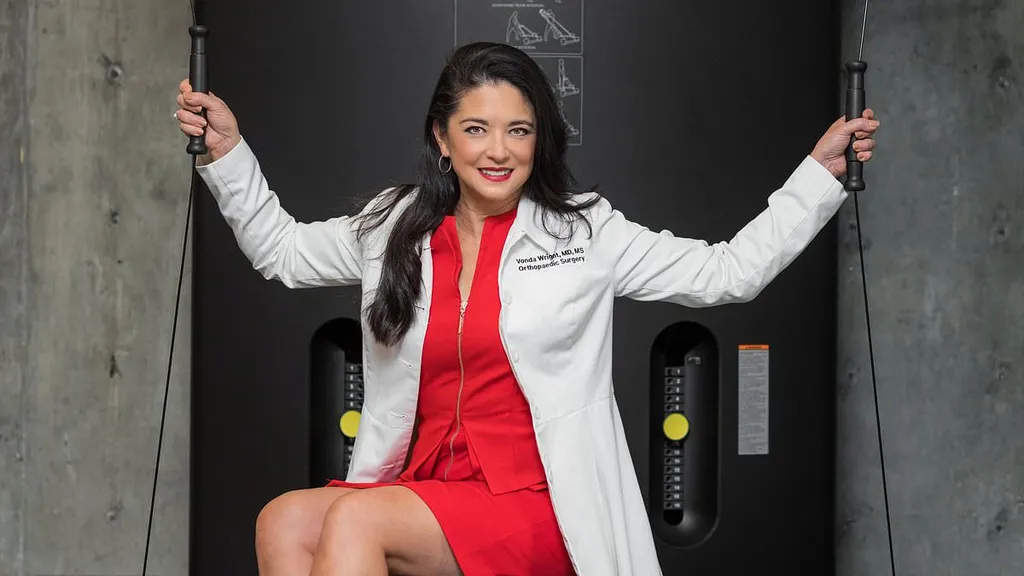
Describing herself not too long ago as 'miserably menopausal', Dr Vonda Wright knew she had to make lifestyle changes when, as an orthopaedic sports surgeon, she suddenly found she could no longer do her job properly.
One day, after attempting to manipulate the position of a 21-stone patient mid-surgery, 'for the first time in my life, I struggled,' she says. 'I was 47 and realised my strength was now affected, so I thought, "OK, I've got to get in front of this."'
Now Vonda has written a book called Unbreakable, describing how midlife women can build stronger muscles and bones in order to 'age with power'. Based in Florida with her husband, a retired ice hockey star, and their blended family of six children, she says: 'When we enter perimenopause - on average in our mid-40s - oestrogen, the key hormone for bone strength and muscle strength, walks out the door.'
'If we don't have enough muscle or bone, we can't climb stairs or - and this is a common story for my patients - we can trip over the cat and break something. That can lead to frailty in later life, and frailty is one of the things that can make an able-bodied women go into a care home, which is nobody's goal. Women need to feed themselves,' she adds. 'We need to get strong.'
It's an issue given extra impetus by the huge numbers using weight-loss jabs such as Mounjaro and Wegovy. According to increasingly stark warnings from doctors, fat jab users lose muscle mass at an alarming rate, almost without exception. 'I don't want to judge women for how they want to look, I'm a midlife woman and I'm as vain as they come,' says Vonda.
But rapidly losing muscle in midlife can set up serious problems - and if you stop the jabs and pile the weight back on, as many seem to do, what returns isn't lost muscle but fat.
Fear not, however. Both fat jab users and post-menopausal women can retain, and even increase, precious muscle. Indeed, they must.
After working with professional sportspeople for more than 25 years, Vonda says: 'I've applied to mere mortals like myself the principles I use for my elite athletes.'
Here are her expert tips for a healthier body - and for building strong bone and muscle that will carry you through menopause and beyond... whether you're on weight-loss drugs or not.
Nutrition
Diet is a key component in building up strong muscle. 'If you're losing weight, with or without the assistance of a weight-loss injection, you will lose a percentage of fat and a percentage of muscle,' she says. 'You don't want to lose 20 to 40 per cent of your muscle just to make the scales look better - you want to become more lean.
'No matter how you're losing weight, you must eat enough protein so your body does not start harvesting your own muscle for bodily function.'
Protein is a non-negotiable. It not only builds and repairs the body's tissues and cells, it keeps the immune system strong and is vital for maintaining muscles and bones.
'I prescribe 30g of protein at every meal,' says Vonda. 'A cup of non-fat Greek yoghurt has about 20 to 25g of protein, for example, so it’s low volume but very nutrient dense.'
For breakfast, eggs are also an excellent source of protein.
'Every egg has 6g of protein and 4g of fat, so to have 30g of protein in eggs alone, you’d need to eat five eggs, which is a lot,’ she explains. ‘Use two, giving 12g of protein and complete your breakfast omelette with egg whites you can buy from most supermarkets. A cup of that mixture is 30g of protein in your small omelette! You can get some good fat from half an avocado and, because we all need a little carbohydrate, have half a slice, or 60g, of sourdough bread.’
As a mid-morning snack, she recommends adding 30g of whey protein isolate powder, which comes from milk protein, to 85ml of water.
For lunch, a 170g chicken breast - ‘the size of the average woman’s hand’ - will provide well over 30g of protein, ‘and you can cut that up on any arrangement of gorgeous salad or steamed vegetables’.
But she warns against too much dressing. ‘What we cannot do is make the most gorgeous protein and vegetable salad and then smother it in salad dressing,’ she warns. ‘Every tablespoon of salad dressing has around 100 calories of fat and not always great fat, so your gorgeous 400-calorie salad is suddenly like a cheeseburger.’
Vonda recommends nine servings of fruit and veg a day in a variety of colours instead of the standard five helpings.
As an afternoon pick-me-up, ‘have a wonderful protein bar or a small handful of almonds’. She adds, ‘I like beef jerky, but only the kind that’s not filled with chemicals.’
Dinner doesn’t have to be prepared ‘like you’re a gourmand’, says Vonda. We’re all busy, after all.
‘In the book I have my dinner system chart which has three columns - for protein, veggies and starch. Choose one in each category and be done cooking in 30 minutes. Have some salmon, broccoli and maybe some quinoa, or seabass, cauliflower and perhaps some lentils. Save the complicated stuff for the weekend.’
FACEing the future
As humans, says Vonda, we were built to move. In our 30s and 40s we start to lose muscle mass, which is essential for performing tasks such as standing up from a chair. Those who live particularly sedentary lives will eventually lose strength and balance and perhaps start to shuffle, or worse, topple over when they walk.
'Seventy to 80 per cent of how we age is due to our lifestyle choices,[but it's] never too late to start making better ones.' Vonda's simple acronym - FACE - represents the four critical components of exercise we need to build up better muscle strength and 'age with power'.
F is for flexibility
'As we get older, our muscles and tendons naturally become shorter,' Vonda explains,'which leads to abnormal muscle firing,decreased range of motion,and really increases our chances of injury.
'We can prevent these changes by stretching every day.'
Stretching can easily be done at home,but 'make sure that you are warmed up and that your muscles are supple first'.
Vonda says,'Stretching should feel like a gentle pulling and there shouldn’t be sharp pain. You should hold your stretches for 30 seconds without bouncing. Toward the end you will feel your muscles relax, which will give you more of a stretch.'
A for aerobic exercise
Many of us remember the big aerobic crazes of the Eighties and Nineties,says Vonda,'and while that was amazing and we do need to maintain a strong cardiovascular engine,the way I prescribe it is different now'.
Vonda recommends the 80/20 strategy where 'for 80 per cent of the time we're going to do low heart rate base training such as a very brisk walk like you're late for the bus'. Her regime incorporates that level of aerobic exercise for three hours a week,broken up into 45 or 60-minute sessions.
If you're losing weight rapidly with injectables,Vonda advises that as well as eating enough protein,you also need to lift weights
C is for carry a load
If you're losing weight rapidly with injectables,Vonda advises that,as well as eating protein,you also need to lift weights.
'Without a weight training practice,'writes Vonda in her book,'ageing can lead to a substantial decline in muscle mass,known as sarcopenia,the progressive loss of skeletal muscle mass,strength and function,'which can actually begin in a woman's 30s.But,says Vonda,'there's lots of research that shows women of any age can lift heavy weights and build bone and muscle'.
Moreover,she adds,'women are much stronger than they think they are.They’ll go to the gym and pick up a 2kg weight,but then they’ll take the big 13kg Christmas turkey out of the oven!’
If you’re intimidated by going to the gym,start off at home ‘by carrying heavy things up and down your staircase,’ says Vonda. ‘Also,everyone’s got a bucket in their garage - fill up a five-gallon bucket with water and carry it up and down your driveway.Or get ten books in a pile and get up and down from a chair.’
Once you feel more comfortable with your ability to lift even household objects,’say to your family,“I don’t need any more socks or underwear - for Christmas,buy me a personal trainer!”’
‘Then we can learn with somebody coaching us the proper form,so that we don’t get injured.Studies have shown that under supervision even midlife and beyond women can [learn to] lift very heavy loads.’
Vonda recommends that twice a week ‘though preferably four times a week’ we must learn to lift heavy.‘And that means lifting high weights at low repetitions and lifting to failure.Lifting to failure means I can do four reps of my lifts - bench presses,pull-ups,deadlifts and squats - and I can probably squeeze out five but I’m not able to do six because it’s too heavy.’
Obviously if you’ve never lifted before ‘you should not start with heavy’ and should have a trainer assist you.Once you start a proper weight training regime though,adds Vonda,‘you’ll feel different in a month’。
Somewhat alarmingly,she also recommends that women ‘bash their bones’。‘Your bones need to feel impact,’Vonda explains。‘If you get a terrible sprain on your ankle and I put you in a cast and take an X-ray after a week,I would notice that your bone was getting less and less dense because bones without impact do not rebuild themselves。’Therefore Vonda recommends that we start,‘jumping rope or on a mini trampoline,playing hopscotch,or jumping in a pool’。
E is for equilibrium
‘We may be strong,’says Vonda。‘We may be sprint intervalling,但如果我们摔倒是因为我们的平衡没有重新训练或者我们没有脚速去不被狗绊倒,那么我们很可能会有麻烦。
‘有一种叫做“致命跌倒”的现象,你可能会一直很好,直到你摔断了什么重要的东西。你一旦摔断了髋骨,如果你是老年女性,你在一年内死亡的几率是30%。’
Vonda说,重新训练平衡“并不难”。
‘早上刷牙时做一件简单的事情就是单腿站立。这很安全——如果你开始倾斜,可以抓住水槽——而你手臂刷牙的动作会让大脑专注于组织肌肉以免摔倒。当你每天换腿时,你会训练两侧的平衡。’此外,Vonda还提到‘你可以做我称之为“平衡伸展”的事情。想象一下你站在一个时钟的中间。站在左脚上,右脚向前伸展,然后触摸想象时钟上的12点,然后3点,然后6点。
‘在一侧做十次,然后换腿锻炼时钟的另一侧12、9和6。这是一种非常简单的重新训练平衡的方法。’
最终,Vonda表示,这一方案并不是快速增强和保持力量的灵丹妙药,“但如果你逐步增加这些行为”,它会有效。
‘首先,我们要走路——这并不难,因为我们从一岁起就开始走路。然后,我们要关注营养和理解蛋白质——这就成为了饮食方式。逐步增加一种行为,直到它成为生活方式。
‘如果我们每天都投资自己,衰退就不是必然的。相反,我们可以有力量地老去。’
Unbreakable: A Woman's Guide to Ageing with Power by Dr Vonda Wright (£20, Ebury Publishing) is out now.