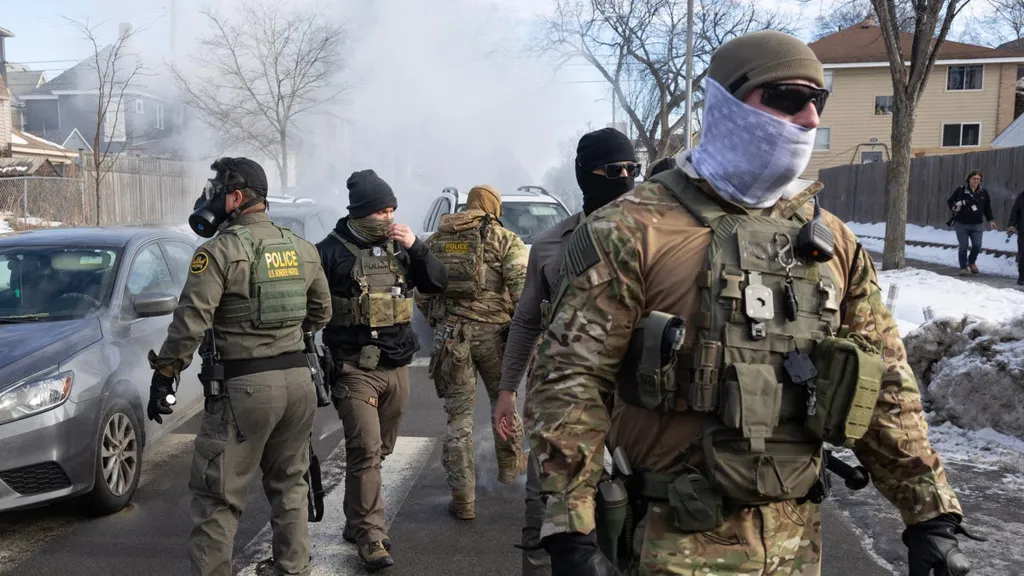
Learn how to identify Border Patrol and ICE agents and understand their tactics and roles in immigration enforcement.
Federal immigration agents pulled over a Hispanic high school football coach driving his players to a game and pointed a pistol at his head.
They swarmed a high school parking lot to question Hispanic students about their citizenship. When the teens explained they were U.S. citizens, agents loaded them into a Border Patrol vehicle anyway.
Agents plowed their vehicles through the high school's baseball diamond and football fields. And they questioned the school secretary's citizenship on her way home from work.
This wasn't Minneapolis, Los Angeles or Chicago in recent months. It was El Paso, Texas - back in 1992.
The U.S. Border Patrol at the time was operating with impunity, aggressively going after anyone who looked Hispanic and lived in a neighborhood near the U.S.-Mexico border.
A rights movement gained traction in the wake of a community lawsuit, and grassroots organizers soon began warning the rest of the country that tactics applied at the U.S.-Mexico border could eventually be exported to American cities everywhere.
"We were saying: The border will become the nation," said Fernando Garcia, executive director of the Border Network for Human Rights. "And then it happened."
Enhanced powers in the border zone
The 19 million people living in the Southwest border zone, which extends 100 miles inland, are under constant surveillance. They're at risk of getting in the way of Border Patrol's high-speed vehicle pursuits. And they're surrounded in all directions by federal highway checkpoints where they must affirm or prove their U.S. citizenship.
Sito Negron, 59, originally from the Bronx, New York, moved to El Paso as a teenager in the 1980s and quickly learned the exceptions to "normal" American life on the border.
"The first time I went through an interior checkpoint I was like, 'What the (expletive) is this?'" he said. He had believed, until then, "that Americans are free because we don't have armed, uniformed, paramilitary officers roaming around to verify my identity and my ability to move around."
But in the border zone, by law, federal agents can push the limits of the Fourth and Fourteenth Amendments in ways they cannot in the country's interior. (The Fourth Amendment protects against unreasonable searches; the Fourteenth guarantees equal protection under the law regardless of race.)
What's less known is that the 100-mile zone doesn't just include border cities and towns like San Diego in California, Tucson in Arizona or El Paso and Brownsville in Texas. It stretches 100 miles inland from every coast and along the northern border to include Los Angeles, Seattle, Chicago, Boston, New York, Miami, New Orleans and Houston. It includes more than 200 million people ‒ nearly two-thirds of the nation's population.
Within that sprawling zone, much of it rarely enforced as a "border" until now, U.S. Customs and Border Protection officers and agents can board public transportation, set up checkpoints and question people about their immigration status - without a warrant or probable cause, according to the Southern Border Communities Coalition. ACLU affiliates are challenging these actions in Washington, D.C., Chicago and Minneapolis, which is more than 250 miles from the Canadian border.
Despite the distances and the agency's documented history of rights abuses, the executive branch, backed by the courts, has fortified Border Patrol "with extra-Constitutional powers," Garcia said.
"Now Border Patrol, trained at the U.S.- Mexico border, is the one leading immigration enforcement agencies in other areas of the nation," he said.
Immigration enforcers, two different agencies
ICE has emerged as the brand-name enforcer of President Donald Trump's mass deportation campaign. "ICE Watch" groups in Minneapolis and other major cities track immigration enforcers' movements. Protestors chant slogans calling for ICE's abolition. Hollywood stars are sporting "ICE out" pins on red carpets.
But in social media videos and photographs of violent encounters, including in Minneapolis, it's often agents wearing Border Patrol patches conducting the enforcement.
U.S. Customs and Border Protection is the nation's largest law enforcement agency, with more than 25,000 customs officers and more than 19,000 Border Patrol agents.
ICE, or U.S. Immigration and Customs Enforcement, the agency tasked with conducting immigration enforcement in the nation's interior, was small by comparison with roughly 6,000 deportation agents before a recent hiring spree. Historically, ICE targeted immigrants who had committed serious crimes, surveilling and quietly arresting them.
In Los Angeles, Chicago, New Orleans and Minneapolis, Border Patrol Commander-at-Large Gregory Bovino has directed enforcement operations aided by an elite El Paso-based Border Patrol force known as BORTAC.
It's essential for border agents to find and arrest migrants who arrived during the Biden administration and weren't properly vetted, said Art Del Cueto, a retired Border Patrol agent.
"I can't say it's a great look when all these individuals are heavily armed in camouflage in city streets," he said,"but they're there for the ineptitude of the last administration."
In a post on the social media site X, the Department of Homeland Security—which oversees both ICE and Border Patrol—said "Operation Metro Surge" in Minneapolis has so far led to the arrest of 2,500 alleged "murderers, fraudsters,predators and gang members."
The Department of Homeland Security declined a USA TODAY request for a breakdown of Border Patrol agents and ICE officers among the roughly 3,000 federal agents deployed to Minneapolis.
Regardless of who's doing the enforcement, immigration agents deployed to interior cities are creating more problems than they're solving,say Minneapolis council member Jason Chavez.
"You have our immigrant neighbors driving to work ... shaking as they are holding their wheel and praying to God that they are going to make it to work and then make it back home," Chavez said.
On Jan. 15,the ACLU sued the Border Patrol its commanders and other federal agencies alleging a "startling pattern of abuse" in Minneapolis that includes "violently stopping and arresting countless Minnesotans based on nothing more than their race and perceived ethnicity."
Minnesota also sued the Department of Homeland Security to stop the ongoing immigration enforcement describing it as a "federal invasion." On Jan. 14,a federal judge declined to issue a temporary restraining order to halt the operations.
The Minnesota Star Tribune's next-day front-page headline could have been torn out of an old El Paso newspaper: "Citizens sue seek ruling to rein in agents' tactics."
Border Patrol's actions 'didn't make the community safer'
El Pasoans won relief in that 1992 lawsuit,and it opened the door to better communication and cooperation between the community and Border Patrol.
"The judge recognized the boundaries that were being pushed," said U.S. Rep. Veronica Escobar (D-El Paso). "The way Border Patrol was acting during that era created a chilling effect in the community and it didn't make the community safer. It created mistrust."
El Paso shares an urban border with Ciudad Juárez,Mexico,and Bowie High School—the center of the 1990s enforcement controversy—overlooks the borderline.Today,the city is more than 80% Hispanic and votes majority Democrat,but Trump gained traction in the last election.
It's a region of contradictions where immigration enforcement is militarized but Border Patrol agents coach local soccer teams;where a majority of residents can trace their roots to Mexico including border agents themselves;where racial profiling is an uncomfortable reality of daily life for many by agents who are also Hispanic.
Ruby Montana,44,grew up in El Paso;her dad was a Border Patrol agent in the 1980s and 90s.She recalled how he kept photos of himself posing over handcuffed migrants,"as if they were hunting trophies,"she said.She fought with him about it,reminded him his own parents came from Mexico without permission.
Today,Montana is a Chicano studies professor at the University of Texas at El Paso and works closely with Border Patrol to rescue animals found along the border.She sees the two faces of the agency:the institutional biases that can lead to heavy-handed enforcement;but also the individuals who call her for help with abandoned animals.
"People will say,'Border Patrol is just following the laws,'"she said."Technically,people here illegally are breaking the law—a misdemeanor—and agents are following their orders.Slavery was the law of the land.Hiding Jews from Nazis was breaking the law.A lot of people are conflating laws with morals."
After the 1992 lawsuit,Garcia's Border Network for Human Rights became the conduit for an engagement model that included regular roundtables with Border Patrol leadership and led to a sharp reduction in complaints about the agency's tactics.
That cooperation has largely ended under Trump,Garcia said.
"There was a successful story in the past,"he said."Now the relationship is in limbo."
Federal agents raided two construction sites in a suburb east of town on Jan.15.Concerns about the old days of blanket enforcement prompted local Democrat officials to hold a news conference and call for restraint.
"We were being aggressively occupied in that era,"Negron said."The federal government heard the community and realized it was wrong.Now they’re doing this in the rest of the country."
He added,"Americans should not get used to living in these conditions."
Lauren Villagran covers immigration for USA TODAY and can be reached at lvillagran@usatoday.com.
Agents stopped two teens headed home from school, questioned their citizenship - both answered in English that they were U.S. citizens - then slammed one of the teens against a fence and searched him.
A federal agent jumped a curb, plowed onto the high school baseball diamond, driving through center field.
From that movement emerged El Paso's Border Network for Human Rights, which has fought against border militarization, human rights abuses and impunity for decades -
The coach asked the agent to holster his gun. An assistant coach following stopped his vehicle, exited and told the agents they had stopped the football coach. The
NEAR THE END...
The affected residents formed a class, sued the federal government and won.