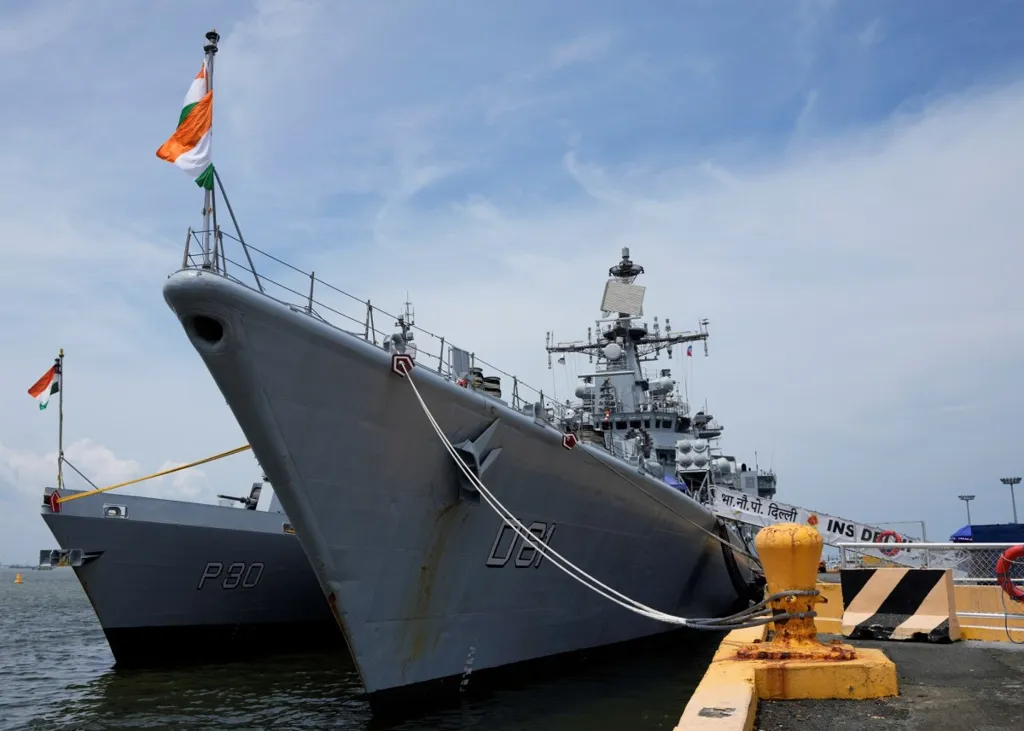
India is set to deploy naval vessels for training in Southeast Asia, following a similar move by its military rival, China, as both powers strengthen ties with regional nations.
India's Ministry of Defense said on Wednesday that four ships assigned to the First Training Squadron will be sent on a long-range mission as part of an officers' training course, during which they are scheduled to visit Singapore, Indonesia and Thailand.
As part of efforts to sustain its military presence overseas, China, which operates the world's largest navy, deployed three vessels for "far-sea comprehensive training" from November 15 to December 22, making port calls in Vietnam, Malaysia and Indonesia.
Newsweek reached out to India's Ministry of External Affairs and the Chinese Foreign Ministry via email for comment.
Southeast Asia is strategically located between China to the east and India to the west, where Beijing and New Delhi are expanding their influence by deepening defense ties with regional nations through military deployments, arms sales and a force presence.
According to a Pentagon report, China views the First Island Chain -- a north-south line running from Japan to the Malay Peninsula, including the South China Sea, which borders China and most Southeast Asian nations -- as its strategic center of gravity.
To counter China's growing reach across the Indian Ocean, considered India's sphere of influence, New Delhi is asserting its geopolitical influence in Southeast Asia in line with its Act East Policy, aiming to maintain a stable balance of power in the region.
The Indian Navy's First Training Squadron, comprising the ships INS Tir, Shardul, Sujata, and ICGS Sarathi, will be deployed to provide "comprehensive operational and cross-cultural exposure" to officer trainees, including six from friendly foreign nations.
Embarked personnel will also include members of the Indian Army and Air Force, aiming to further strengthen "jointness and cohesiveness" among the three services.
The deployment will reinforce India's "sustained maritime engagement" with Southeast Asian countries under the Act East Policy while contributing to a cooperative approach to regional maritime security, the Indian Ministry of Defense said in a press release.
During the Indian flotilla's port visits, it will interact with host navies and maritime agencies through activities including "structured training exchanges, cross-deck visits, interactions with subject matter experts and joint maritime partnership exercises."
However, it remains unclear when the Indian naval training squadron will set sail from the country or whether it will make additional port calls in Southeast Asia, particularly around the South China Sea, where China claims sovereignty over most of the waters.
By comparison, China's naval training deployment involved more than 2,000 cadets and sailors, including 14 foreign officers and military cadets from eight countries.
During the monthlong mission, the Chinese naval task group organized ship open-day events, visits and exchanges, athletic competitions, and subject-matter expert exchanges.
The Chinese Navy said the voyage demonstrated its positive image and strengthened friendship and mutual trust with the armed forces and people of the host countries.
India's Ministry of Defense said in a press release: "These engagements [with host navies and maritime agencies] are designed to further enhance interoperability, mutual trust and understanding, while promoting the exchange of best practices at sea."
India's Ministry of External Affairs said of Prime Minister Narendra Modi's meeting with Chinese President Xi Jinping in August 2025: "A stable relationship and cooperation between India and China and their 2.8 billion peoples on the basis of mutual respect, mutual interest and mutual sensitivity are necessary for the growth and development of the two countries, as well as for a multipolar world and a multi-polar Asia befitting the trends of the 21st century."
Both China and India are expected to sustain their military presence across Southeast Asia. It remains to be seen whether both sides will further bolster naval deployments in the region as they continue efforts to settle their contested land border disputes.