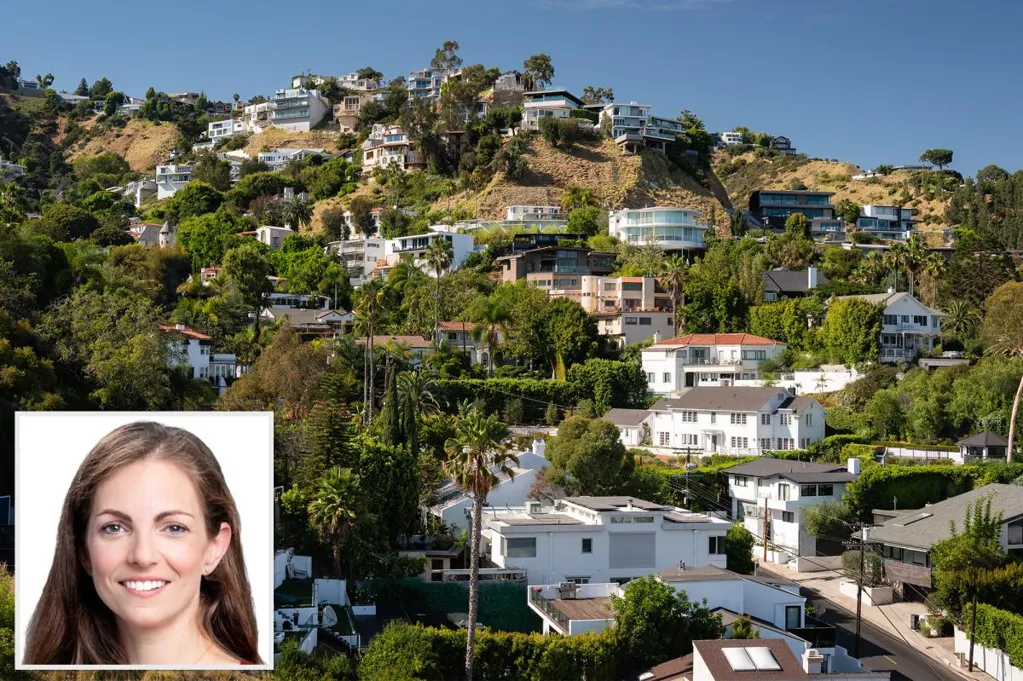
California's spiraling housing crisis is being driven by insane property prices, draconian building restrictions and historically low mortgage rates that deter people from moving, an expert has revealed.
The Golden State is in the midst of an unprecedented slump as buyers sink to levels lower than during and immediately after the Great Recession.
It has sparked fears a housing collapse is on the near horizon, as the state battles its worst sales levels in more than 30 years and is seeing a mass exodus of residents.
Research by Realtor.com revealed California is among the worst housing markets in the country and Los Angelenos are suffering the hardest.
Buyers in Tinseltown would need to spend 72% of their household income to bag an average home, well above the recommended 30% across the country.
Even the most affordable market in the state, Bakersfield, requires nearly 40% of a typical income for a mortgage. Only Montana and Hawaii rank worse nationally than California.
Realtor.com's chief economist Danielle Hale told the Post: "In California, we're looking at home sales that are some of the lowest they've been in more than 30 years, and in many cases, lower than during the 2007 and 2009 period."
She warned the state's stringent building regulations is one of the top factors impacting the housing crisis, while other regions have more relaxed rules for developers.
She said the California Environmental Quality Act and local zoning laws are two of the major causes of the shortage, despite recent attempts to pass pro-housing legislation.
Hale said: "If you make it easier to build, it enables more home building, and that can help bring down the cost of homes.
"Builders can't build enough homes for the people that want to live there, so the homes that do get built in California become very, very expensive.
"I don't think there's anything inherent about California that makes people not want to live there. It's really a response to high housing costs."
She continued: "California has its prices increase more than other areas, and a big part of the reason for that is the lack of housing supply."
California's Department of Housing and Community Development estimated the housing deficit at 2.5 million units in 2023. Other analyses range from 840,000 units to 3.5 million homes.
Hale also noted the Palisades Fire worsened the supply shortage, making the problem "a whole lot bigger."
As of Feb 2026, of the 6,571 homes destroyed by the fire in unincorporated Los Angeles County, only 13 have been rebuilt, according to the official LA Recovers website.
Another factor turning off potential buyers is they are already locked into low mortgage rates that makes them not want to buy again at the current rates.
Hale said: "A lot of homeowners are locked into very low mortgage rates, and so they don't have a very strong incentive to move. They have a very strong reason to stay put and hold on to their low mortgage."
While low mortgage rates benefit existing homeowners, they also hinder sellers and exacerbate an already frozen market caused by the gap between housing demand and supply.
Over the past 25 years, California has recorded its slowest population growth on record, fueled largely by sustained domestic outmigration.
From 2010 to 2024, nearly 10 million people left California for other states, while just over 7 million moved in, resulting in net losses each year since 2001, according to the Public Policy Institute of California.