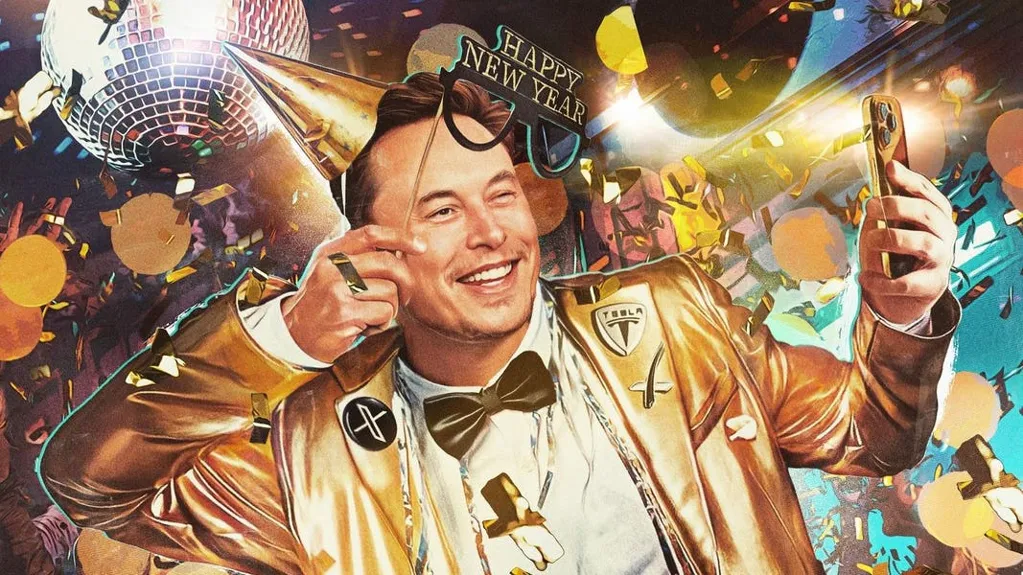
Surging AI stocks, big IPOs and Elon Musk fueled a billionaire bonanza this year.
On October 7, the parent company of the New York Stock Exchange disclosed it was pumping $2 billion into prediction market startup Polymarket at a $9 billion valuation. The deal marked a big win for the five-year-old firm—and its 27-year-old founder, Shayne Coplan, who instantly became the world's youngest self-made billionaire. His reign wouldn't last three weeks.
That's because, on October 27, AI-powered recruiting startup Mercor announced it had raised funding from a handful of blue chip investors at a $10 billion valuation—enough to make its three cofounders the youngest self-made billionaires of all time, at age 22, besting Coplan by a half-decade each and even breaking the record set by Mark Zuckerberg, who became a billionaire in 2008 at age 23.
A similar battle played out for the title of youngest self-made woman billionaire. Taylor Swift, 36, had held the top spot since 2023. Then came Scale AI cofounder Lucy Guo, then age 30, when Scale revealed a share sale in April. Then came 29-year-old Luana Lopes Lara, a former ballerina from Brazil who took the title when private investors valued her prediction market startup Kalshi at $11 billion earlier this month.
Such is the pace of wealth creation in 2025. Over the past year, the planet has added more than 340 new billionaires—roughly one per day—across the U.S., China, India, Russia and places as far and wide as St. Kitts and Nevis and Albania. There are now more billionaires than ever before: a record 3,148, up nearly 50% over the past five years. In 1987, when Forbes published the first ever international ranking, we found just 140 billionaires around the globe. And the billionaire population is richer than ever before, too—both in total ($18.7 trillion, up by $10 trillion since 2020) and on average ($5.9 billion, versus $4 billion back then). A record 19 people are now centibillionaires, having amassed fortunes of at least $100 billion; only one, Amazon's Jeff Bezos, was that rich six years ago.
All this wealth has translated into plenty of power. Some 135 billionaires pumped money into the 2024 U.S. presidential election, and many of them spent the past year lining up behind America's billionaire president. They donated millions to his inauguration—where billionaires like Bezos, Zuckerberg, Tim Cook and Sundar Pichai scored prominent seats usually reserved for the likes of the president's family, past presidents and other top government officials. They donated millions more to his White House ballroom project. Some of them even joined his Cabinet, the richest in U.S. history. Last week, billionaire Jared Isaacman was confirmed as head of NASA, the day after billionaire megadonor Miriam Adelson quipped that she'd give Trump another $250 million to run for a third term. The week prior, agriculture billionaire Andrej Babis was sworn in as prime minister of the Czech Republic—the latest sign that the entire world is, now more than ever, in its billionaire era.
It all starts at the top. Elon Musk began the year already worth $421 billion, then smashed a series of records—first person to $500 billion, in October; first to $600 billion, on December 15; then first to $700 billion, on December 19—as shares of his electric carmaker climbed nearly 30% and the value of his rocket company SpaceX more than doubled, to $800 billion. Musk has added $333 billion to his fortune this year, through December 22, more than the entire fortune of the world's second-richest person, Google cofounder Larry Page, who is worth $255 billion. In other words, Musk has amassed more wealth just in 2025 than any other person on the planet has amassed in their lifetime. With a net worth of $754 billion, Musk is richer than the "poorest" 620 billionaires on the planet combined.
Yet it wasn't Musk who had the single best day of 2025. That was Oracle cofounder Larry Ellison on September 10th, when the software giant's stock soared by 36%, despite the company missing both quarterly sales and earnings expectations, thanks to huge projections for cloud infrastructure revenues driven by the AI boom. Ellison, who owns around 40% of Oracle's shares, added nearly $100 billion to his fortune in the runup—the biggest single-day wealth gain in world history. Shares have since cooled by 40%, but Ellison (who also spent part of his year helping orchestrate takeovers of Paramount and TikTok) is still worth an estimated $250 billion, up $41 billion since the start of 2025.
Page and his Google cofounder Sergey Brin are a combined $185 billion richer this year as the tech giant's parent company Alphabet rolled out its Gemini 3 AI model to compete with the likes of Open AI and DeepSeek. Meanwhile, shares of graphics-chip maker Nvidia are up 33% in 2025—boosting cofounder Jensen Huang's net worth by $42 billion this year, and briefly making an executive and a longtime board member Nvidia’s fifth and sixth billionaires. Japanese tycoon Masayoshi Son, who has steered investment giant Softbank into becoming one of the world's biggest AI investors, is $25 billion richer in 2025.
Then there's the bonanza of new billionaires who have ridden the AI wave to the billionaire ranks for the first time this year. Some are developing large language models, like Liang Wengfeng of China, who launched DeepSeek in 2023 and joined the three-comma club in January when his R1 model took the world by storm, claiming to rival the performance of OpenAI's ChatGPT at a lower cost. Seven former OpenAI employees who left to launch AI giant Anthropic are also new billionaires as the company behind the chatbot Claude has seen its valuation soar from $18 billion to $61.5 billion to $183 billion—all in the span of a year.
Others are getting rich supplying the boom. Shares of ISU Petasys, a little-known South Korean manufacturer of printed circuit boards, are up more than 360% this year; making chairman Kim Sang-beom a new billionaire; while four former execs of U.S. chipmakers Nvidia and AMD are new Chinese billionaires as cofounders of semiconductor firms vying to be the Nvidia and AMD of China.
Jitendra Mohan and Sanjay Gajendra cofounded California-based Astera Labs, which supplies networking technologies for data centers, in 2017 after realizing connectivity wasn't keeping up with advances in AI and machine learning. The stock is up 140% since they took the firm public in 2024; putting both in the billionaire ranks. Meanwhile, three new billionaires behind CoreWeave have built an empire renting some 250,000 GPUs of computing power to AI companies across three dozen data centers across the U.S. and Europe. The stock has more than doubled since their March IPO.
Then there's Fermi America, which is building a huge data center in the Texas panhandle aimed at AI tenants. Fermi went public in October at a $12.5 billion valuation—making billionaires of cofounders Toby Neugebauer and Griffin Perry, and making a centimillionaire of Perry's father, former Texas governor and U.S. energy secretary Rick Perry. All that despite the fact that Fermi hasn't generated a cent of revenue and is at least a year away from completing its first phase of construction. Shares have plummeted 70% since the public offering, knocking Griffin Perry out of the billionaire ranks, but the company remains valued north of $5 billion and Neugebauer is still worth ten digits.
Other AI moguls have muscled their way into the billionaire ranks thanks to cables used to wire data centers; vibe coding; data labeling; AI customer service agents; AI voice cloning; even an AI-powered dating game.
But the billionaire bubble stretches well beyond artificial intelligence. In June, Circle, the cryptocurrency company behind the stablecoin USDC, became the first stablecoin issuer to go public, in a blockbuster IPO that made cofounder Jeremy Allaire a billionaire. The next month, Dylan Field took his design software firm Figma public, becoming a multi-billionaire in the process. His cofounder, Evan Wallace, is a new billionaire, too.
Shares of Cadre Holdings, whose products include body armor and bomb suits for customers including Immigration and Customs Enforcement (ICE), have gotten a bump from increased defense spending in the U.S. and in Europe, helping make CEO Warren Kanders a billionaire. A 300% jump in the shares of AST SpaceMobile—which is racing Musk's SpaceX to build satellites to connect broadband directly to cell phones—has catapulted founder Abel Avellan into the super-rich stratosphere. Steve Huffman made a bundle as the cofounder of social media site Reddit. Hollywood great James Cameron built his wealth one movie ticket at a time. Tennis legend Roger Federer hustled his way onto the list this year.
In all, the world added new billionaires worth a combined $876 billion over the past 12 months—roughly 5% of total global billionaire wealth. Nearly 40% of 2025's newcomers are Americans; but the billionaire bash has spanned 32 countries in all—including 35 new Chinese citizens; 15 new Indians; and 15 new Russians. Germany's Clemens Fischer has gotten rich building and selling a series of over-the-counter drug and supplement companies; he's now trying to develop a cannabis painkiller to replace opioids. Meanwhile Albania got its first-ever billionaire this year in real estate and retail mogul Samir Mane; who fled the country's communist regime in the early 1990s; resettled in Austria; built a first fortune; then returned launch country’s first shopping mall outskirts capital Tirana.
Two-thirds of this nouveau riche set created their own fortunes—including 11 new self-made billionaires under 30—bringing worldwide total record 13. But others—including three daughters Indianapolis Colts owner Jim Irsay (d. May), five heirs Italian fashion designer Giorgio Armani (d. September) and five members family behind medical supplies giant Medline’s year-topping IPO—joined billionaires list this year old fashioned way: inheritance.
And the thing about those who get this wealth is they tend to stay wealthy. Even with all these fresh faces, nearly 85% of current billionaires began the year already a billionaire. Four-fifths of them are heading into 2026 as rich or richer than they were a year ago—leaving billionaire class well positioned yet another year many happy returns.