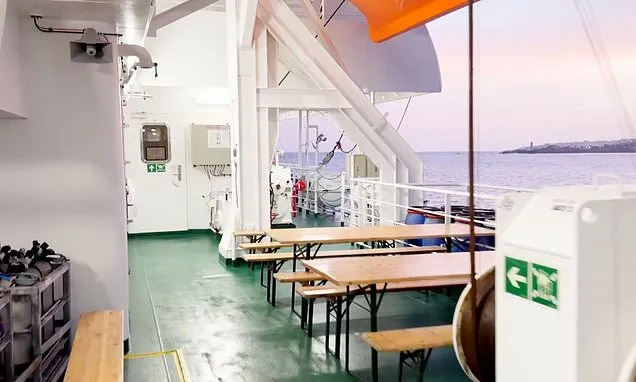
New footage has emerged from inside the MV Hondius cruise ship, showing deserted spaces and masked staff after three passengers died and at least four others were left ill in a suspected hantavirus outbreak. The nearly 150 people aboard a cruise ship off the coast of Cape Verde have been mostly confined to their cabins, according to the footage. The luxury ship has been stranded at the Port of Praia after health authorities in Cape Verde said they would not authorise its docking 'with the aim of protecting national public health'. Footage showed the ship's decks mostly deserted, with only a few people wearing medical masks moving about. Common spaces were empty as passengers isolated in their cabins. At least five people with full protective gear, white overalls, boots and face masks, were seen disembarking from the ship into a small vessel.
The World Health Organization said Monday passengers were asked to stay in their cabins and 'limit their risk while disinfection and other measures are being taken.' In its latest update on the crisis, cruise firm Oceanwide Expeditions said on Monday that two crew members - one British and the other Dutch - were continuing to show 'acute respiratory symptoms', one mild and one severe, and required urgent medical care. The infected British crew member is the ship's doctor, according to passenger Ann Lane from Donnybrook, south Dublin. 'Now the ship's doctor and a member of the expedition staff are sick on board. The doctor had been treating everybody day and night, really dedicated to what he was doing - [he has been] fabulous,' she told the Irish Times. 'He's a younger man, British. He has been sick quite a few days, maybe since last Thursday.'
Medics are scrambling to evacuate the sick passengers with two specialised aircraft, but an 'accurate timeline of this complex operation is currently unknown' and the mission is still 'not confirmed and is subject to change'. Meanwhile, 'a definitive disembarkation point for the remaining guests on board has not been finalised', the statement said, leaving 149 people from 23 countries anxiously waiting to learn their fate. Sailing on to Las Palmas or Tenerife is being considered, where medical screening supervised by the World Health Organisation (WHO) and Dutch health services will take place, but no definitive evacuation plan has been confirmed.
'We're working with Spanish authorities who... have said that they will welcome the ship to do a full investigation, a full epidemiologic investigation, full disinfection of the ship and of course, to assess the risk of the passengers that are actually on board,' WHO epidemic and pandemic prevention director Maria Van Kerkhove said on Tuesday. But Spain was quick to shoot down the suggestion, insisting immediately that 'no decision' had been taken yet to accept the cruise ship.
On Monday, the WHO said it had identified seven cases of hantavirus on the vessel, including three people who had died, one who was critically ill and three with mild symptoms . The first stricken passenger, a 70-year-old Dutch man, died on April 11 as the ship steamed towards Tristan da Cunha.
His body remained on board until April 24, when it 'was disembarked on St Helena, with his wife accompanying the repatriation,' Oceanwide Expeditions said. Three days later, the man's 69-year-old wife also fell sick and later died, while another passenger, a Briton, became 'seriously ill and was medically evacuated to South Africa,' the company said. South African authorities have confirmed that the 69-year-old British patient, who is being treated in a Johannesburg hospital, tested positive for the hantavirus. On May 2, another passenger of German nationality died on board the ship. The WHO said: 'As of 4 May 2026, seven cases (two laboratory confirmed cases of hantavirus and five suspected cases) have been identified, including three deaths, one critically ill patient and three individuals reporting mild symptoms.'
Passengers Urged to Follow Strict Isolation Measures
Passengers still on board are being asked to follow strict isolation measures, hygiene protocols and medical monitoring. According to the UK Government's hantavirus advice, symptoms typically appear anywhere from two to four weeks, but can range from two days to eight weeks after exposure, meaning illness may develop in other passengers in the coming days or weeks. Around 40 per cent of cases result in death, according to the US Centers for Disease Control. Hantaviruses - a family of viruses - are spread by rodents, in particular through contact with their urine, droppings and saliva. They are known to cause a range of diseases in humans ranging from mild, flu-like illness to severe respiratory illness or haemorrhagic disease. Early symptoms can include fatigue, fever, muscle aches and intense headaches. They are not usually spread person-to-person and are typically only transferred via bodily fluids and close contact.
Starmer Speaks Out
The risk of contracting the illness can be reduced through minimising contact with rodents. Meanwhile, the UK Government is putting 'plans in place' for the onward travel of Britons stuck aboard the cruise ship, the Prime Minister said. In a post on X, Sir Keir Starmer said: 'My thoughts are with those affected by the hantavirus outbreak onboard the MV Hondius. 'We are working closely with international partners to support British nationals on board and we're putting plans in place for their safe onward travel. 'The risk to the wider public remains very low - protecting the British people is our number one priority.' The ship left Ushuaia in southern Argentina on April 1, according to Argentine provincial authorities. Although health officials in Ushuaia have said they confirmed no passengers had hantavirus symptoms when the ship departed, symptoms can appear up to eight weeks after exposure.
The WHO said Monday night that, as of then, no new people on the ship had shown symptoms of the virus, but the situation is being 'carefully monitored' for further developments. 'The outbreak is being managed through coordinated international response, and includes in-depth investigations, case isolation and care, medical evacuation and laboratory investigations,' the WHO has also said. Cape Verde's National Director of Health Angela Gomes told the state-run Radiotelevisao Caboverdiana radio that authorities are focused on guaranteeing 'the maximum level of safety' for the local population. 'And for this reason, all assistance is being provided with personal protective equipment, with maximum protection, both to our medical team but also to the entire team that assists the medical team in transporting it to the vessel,' said Gomes.