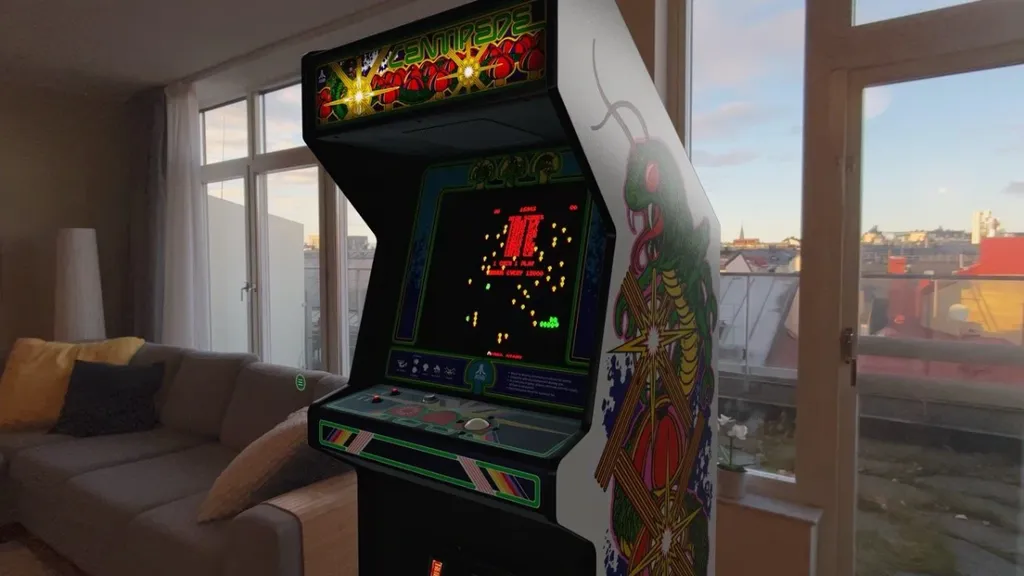
In a world where gaming is headed in directions never thought possible, it's almost difficult to imagine what the next step in development is going to look like. After spending a bit of time in "Retrocade" by developer Resolution Games, it was clear that there was a lot of thought and care put into the entire development process to ensure the most memorable, nostalgic and immersive arcade gaming experience possible.
If Resolution Games already sounds familiar, they're the developers behind "Spatial Ops," a fast-paced first-person shooter that turns your living room into a battleground that can be experienced with up to seven additional friends online.
I had the pleasure of sitting down with Resolution Games CEO Tommy Palm to talk about "Retrocade" as well as the latest addition of classic game "Tetris" to the lineup, as well as a new immersive Japanese arcade environment. On the call with us was Jamie Camargo, the Director of Public Relations for Resolution Games.
Nat Collazo (Newsweek): Thank you so much for meeting with me! I'd love to get a little bit more of a background (on Resolution Games). I did a little bit of preliminary research, but it's always great to hear directly from those who worked on it and worked within it.
Tommy Palm (CEO of Resolution Games): Of course! We're mainly based in Stockholm, Sweden, where I'm at right now. We've been doing virtual reality and augmented reality and spatial computing, or whatever you want to call it, for more than 11 years now. We started with virtual reality, but we said from the get-go that we believe that the really big game changer is going to be when you can augment your world with 3D stuff.
It's such a fascinating thing to be able to work on something like "Retrocade" where we get to take something that we are very passionate about, like these old arcade games, where it started for a lot of us, and then recreate this little time capsule of, like, "this is what it looked like back then," and be very detailed with all the fingerprints on the plexiglass that you can only see from certain angles and a lot of these amazing capabilities that we haven't been able to do on a regular flat screen gaming.
It's been a super fun project, and then kind of the thing we dreamed about when we started back in 2015, around cardboard headsets and very simplistic technology.
Collazo: So you've had the chance to check out "Retrocade?" Like, fiddle around in it?
Jamie Camargo (Director of Public Relations at Resolution Games): Tommy's not a normal game CEO. He built the game. He was very involved.
Palm: Haha, not only me, obviously! But I got a chance to code a little bit as well. That was a lot of fun.
But, you know, these games were made for competing with your friends. So, it mixes really well with the Game Center list, if you have friends on Game Center. It automatically sends you notifications and such when they beat your score. I used to be higher on the High Score list, but definitely not anymore.
Collazo: What was the thought process concerning doing this (a more retro arcade) as opposed to something like Dave and Busters, that's a, you know, a genuine change in visuals and sounds in the general area.
Palm: We wanted to get the real legendary games from the early days. The Golden Age of gaming, as we call it in the description. For me, a lot of the game technology was invented then. Space Invaders was one of the first games with a soundtrack, a pretty simple heartbeat that goes faster and faster as you shoot away the aliens.
Doing something from the early 80s felt like a really good place. I had the opportunity to visit American arcades back in the 80s. So, I have some experience from that myself. It's actually very different in different regions, right? In Sweden, we had laws prohibiting this type of machine for a while, and then that phased out, fortunately.
Collazo: I agree. Even Japan has a large culture around arcades. It's incredible to see how well it's implemented into their culture.
Palm: Yes, it's really cool to see the difference. They often sit by the machines and maybe even smoke inside. I guess they were smoking inside back in the '80s, back in the US as well.
Camargo: The team did a really cool dichotomy of the difference between what really encompasses a more U.S. arcade and then a more Japanese arcade because it really is a different feeling.
Palm: That's been really fun to be able to deep-dive into those different cultures, but the same in a way. A lot of these games are Japanese from the beginning obviously so it's been super fun to sort of capture the inception of what that looked like as well as let the Japanese people be nostalgic over what it looked like in game centers back then.
Collazo: The Japanese environment is exclusive to Tetris? Would you mind explaining how that works to me?
Palm: So, the version of Tetris we have is the original Tetris version that is on the Elektronika 60 computer. So, it isn't the arcade machine. That was made back in '83 or '84, and it looks the way it did then. Not a lot of people have been able to test that version obviously, but it's very cool to be able to play it in the original format.
That machine didn't even have graphics, really. You played with the ASD keys.
Collazo: I love the idea of being able to use a controller while playing. I'm sure it's way more immersive when using a fightstick or joystick pad of some kind to really get that engagement. When it comes to the Apple Vision Pro and the concept of Personas, will there be a way to use your hands to play? Is that any sort of future thought?
Palm: We tried to make that happen. That's the most intuitive thing. You see that cabinet, and you kind of want to look around it virtually, and with some games, there aren’t a lot of controls, and it works a little better. But it’s one thing to sort of press down and be pretty accurate with that; it’s when you let go that it’s very difficult to see.
It is possible, but it’s unfortunately not the greatest experience. We haven’t been able to enable that type of gameplay. It can do really cool things where you can place the touch surface on a real table so when you touch the table you can get some kind of tactile feedback like when you’re pressing a button.
But the joystick, for instance, is very hard to get really good. It’s like one of the big things that we’ve been working on here for the iPhone and iPad to get the touch controllers to be great. It’s hard to replicate real, physical controllers. Part of these arcade games is deeply integrated into the control patterns. “Centipede” is a great example that has this super amazing roller ball that you can be very good at remembering exactly how much power you need to push it. That’s really tricky to replicate on a phone.
So, we are allowing for a lot of different things you can connect to the device, but it would be super cool if you could just use your virtual fingers, and it would work magically. But, unfortunately, we aren’t quite there yet.
Collazo: I was curious to know what sort of AI (Apple Immersive) implementation "Retrocade" has when it comes to the immersive experience?
Palm: So, we are using a technology that Apple made called Reality Kit that helps create this incredible, realistic area. So, if you place a cabinet in your home, for instance, so you're not in this fully immersive area or a spatial computing version of it, then your light in your room will affect the cabinet and the reflections in the right way.
You can see reflections from your real room, which is what creates this enormous sense of anchoring of the objects in your space. It really looks like it's there. It's a very fascinating thing that we don't do very much. We need to make the surfaces and decide what materials they are, and the more detailed they are like the fingerprints or minor scratches and imperfections are just going to make things much more realistic.
Of course, if you push on it, you won't feel it.
Collazo: What are a few other games under the Resolution Games belt that you would recommend outside of "Retrocade?" "Retrocade" is already an incredible experience, so I'm really excited to jump in.
Palm: We've released "Game Room." That was the first title that we had very quickly after the launch of the Apple Vision Pro. It's also available on multiple devices like iPhone and iPad. We just released last week something called "Spatial Ops."
Unfortunately, it does require the PlayStation PSVR 2 controllers. So, it becomes a little bit more challenging. Even fewer people have both the headset and the spatial controllers. They don't come with the headset and can be bought separately. But it's really cool. We always wanted to do that kind of game.
The resolution is so incredibly strong and the screen is really impressive. It looks really great on the Apple Vision Pro.
Collazo: I can imagine it's great! Everyone immediately after my Apple Vision Pro briefing talked about the game and pulled out their PSVR 2 controllers. I guess I need to add it to my list.
Palm: We also have a racket game called "Pickle Pro" that we released last year. And when the Apple Vision Pro was announced to support the PSVR 2 controllers, it was featured at the Apple Keynote.
If you have the controller, you can just get the ball physics. If you’re a great tennis player or a great pickleball player, then you know exactly how to handle it. It’s very similar to reality even though you don’t feel the force from the ball. We have a little bit of a rumble in the controls when you touch it so you can feel it a little bit.
But it’s not like a real tennis ball that would use much more force when you hit it. But, then again, with virtual objects,you can play with somebody in another state.Youcan do thatreallywellherewithPersonas.