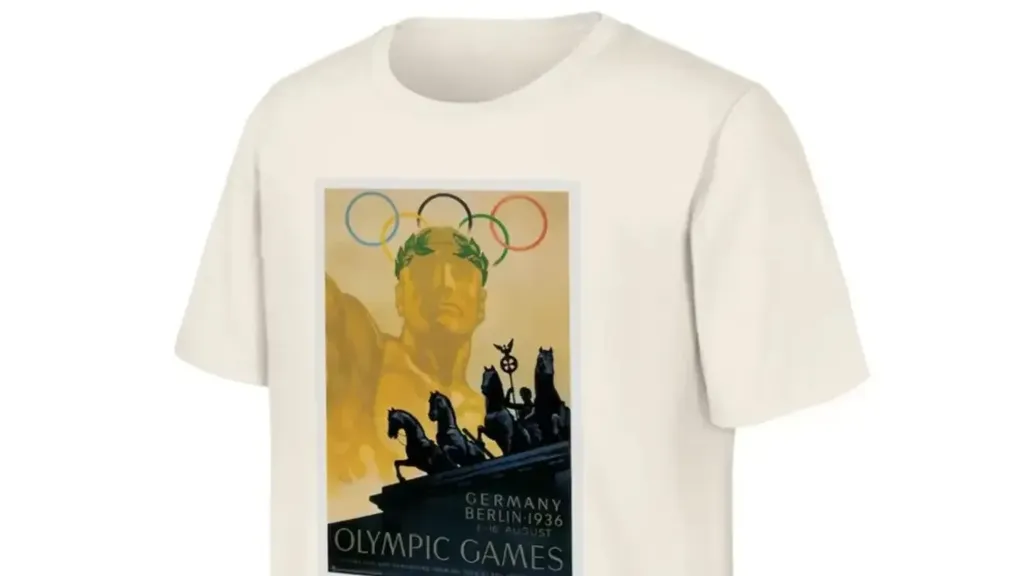
WASHINGTON (TNND) -- The International Olympic Committee (IOC) is catching flack from Holocaust remembrance organizations for selling T-shirts commemorating the 1936 Olympic Games, which was held in Berlin, Germany -- more than three years after Adolf Hitler's Nazi regime took power.
It's widely recognized among historians that Hitler used the Olympic Games to push his propaganda of Aryan racial superiority. The Nazis prevented German-Jewish athletes from competing and openly called black athletes "non-humans."
The shirt was a part of the IOC'S "Heritage Collection," but it has since been removed after selling out.
The shirt displayed the original 1936 Olympic poster created by Franz Würbel, which depicts a muscular statue of a man wearing a wreath. The iconic Olympic wreaths sit above his head. The poster also displays Berlin's Brandenburg Gate with the words "Germany Berlin 1936 Olympic Games" written across it.
"Each edition of the Games reflects a unique time and place in history when the world came together to celebrate humanity," the website stated on the collection's landing page.
But, Holocaust advocacy groups were quick to point out how Hitler used the Olympic Games to dehumanize non-white athletes.
"The Nazis used the 1936 Olympics to showcase their oppressive regime to the world, aiming to smooth over international relations while at the same time preventing almost all German-Jewish athletes from competing, rounding up the 800 Roma who lived in Berlin, and concealing signs of virulent antisemitic violence and propaganda from the world's visitors," Christine Schmidt, co-director of the Wiener Holocaust Library told CNN.
"The Nazis' fascist and antisemitic propaganda infiltrated their promotion of the games, and many international Jewish athletes chose not to compete," Schmidt continued. "The IOC would be minded to consider whether any aesthetic appreciation of these games can be comfortably separated from the horror that followed."
Scott Saunders, CEO of International March of the Living, an organization which organizes educational trips to the former Auschwitz concentration camp, said the 1936 Olympics showed a complicit society in antisemitism.
"Sport has the power to unite, to inspire, and to elevate the very best of humanity. But history reminds us that it can also be manipulated to sanitize hatred and normalize exclusion. The lesson of Berlin is urgent. When antisemitism resurfaces in public life, whether in stadiums, streets, or online, silence is not neutrality. It is complicity," Saunders told CNN.
But despite the backlash IOC defended the sale of the shirt, saying while "Nazi propaganda" may have been present, it did not taint the games.
"While we of course acknowledge the historical issues of 'Nazi propaganda' related to the Berlin 1936 Olympic Games, we must also remember that the Games in Berlin saw 4,483 athletes from 49 countries compete in 149 medal events. Many of them stunned the world with their athletic achievements, including Jesse Owens," a IOC spokesperson told CNN.
Owens is an African American Olympic who won four gold medals. He saluted at the first place podium; while those around him performed the Nazi salute.
"The historical context of these Games is further explained at the Olympic Museum in Lausanne," the spokesperson continued. " For the 1936 edition, the number of T-shirts produced and sold by the IOC is limited, which is why they are currently sold out."