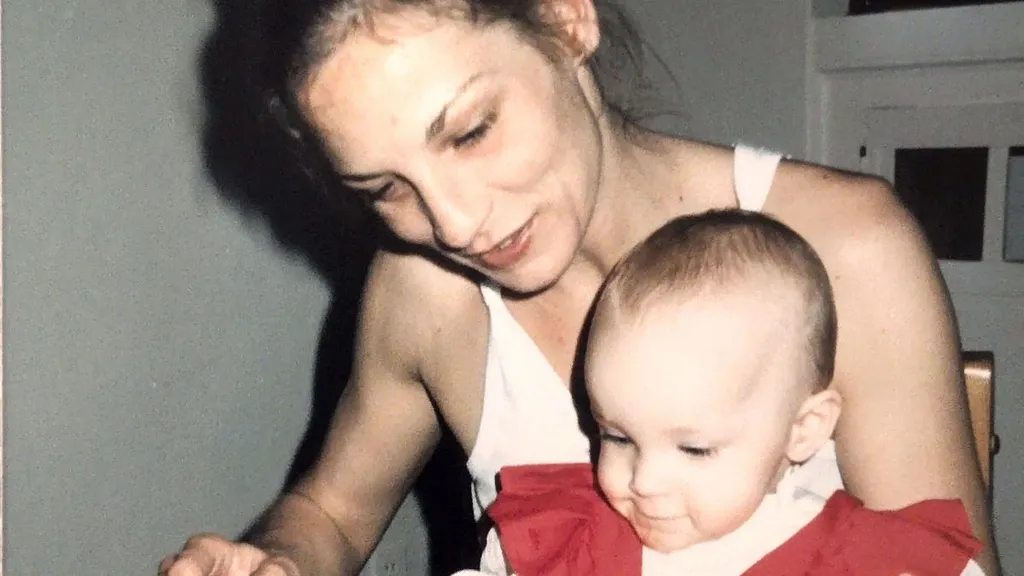
Barbara Lenz went missing in 1989. Her daughter, Lindsy Baumgart, looks back after her mother's killer was convicted.
- Robert Davis was convicted of second-degree murder for the 1989 killing of his girlfriend, Barbara Lenz.
- Lenz's daughter, Lindsy Baumgart, attended the trial to get justice for her mother, who went missing when she was 3.
- The case was reopened by the Iowa Cold Case Unit, leading to Davis's arrest nearly 37 years after Lenz's disappearance.
Lindsy Baumgart wore jeans, a T-shirt and the cowboy boots she calls her "Barbaras" when she saw the man who killed her mother for the first time since she was 3 years old.
It was the signature look of her mother, Barbara Lenz. Baumgart, now 40, who looks strikingly like her mother, bought a pair of cowboy boots to wear in her honor.
"I did that for her," Baumgart told the Des Moines Register. "I know she's proud of me."
She wanted Robert Davis, the man long suspected of killing Lenz in 1989, to see the ghost of her mother at a hearing after he was charged with her death. She looked him in the eyes until he looked away.
Baumgart again wore her Barbaras at trial. And she plans to do it again at Davis' sentencing in May, two months after a jury found him guilty of second-degree murder.
Davis was convicted almost 37 years after Lenz went missing, though her body has never been found. Baumgart now lives with her four children in Omaha, an hour south and just across the Iowa border from her hometown of Woodbine, where Lenz was last seen.
"I know I may not know where her body is, but I know where the best part of her is," said Baumgart, her voice faltering.
She calls the guilty verdict "divine intervention" and said justice was long overdue. She had promised her mother she would get justice. She was convinced it would come -- it was just a matter of when.
"I just knew one day it was going to happen," Baumgart said. "I didn't know how I was going to do it, but it's just something that I never let go of. It was just like a continuous battle for me, you know? I just never wanted to stop."
Lenz suffered domestic abuse before going missing
Lenz and Davis dated for two years, but their relationship was filled with assault, arguments and abuse, according to court filings.
Davis acknowledged "assaulting Lenz in the past and to having a violent temper when things went wrong," he said in an interview with law enforcement in 1989, according to court filings.
In the days leading to Lenz's disappearance, she had "expressed to several people that she was in fear of her boyfriend Robert Davis and that she was trying to get away from him," court filings say. She also told at least two witnesses that Davis had threatened to kill her if she left him.
Lenz was last seen on May 6, 1989, when multiple witnesses said they saw him and Lenz arguing at his rural Woodbine residence because she wanted to go to Omaha to visit her daughter. Later that day, a witness saw Davis slash "Barbara's face with a boot spur," according to a Facebook post from the Iowa Division of Criminal Investigation.
Her family reported her missing May 17, 1989.
A witness later reported that Davis and his brother buried something in a rural area near Davis's home. Two more witnesses, including a former partner, said Davis threatened they would "end up like Barbara" after an argument.
The case went cold without a body, no physical evidence and few witnesses, according to the Iowa DCI Facebook post.
It was cold for longer than Lenz had been alive. She was 31 when she went missing.
But the Iowa Cold Case Unit, which Iowa Attorney General Brenna Bird re-established in 2024, started looking into it again. The team soon decided the case "warranted a murder charge," according to the Iowa DCI post, and a warrant for Davis's arrest was issued March 7, 2025.
Davis was arrested during a traffic stop three days later. He told police, "I mean, you got a body or something or what?" according to the DCI post.
He was the first person arrested after the formation of the cold case unit, which brought "fresh eyes and a focused team to dig through information, meet with witnesses and loosen up leads in Lenz's case," a news release from the Iowa Attorney General's Office said at the time of Davis' arrest.
Davis initially was charged with first-degree murder, but prosecutors reduced it to second-degree murder before his trial began March 24. On March 31, the jury returned a guilty verdict after less than four hours of deliberation.
Fourteen witnesses -- including Baumgart, friends, neighbors, a former girlfriend of Davis, and the Iowa state medical examiner -- helped piece together the story that led to a conviction, despite the lack of physical evidence and a body.
"I'm very grateful that people care," Baumgart said. "This case has taken a lot of courage from people who want to gain their power back and to be able to come forward."
Davis faces 50 years in prison when he's sentenced May 22.
Davis abused mother and child
Baumgart said she knew her whole life that Davis killed her mother.
"I think everybody knew that," she said. "I think everybody in the county knew that."
Davis told investigators in 1989 he assaulted Baumgart as a child in a restaurant in front of several witnesses. It was one of many instances of abuse, Baumgart said.
Even though she was just 3 years old, she recalls Davis peeking in her windows as a child to scare her. He once stuck his fingers down her throat, choking her and preventing her from breathing.
"It's like I can still feel his fingers down my throat," Baumgart said. "That's how vivid it is."
But she also remembers her mother, even though they had a short time together.
"I remember this mama cat had kittens, and I remember my mom telling me, 'You can look at them, but don't touch them,'" Baumgart recalled. "It's like I can picture her face, but I can't really remember the sound of her voice. And that bothers me. I just wish I knew what she sounded like."
She learned more about her from her family and her father, John Crews, over the years.
"Weirdly enough, I feel like even though I didn't get the chance to know my mom the way that I should have, I feel like I'm a lot like her," Baumgart said.
"I look a lot like my mom," she said. "And there have been a few instances that I don't know if it was something I said, or maybe even how I laughed; but my dad said: ‘Oh, like you sounded like your mom there.’”
Though Baumgart doesn't have many pictures of them together, she does have paintings and drawings her mother created. She thinks of her mother every day, seeing her in the sunrise when she's driving to work.
"I feel like that's my mom smiling down on me," Baumgart said.
Trauma from losing Lenz spans generations
Baumgart grew up without her mother, leaving her father to fill the gap.
"He was such a wonderful father," Baumgart said. "And such a wonderful mother at the same time. He really did everything that he could in his power to just make sure that I had all the advice I needed. Everything I needed."
But she still grew up without her mother. She recalls watching an episode of "Maury," where a mother and daughter dressed the same.
"I just remember that so vividly," Baumgart said. "I wish I had that."
Lenz missed her daughter's major milestones as she grew up. High school graduation. Having her children. Her wedding.
"She missed out on so many things, and I missed out on so many things," she said. "It's just so unfair."
Baumgart's children, Kayleigh, 18; Ella, 16; Zoey, 13; and Alexander, 3; also share the loss of the woman who should have been their grandmother.
"They got their grandma taken away," Baumgart said. "They never had the chance to meet her, know what she was like. I never really knew how much it would impact them, but it really did."
Even with Lenz gone, her daughter, her grandchildren and the rest of her family keep her "at the forefront of our minds," Baumgart said. During family gatherings, Baumgart describes a "warmth" that's there with them.
"It feels so warm; I just know she's there with us," Baumgart said."She lives in all of our hearts."
Baumgart visited memorial, told her mother 'we did it'
It had been so long since her mother went missing that Baumgart didn't know how she'd react when she got the news of an arrest. She got the call while she was at work, breaking down in tears when investigators told her Davis was arrested.
"I just started crying. I was shaking. I just couldn't believe it," Baumgart recalled. "The only thing I wanted to do was like call my mom's siblings and tell them like, 'We got him,' you know? And it was such an emotional, overwhelming incredible moment."
But the news also "opened the wound back up," she said. "It felt like that was the day that my mom died."
The day after the arrest, she drove an hour to the rural Woodbine cemetery where a memorial stone rests for her mother. The cemetery is surrounded by trees where the breeze gently blows and the birds sing.
"It just feels, you know, so inviting and serene to just sit there and be with her," Baumgart said.
She brought a blanket and packed a lunch. She talked to her mom about her children. About life. About missing her.
"We did it, mom," Baumgart said to her mother that day. "We got him."