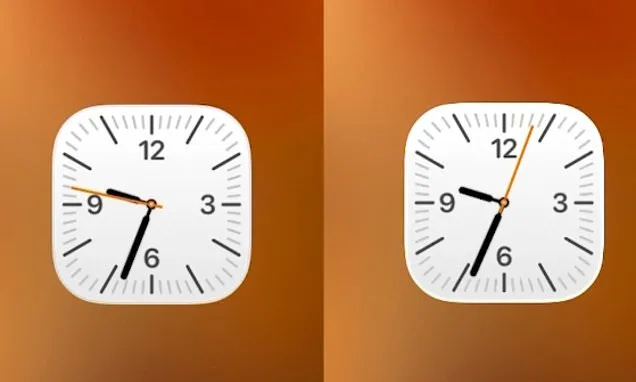
iPhone users have been amazed to discover a secret design element hidden in the clock app.
In a viral post on X, user @ShishirShelke1 shared their strange discovery about the clock app icon.
Normally, the icon on the home screen shows the second hand smoothly gliding around the clock face.
However, when an iPhone is in Low Power Mode, the second hand begins ticking around the clock instead.
'Wait... the Clock icon on iOS ticks like quartz watch in low power mode and mechanical in normal mode???' said @ShishirShelke1.
'That's ridiculous attention to detail.'
His discovery has amazed iPhone users, although many pointed out that this probably wasn't a design decision by Apple.
'It's not an attention to detail, it's an easy point to save battery! When you animate the entire flow, that is more pixels having to turn on and off. When you cut each second, the pixels are doing less, saving battery life,' one user replied.
Since 2015, iPhone users have been able to toggle Low Power Mode on when they're low on battery.
'When the battery level gets low, Low Power Mode reduces background activity on iPhone and iPad devices to extend battery life,' Apple explained.
When you turn it on, Low Power Mode affects several features.
Email fetch, background app refresh, and automatic downloads will be turned off, while iCloud Photos will be temporarily paused.
In addition, your display brightness is reduced, while your display refresh rate will be limited.
This reduced refresh rate is likely to thank for the change to the clock app icon.
'I think its merely due to the refresh rate of the always on screen that goes down to 1/s,' one user replied to @ShishirShelke1.
Another added: 'It's probably not attention to detail but rather saving some battery by processing lesser frames.'
And one wrote: 'It's even cooler than that - the screen goes down to 1Hz refresh rate. Super smart stuff.'
This isn't the first time eagle-eyed iPhone users have spotted hidden elements in the clock app.
Last year, users discovered that when you set an alarm on an iPhone, the spinning wheel of numbers is actually a long list.
Eventually, if you scroll for long enough, you will actually find the end of the alarm app’s list of possible times.
As confused iPhone users have discovered, this time is always 04:39pm.
On social media, Apple fans have been shocked by this strange discovery, with one commenter asking: 'Why is this such a disturbing discovery?'
THE TRILLION DOLLAR RISE OF APPLE
1976: Founders Steve Jobs, Steve Wozniak and Ronald Wayne created the company on April 1 1976 as they set about selling computer kits to hobbyists, each of which was built by Wozniak.
The first product was the Apple I.
1977: Apple released the Apple II in June, which was the first PC made for the mass market.
1981: Jobs became chairman.
1984: The Macintosh was introduced during an ad break for the Super Bowl and later officially unveiled during a launch event. It was discontinued a year later and Jobs left the firm.
1987: Apple released the Macintosh II, the first colour Mac.
1997: Apple announces it will acquire NeXT software in a $400 million deal that involves Jobs returning to Apple as interim CEO. He officially took the role in 2000.
2001: Apple introduced iTunes, OS X and the first-generation iPod.
2007: Apple unveils the iPhone.
2010: The first iPad was unveiled.
2011: Jobs resigned in 2011 due to illness, handing the CEO title to Tim Cook. Jobs died in October from pancreatic cancer.
2014: Apple unveiled the Apple Watch. It also unveiled its first larger iPhones - the 6 and 6 Plus.
2015: After purchasing Beats from Dr Dre, Apple launched Apple Music to compete with Spotify and other music streaming services.
2016: Apple returned to its roots and announced the 4-inch iPhone SE. Meanwhile, the firm is embroiled in a legal battle with the FBI, involving the agency demanding access to the locked phone used by Syed Farook, who died in a shootout after carrying out a deadly December attack in San Bernardino, California with his wife. The court order was dropped on March 28 after the FBI said a third party was able to unlock the device.
2017: Apple introduces the iPhone X, which removes the home button to make way for a futuristic edge-to-edge screen design and a new FaceID system that uses advanced sensors and lasers to unlock phones with just the owner's face.
2018: In a first for the company, Apple introduces new features in its latest operating system, iOS 12, that encourage users to manage and spend less time on their devices. The move was spawned by a strongly worded letter from shareholders that urged the firm to address the growing problem of smartphone addiction among kids and teenagers.
2019: In January, Apple reports its first decline in revenues and profits in a decade. CEO Tim Cook partly blamed steep declines in revenue from China.
2020: In March, Apple closes all its bricks-and-mortar retail stores outside of China in response to coronavirus.
2021: In an online virtual event in April CEO Tim Cook declared Apple's goal of becoming carbon neutral for Earth Day. Later in the year the iPhone 13 was announced.
2022: In September the iPhone 14 was announced. One of the new features included a new sensor to detect if a user had been in a car crash as well as an improved camera system.
2023: Apple brought back its 'Home Pod' after the first generation was discontinued. The 'Home Pod' can be seen as an alternative to Amazon's Alexa or Google Home as it is powered by voice commands.
2024: Apple makes its first steps into artificial intelligence with the release of Apple Intelligence. The features are not all released at once with many delayed until the following year.