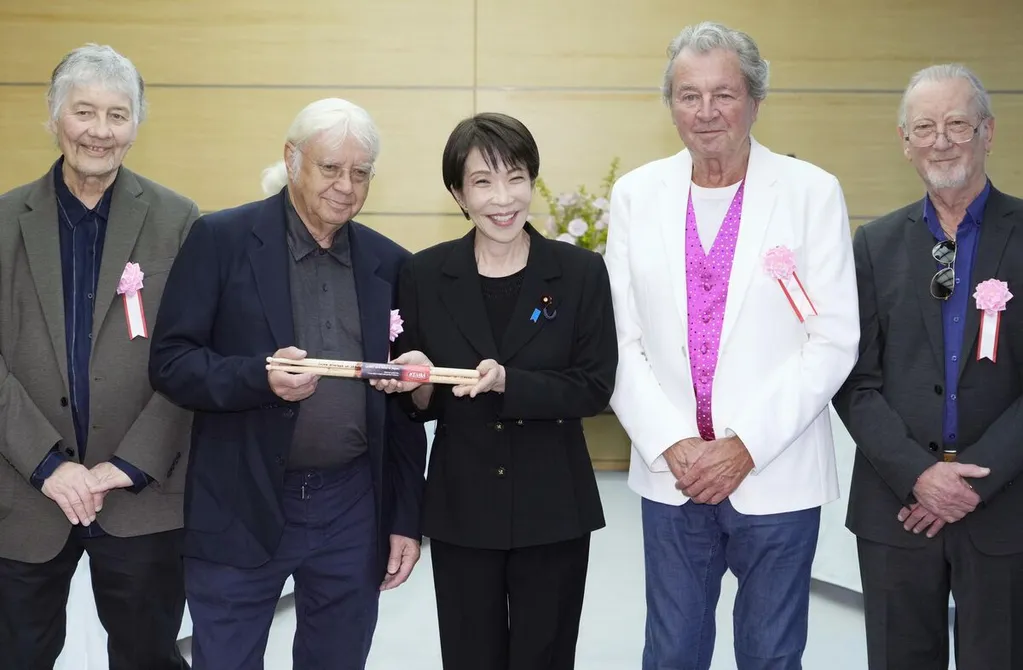
As the Iran war prompts some countries to call for restrictions that hark back to the oil-shock era -- Australia is urging people to take public transport, South Korea is calling for shorter showers -- in Tokyo, Japanese Prime Minister Sanae Takaichi is doing a 70s throwback of a different kind: Hanging out with heavy rockers Deep Purple.
The noted metal-lover Takaichi can afford to take time to meet one of her idols, whose hits include Woman From Tokyo (Takaichi, alas, hails from Nara). Despite Japan's dearth of natural resources and dependence on Middle Eastern oil, the situation in Tokyo has been remarkably sanguine.
While the public opposes the war, her polling remains firm, with support rising 2 percentage points to 61% in an NHK survey taken this weekend. Clear majorities favor her diplomatic efforts and steps to ensure energy security. She can't take all the credit: Japan's energy diversity is a long-standing policy that seeks to avoid over-dependence on any one region. In recent times, from the sanctions on Russia after the Ukraine invasion to Beijing's current economic pressure campaign against Tokyo, it's been more crucial than ever. And while Tokyo is regularly tarred with "fossil" awards at international climate conferences, its decision not to phase out coal and demolish mothballed thermal plants and refineries now turns out to be more than worth the bad publicity.
But Takaichi has also moved swiftly to introduce subsidies for gas that have kept prices near pre-war levels, and has made alleviating supply bottlenecks a priority. Politically, she has played her cards well: While much was made in the foreign press of her flattery of President Donald Trump during her visit to Washington, it was less of a big deal domestically. For the most part, the public recognizes the strategy; Trump's remarks on Pearl Harbor might have surprised, but he is far from the first president Japan has had to flatter. The important thing was to avoid getting sucked into committing resources in the Strait of Hormuz, while also dodging any blowback. That, so far, is mission accomplished.
The prime minister can even use the situation further to her advantage. The crisis provides impetus to expand the country's nuclear power supply. She is already boosting Japan's defense spending and, given the erratic behavior of its security guarantor, efforts to revise the pacifist constitution will now make more sense to the public. Likewise, deepening ties with NATO, something previously rebuffed by France, is now back on the agenda, with the alliance sending its largest-ever delegation to Tokyo this week.
Japan gets some 94% of its oil imports via the Strait of Hormuz. The lack of panic so far has been thanks to a preparedness that comes from past bitter experience of the oil shocks of the 1970s. The country holds extensive reserves, which it expects to be able to stretch through to next year. It has also been swift to source alternative supplies.
Nonetheless, the first signs of the impact are appearing in an unlikely place: the bathroom. Fixture-maker Toto Ltd. said it had suspended orders for bathroom units, a result of raw material bottlenecks owing to naphtha shortages. Sector peers soon followed, sending shares tumbling. Some fear it could lead to knock-on effects on housing construction. The bigger concern is that this might just be the beginning.
One eyebrow-raising report floated the idea that some in the government want to ask the public for energy-saving measures after the Golden Week holidays at the start of May. It's reminiscent of the early days of the Covid pandemic, when the kind of upheaval abroad was initially absent in Japan.
The country's dependence on the Middle East for electricity generation is minimal, and has shown it can endure grid shocks. But it's the harder-to-predict, second- and third-order effects that will surprise. The pandemic showed how little we understand supply-chain complexity. A popular brand of beef-and-wasabi flavored chips has been temporarily taken off the market. Of greater concern will be reported shortages of crucial medical supplies, such as surgical gloves. And top of mind will be the impact of higher energy prices on inflation and wage growth, at a time when real wages had finally begun to climb.
As her flurry of outreach to leaders in the Middle East and Pakistan in recent days shows, Takaichi will be looking to de-escalate before any more supply shocks bite. Tokyo has long-standing good relations with Tehran and might have sought passage through the strait for its ships. Trump's own blockade now complicates that logic. The US president's patience is also not infinite; it was all smiles when Takaichi was in Washington but he recently declared his dissatisfaction with Tokyo's lack of support. To maintain her good relations, she will likely have to contribute more than just flattery, whether in the form of logistical support or Japan's world-class minesweepers.
Expect that to meet with skepticism at home, where demonstrations against the war and her administration are growing though still on the fringes. Whether she can keep it that way depends on if the prime minister can prevent shortages in the bathroom from seeping into the broader economy.