The U.S. war in Iran is taking a mounting toll on America's military, with rising casualties, dwindling munitions stockpiles, a sidelined aircraft carrier and numerous downed aircraft just three weeks into the conflict.
At least 13 U.S. service members have been killed, while another 232 have been injured since the U.S.-Israeli war against Tehran began on Feb. 28. In addition, some 16 American aircraft have been destroyed, the USS Gerald R. Ford aircraft carrier was damaged in a laundry room fire earlier this month and American forces are quickly blowing through stocks of air defense and long-range munitions.
Now, with reports that Pentagon officials have made detailed preparations for deploying U.S. ground forces into Iran -- a move that is almost sure to be met by fierce retaliation from Tehran -- those losses could quickly increase. Experts say the developments in the Middle East threaten U.S. security in other areas of the world, namely the Indo-Pacific.
"The problem, I think, is several-fold," said Seth Jones, a former Pentagon official now with the Center for Strategic and International Studies. "You're taking an area that is not your top priority, and you're now sort of blown through readiness and maintenance issues with aircraft and ships that will be important for a China contingency operation."
President Trump said Monday that the U.S. and Iran renewed talks over the latter's nuclear program over the weekend after he threatened to bomb Tehran's energy infrastructure if it did not reopen the Strait of Hormuz.
But even with restarted negotiations, the U.S.-Israeli offensive in Iran continues, with reports Monday that senior military officials are weighing a possible deployment of a combat brigade from the Army's 82nd Airborne Division.
The Pentagon also last week reportedly sped up the deployment of thousands more Marines and three warships to the region. The 11th Marine Expeditionary Unit, made up of at least 2,200 Marines, set off from San Diego aboard the amphibious assault ship USS Boxer on Wednesday, three weeks sooner than expected, but it's still a month away from reaching the U.S. Central Command area of responsibility.
That deployment follows less than a week after the 31st Marine Expeditionary Unit, made up of 2,200 Marines and sailors, left for the area aboard the Japan-based USS Tripoli. The ship is expected to arrive in the region as early as this week.
The additional troops to the Middle East come even as the Trump administration has downplayed the mounting costs of the conflict -- by some accounts racking up to $1 billion per day -- as well as the broadening scope of the fighting.
Trump last week said he's "not putting troops anywhere," but the U.S. "will do whatever's necessary to keep the price" of oil down, amid reports Trump is considering sending troops into Iranian territory to force the reopening of the Strait of Hormuz.
Sparking concerns of a longer war, the White House plans to ask Congress for an expected $200 billion request for supplemental funding for the conflict -- another nod to how the war is taking a costly toll on U.S. equipment.
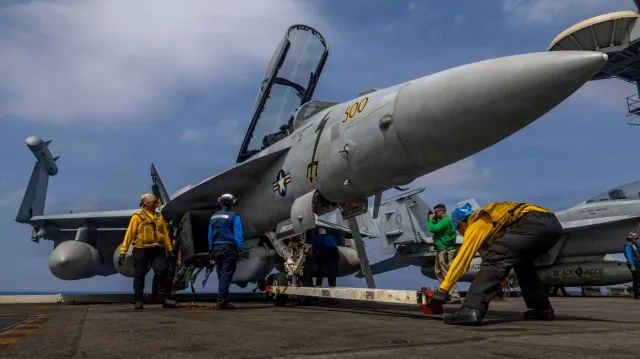
At least 16 aircraft have been shot down or crashed, including 10 Reaper drones, three F-15s and a KC-135 tanker, Bloomberg reported. Five other KC-135s were reportedly damaged by an Iranian missile strike on an airfield in Saudi Arabia, and an American F-35 fighter jet was forced to make an emergency landing after a combat mission on Thursday in the Middle East.
In contrast, during the 2011 U.S. military intervention in Libya, another large-scale air campaign, there were just three reported combat losses over four months.
A Reaper can cost upwards of $56.5 million apiece; F-15s can go for $90 million to $97 million; KC-135s are worth $70 million to $80 million. The F-35 is the most costly, coming in at $90 million to $100 million per plane.
U.S. forces are also experiencing wear and tear on their ships, with the largest aircraft carrier, the USS Gerald R. Ford, arriving in Crete, Greece, on Monday for repairs after a March 12 fire onboard injured two sailors and damaged some 100 beds. The ship was also reportedly having issues with its toilet system.
"We saw last year that about a quarter of the Navy's deployed service fleet went to the Western Hemisphere for Venezuela operations, and now I'm seeing numbers of over 40 percent of deployed Navy ships for Iran operations. That stuff takes a toll. It's wear and tear," Jones said.
"We see that with what's happened to the Gerald Ford -- the fire in the main laundry room -- and some of the other maintenance problems that have led to the emergency creep," he added.
Washington's munitions stockpiles also have taken a hit, with shortages in precision, high-end munitions and interceptors becoming more likely the longer the war continues.
American forces are expending a significant amount of Terminal High Altitude Area Defense and Patriot interceptors, the Advanced Medium-Range Air-to-Air Missile, Tomahawks and ship-launched missiles.
Trump in early March insisted that U.S. munitions stockpiles of medium- and upper-medium-grade weapons have "never been higher or better," and that he was told the armed forces "have a virtually unlimited supply of these weapons."
Katherine Thompson, a former Trump administration official and now a senior fellow at the Cato Institute>, was skeptical of these claims, telling The Hill: "I would be most curious to understand what the definition they're using in terms of what stockpiles they're talking about because I think that context matters."
She added that depleted munitions stockpiles are one of the most significant long-term effects of the war given that such weaponry cannot quickly be replaced. Washington's weapons cache already took a hit during the Biden administration when the U.S. sent billions of dollars' worth of lethal aid to help Ukraine in its war with Russia.
"The Trump administration unfortunately inherited a really crappy situation when it comes to the state of our munitions stockpiles and just overall U.S. readiness to engage in a conflict like Iran or even to do any of the other priorities that the Trump administration has stated are top of mind for them," Thompson said.
"But then we took the step of entering this war of choice and knowing the risks on our stockpiles and munitions writ large and knowing what we would have to do to defend the region and also not having solved the replenishment problems."
That could spell trouble should the U.S. get drawn into another conflict, with China, for example, should Beijing make good on its threats and look to take Taiwan while Washington is otherwise occupied in Iran.
"I'm very concerned that because of the choices we've made ... that we would be prepared to back up a deterrence by denial or to win in the event that we got drawn into conflict over Taiwan if the Chinese decide to make a move here," Thompson said.