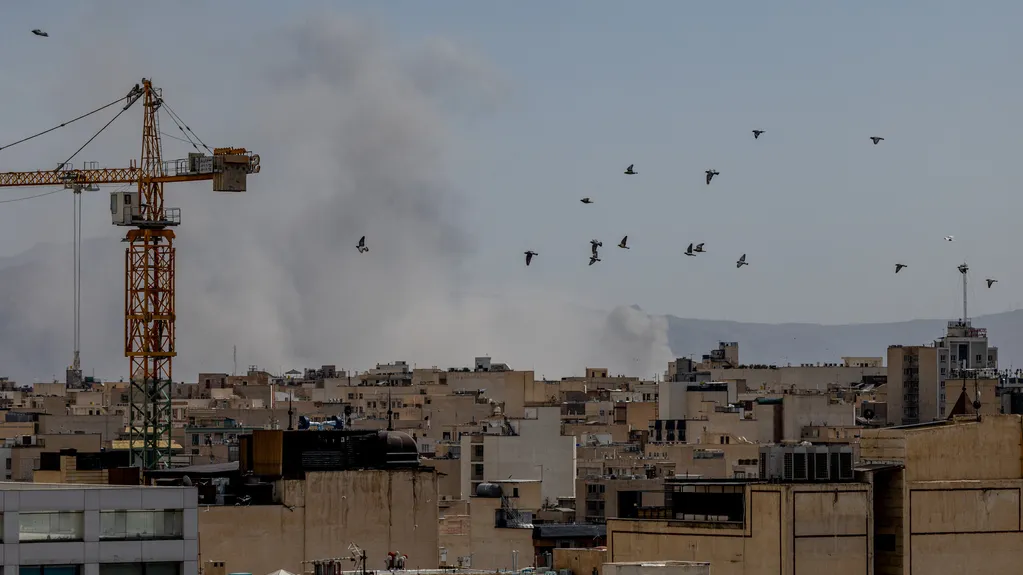
The United States and Israel attacked Iran on Feb. 28, starting a weekslong war that spread to neighboring countries and rocked global markets.
The U.S.-Israeli war with Iran raged for more than five weeks before a cease-fire was announced on the 39th day. It was the second time in less than a year that President Trump directly involved the United States in a military conflict with Tehran.
Cast by Mr. Trump in part as an effort to spur Iranians to topple their theocratic leadership, the conflict soon became a regional war that resulted in thousands of deaths, mostly in Iran and Lebanon. Hundreds of thousands of people have been forced from their homes, and the global economy has been badly rattled.
Here are some key moments in the war:
Feb. 28: The United States and Israel launched strikes across Iran, hitting a government compound in Tehran and military targets. The blasts killed Ayatollah Ali Khamenei, the nation's supreme leader for almost 37 years, as well as other high-level military and intelligence leaders.
At least 175 people, most of them likely children, were killed in a strike on a girls' elementary school in southern Iran, health officials and Iranian state media said. The strike was a targeting mistake by the U.S. military, according to U.S. officials familiar with a military investigation.
Iran retaliated by firing missiles and drones at Israel and at U.S. military bases in the region, including in Qatar, Kuwait and the United Arab Emirates.
March 1: An Iranian drone attack killed six U.S. soldiers in Port Shuaiba, Kuwait, the first Americans to die in the war.
Hezbollah, an Iran-backed militant group, dragged Lebanon into the conflict, firing rockets toward Israel in retaliation for the killing of Iran's supreme leader.
In a brief telephone interview with The New York Times, Mr. Trump offered several seemingly contradictory visions of how a new government could take shape in Iran and how the conflict would unfold. Asked how long the United States and Israel intended to sustain its assault on Iran, Mr. Trump said "four to five weeks."
March 8: With several top Iranian leaders killed in airstrikes, Iran named Mojtaba Khamenei, a son of the slain supreme leader, as his father's successor. Mr. Khamenei, 56, was appointed by a committee of senior Shiite clerics, signaling continuity and defiance after Mr. Trump called him an "unacceptable" choice. But it would be several days before Iran would hear from its new supreme leader, who U.S. officials said had been injured in the war's initial days.
March 11: Iran escalated its attacks in and around the Strait of Hormuz, through which passes a significant portion of the world's oil and natural gas supply, striking at least three ships, according to a British maritime agency. Iran claimed responsibility for one assault on a bulk carrier from Thailand. The attacks sent oil prices surging and the Trump administration scrambling to pacify global markets.
March 12: Mojtaba Khamenei issued his first written statement as supreme leader, directing the military to continue choking off the Strait of Hormuz.
Six American crew members died after a KC-135 military refueling aircraft crashed in Iraq, bringing the number of U.S. service members killed in the war to at least 13.
March 13: The U.S. military conducted a large bombing raid on Kharg Island, Iran's main oil export hub. Mr. Trump said the raid had targeted military infrastructure but did not hit oil facilities on the island, which is responsible for about 90 percent of Iran's oil exports.
March 17: The Israeli military killed two of Iran's top leaders: Ali Larijani, the head of the country's National Security Council, and Gholamreza Soleimani, the head of the Basij, a militia aligned with the Islamic Revolutionary Guards Corps. The deaths represented the biggest blows to Iran's leadership since Feb. 28.
March 18: Iran and U.S. allies traded attacks on key energy infrastructure in the Gulf. Israel attacked Iran's South Pars gas field, which accounts for about 70 to 75 percent of its natural gas production. Qatar, a U.S. ally, said Iran had struck its Ras Laffan Industrial City, which is the world's largest liquefied natural gas export plant.
March 23: Mr. Trump said that the United States and Iran were discussing an end to the war. It was the first public indication of diplomatic talks since the war began.
March 27: An Iranian strike injured 12 U.S. troops in Saudi Arabia on the Prince Sultan Air Base, one of the most serious breaches of U.S. air defenses since the start of the war.
March 28: The Houthis, an Iran-backed militant group in Yemen, joined the war by launching a ballistic missile at Israel that was intercepted.
April 3: Iran shot down a U.S. Air Force F-15E fighter jet carrying two crew members, one of whom was recovered safely that day. The risky search-and-rescue operation for the second airman lasted two days and took commandos deep inside Iran. The downing of the F-15E was the first time that a U.S. combat aircraft was shot down in the war.
April 7: Mr. Trump announced a two-week cease-fire with Iran. Iran's national security council confirmed the agreement, casting it as a victory.