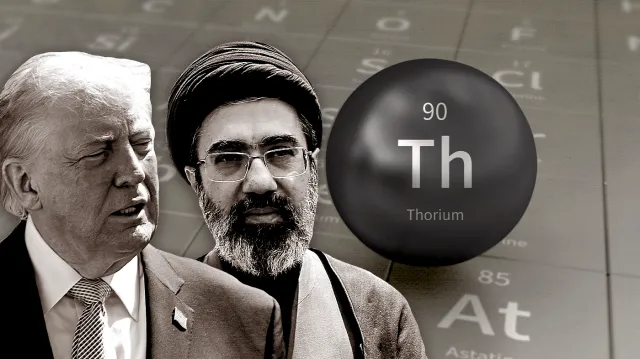
Iran's Supreme Leader Ayatollah Mojtaba Khamenei is facing critical medical conditions after surviving a bomb attack that left him awaiting a prosthetic leg and facial plastic surgery, according to a Thursday New York Times report.
Mentally, Khamenei is still capable of comprehending communications and making decisions, but he's already been subject to a surgery on his hand and severe facial burns that will cause him to get additional surgical procedures, the outlet reported.
Four officials familiar with the matter confirmed Khamenei's condition to The New York Times and noted has had very little contact with Iranian generals amid negotiations to end the war. The report confirms Defense Secretary Pete Hegseth's March evaluation that the leader was "wounded" and likely "disfigured."
The youngest son of former Supreme Leader Ayatollah Ali Khamanei was elected to serve as Iran's highest-ranking leader following the death of his father and wife in U.S.-Israeli strikes on Iran.
"Mojtaba is not yet in full command or control," Sanam Vakil, the director of the Middle East and North Africa for international affairs think tank Chatham House, told The New York Times.
"There is, perhaps, deference to him. He signs off or he is part of the decision-making structure in a formal way. But he is presented with fait accompli presentations right now," Vakil added.
All correspondence commences in hand-to-hand sealed letter transfers to the supreme leader's location and delivered back out via the same form, per The New York Times.
Iranian officials maintain that Khamenei has a say in decisions, but some have noted that his leadership has been weakened by his physical condition.
"Mojtaba is not supreme; he might be leader in name, but he is not supreme the way his father was," Ali Vaez, the Iran director of the International Crisis Group who has extensive contacts in Iran, said in an interview with the Times.
"Mojtaba is subservient to the Revolutionary Guards because he owes his position and he owes the survival of the system to them," Vaez continued.
Iran's President Masoud Pezeshkian, Foreign Minister Abbas Araghchi and Speaker of Parliament Mohammad Bagher Qalibaf have served as the country's face and chief negotiators amid Khamanei's retreat.
The supreme leader has not made any verbal public statements out of fear of appearing weak, the Times reported.
"Mojtaba is managing the country as though he is the director of the board. He relies heavily on the advice and guidance of the board members, and they collectively make all decisions," Abdolreza Davari, a former senior adviser to former Iranian President Mahmoud Ahmadinejad and person familiar with Khamenei, told the Times.
"The generals are the board members."
Trump has refused to recognize the youngest Khamenei as Iran's new leader and said the country must elect or appoint someone the U.S. approves of.
Right now, an indefinite ceasefire is in place as both Tehran and leaders in Washington, D.C., evaluate the best path toward ending the war and reopening the Strait of Hormuz.