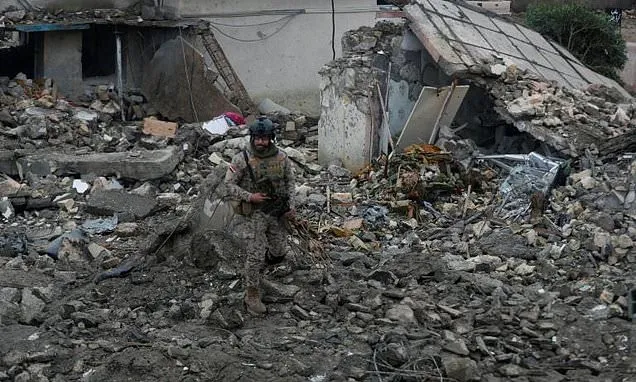
Hunched against the cold and drizzle, Iraqi army medic Ahmed and two colleagues looked across the wreckage that just days ago was their clinic, now rubble after a strike on Wednesday.
"We're the only ones left of the medical unit," he said, his voice breaking with grief.
"They were all either killed or wounded."
Iraq has been drawn into the war sparked by US and Israeli strikes against Iran on February 28, which has since engulfed much of the region.
The country is having to weather both strikes targeting US interests on its soil and also attacks on pro-Iran groups.
On Wednesday, strikes targeting the Habbaniyah base in western Anbar province killed seven military personnel, the defence ministry said.
Afterwards, Baghdad said the incident undermined "ties between the peoples of Iraq and the United States", but without directly blaming the United States for the attack.
A State Department spokesperson contacted by AFP strongly denied US strikes had targeted Iraqi security forces.
However, the former paramilitary Popular Mobilisation Forces, now part of the regular army, has condemned US strikes on PMF positions. The group's base nearby was targeted earlier in the week, killing 15 people.
Ahmed, who gave only his first name, said several of his friends were trapped under the debris after Wednesday's strike in Habbaniyah, some 70 kilometres (40 miles) from Baghdad.
"We tried to rescue them from under the rubble... but the pilot returned and targeted us directly," he said.
"The medics and those who came to rescue the trapped were killed."
The site was known to be a base hosting the Iraqi army, military commanders on the ground told AFP during a media tour.
Another soldier, who gave only his first name as Ali, said the following day there was little to recover from what had once been a thriving clinic.
The force of the first strike was so strong it "melted everything", Ali said.
"We even found pistols that had turned into lumps of molten metal from the intense heat."
- 'Sacrifice' -
From western Iraq to the country's northern autonomous Kurdistan region, families mourned.
On Tuesday, an Iranian strike killed six peshmerga soldiers near the border with Iran in the first deadly attack on the Kurdish regional force since the war began.
At their funeral, attended by the leaders of the autonomous region, the men gathered wearing traditional keffiyehs and draped Kurdish trousers to pay their respects.
Before portraits of the six projected onto a large screen and framed by white flower bouquets, mourners recited a prayer for the dead. In a separate room, black-clad women wept.
Fatima Muzafar, 24, cried for her 21-year-old brother Kaywan, a peshmerga member for three years.
"When we went to the hospital, we were hoping he'd only been wounded,"
she said, her voice hoarse.
At the family home, she showed AFP photographs of her younger brother on his wedding day, while in another room her father Muzafar Qader mourned the loss of his son.
Tissue balled in his hands, he said he spoke to Kaywan by phone immediately after the first missile strike. But then just seconds later, a second missile hit.
"I tried to call him back, but the phone was disconnected."
Retired peshmerga Muzafar said he was left partly paralysed after fighting the jihadist Islamic State group (IS). Before that he had fought in the 1980s against Saddam Hussein's regime.
"Now my son has fallen to an Iranian missile strike. Our family has a long history of sacrifice for this land,"
Muzafar said.