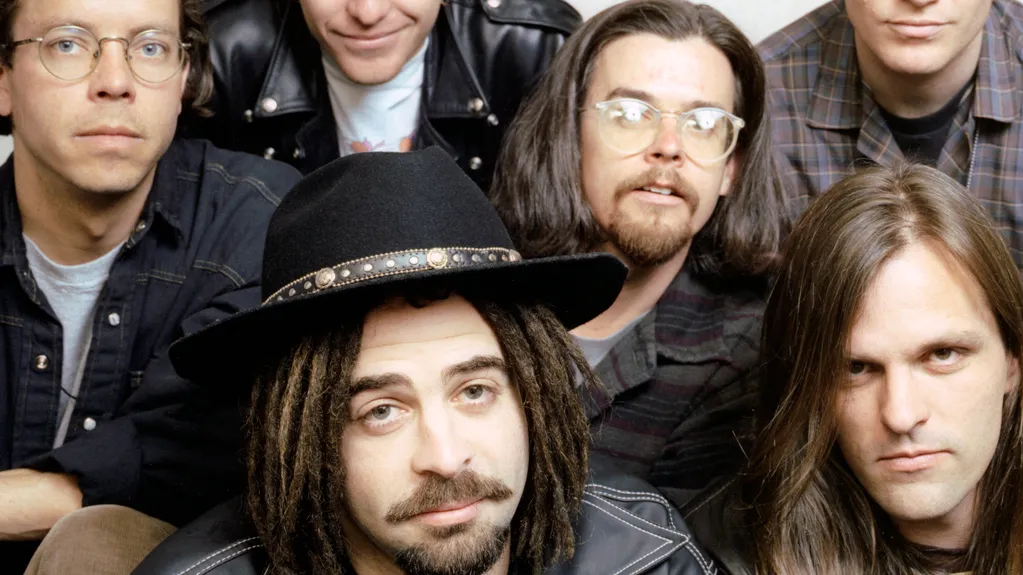
Stagecoach Festival started out as the "country Coachella," but has been morphing into a new home for '90s rock bands slinging angst and guitar music.
By sheer numbers, Blockbuster Rock Fest was one of the biggest musical events of the 1990s. On the first day of summer in 1997, more than 350,000 people packed into the Texas Motor Speedway in Fort Worth to see a dozen bands, among them Counting Crows, Bush, the Wallflowers and Third Eye Blind. Those groups were all multiplatinum staples of alternative rock radio and MTV, which, you'll have to take it as an article of faith, were things that not only existed but actually drove the culture.
Nearly 30 years later, those four bands will be back together on the same concert bill. But it won't be at a show celebrating the days when alt-rock ruled the land. Instead, songs like "Mr. Jones," "Glycerine" and "Semi-Charmed Life" will be performed this weekend at Stagecoach Festival. Initially started as the "country Coachella" in 2007 (it takes place on the same California grounds, has the same promoter and happens the weekend after the original), Stagecoach has morphed into something broader.
The biggest fonts on its poster are still reserved for country hitmakers and hat-wearers like Lainey Wilson, Cody Johnson and Riley Green, but the presence of the Clinton-era throwback acts is more of a strategy than a novelty. If Coachella is the event where the pop A-list congregates, and headline sets are either multi-sensory spectacles or computer-driven chill sessions, then Stagecoach is the catchall of everything else -- a place where, crucially, the guitar isn't an endangered species.
"I think country music today and a lot of the '90s alt-rock definitely have a kinship," Darius Rucker said.
There's perhaps nobody better suited to talk about this crossover than Rucker, the Hootie and the Blowfish frontman who went on to become one of the biggest stars in country music following his band's hugely successful '90s run. Rucker has played Stagecoach three times as a solo act; 2026 will mark Hootie's debut.
"There's no rock 'n' roll in pop music anymore," Rucker said. "It's not driven by guitar, it's not driven by angst. People that were big into that in the '90s are now bigger into country music."
For those reasons, the minor infiltration of bands that were his rock radio peers 30 years ago doesn't surprise him. "You look at the lineup and you don't go, 'That's crazy.' It makes sense," he said. "It's the aesthetics of the mood, the music, and maybe the way it makes you feel."
Bobby Bones, the host of a nationally syndicated country music radio show, has been watching this trend play out in recent years. "You look at artists and what they cover now -- Mitchell Tenpenny did a Goo Goo Dolls song. John Pardi did a Counting Crows song. So when they're picking songs, it tends to fall back into that area, that '90s rock-ish type vibe," he said. "It basically was an early version of this country music now."
A glance at the Stagecoach lineup supports that idea. While there are still plenty of artists with a traditional country sound, and others working in the runoff of the dominant bro-country trend of a generation ago, the likes of Bailey Zimmerman and Wyatt Flores (both born in the 2000s and representing a younger generation of artists) have songs that would sound perfectly in place following Bush or Counting Crows.
Another performer who sits at the center of the country/alternative Venn diagram is Stephen Wilson Jr. The 46-year-old songwriter grew up in the '90s when country music was experiencing a boom period parallel to the rock one of the same era. Except for Wilson it wasn't parallel, but intersecting. "I remember hearing 'Don't Take the Girl' by Tim McGraw and it destroying me," Wilson said. "Immediately after, I put on a Soundgarden record. There were two horses in the race. I was listening to just as much country music as I was rock 'n' roll music, grunge music."
Bones says growing up with country music in the '90s also meant you consumed rock music because of its ubiquitous nature at the time. "But if you were rock first, you didn't get country," he added.
Wilson's "Blankets" EP from last year featured covers of songs by the '90s tone setters Nirvana, Smashing Pumpkins and Temple of the Dog. Nirvana's "Something in the Way" is a standard part of his set list, and he says it's a regular highlight.
"I think people are looking for something real in the same way that people were looking for something real in the '90s," Wilson added.
The idea of "something real" also plays to a mythos that's forever been at the core of country music's appeal. Presenting itself as a genre of authenticity is key to its messaging -- and one that has sometimes become a punchline as it's delivered through song after song about trucks and cold beers. So you can debate whether bands that found success through major labels and MTV exposure in the '90s are avatars of authenticity, but the decade itself does represent a more artistically pure era.
Perhaps just as importantly, those bands existed at the tail end of a monoculture that seems ever more distant. "Those songs were just part of the fabric of America," Rucker said. "Everybody knew them. Even if you didn't listen to that style of music, you knew that song."
So if you're asking people to potentially spend thousands of dollars and travel thousands of miles to stand in the California desert, then you had better serve them some hits.
"And all those bands that are playing," Bones said,"they got a bunch of freaking songs that people can sing along to."