This article is part of our Design special section about buildings, objects and techniques that are fighting to stay alive.
Built in the shadow of an active volcano, Naples is a city where life explodes into the streets. Locals banter in the boisterous Neapolitan dialect, mopeds zigzag through crowds and vendors summon shoppers to stands heaped with Mediterranean bounty. Announcing the clementines, artichokes and other goods on offer are cheerful, hand-painted signs in sun-bright lettering.
Quotidian but also quintessential, the signs have become emblems of Naples's vibrancy. Yet like so many traditions here, they are at risk of vanishing, or of being turned into tourist kitsch.
Pasquale De Stefano is, by consensus, the last living numeraio -- or number painter -- in Naples. Two of his brothers practiced the craft, as did their father and grandfather, along with members of several other Neapolitan families. Now, Mr. De Stefano, 77, is upholding the tradition on his own.
The numeraio's trade emerged in the late 1800s, a time of mass illiteracy, when most vegetable sellers struggled to write placards advertising their produce. Instead, they hired itinerant sign painters who invented an attention-grabbing style of primary colors and fat, serif lettering with drop shadows. Carrying their brushes and paints in baskets to markets, the painters executed signs on the spot.
"Even the most humble Neapolitans -- even the fruit vendors -- refuse to forgo beauty, embracing ornament above mere function," said Marino Niola, a cultural anthropologist. "Naples is, after all, a baroque city."
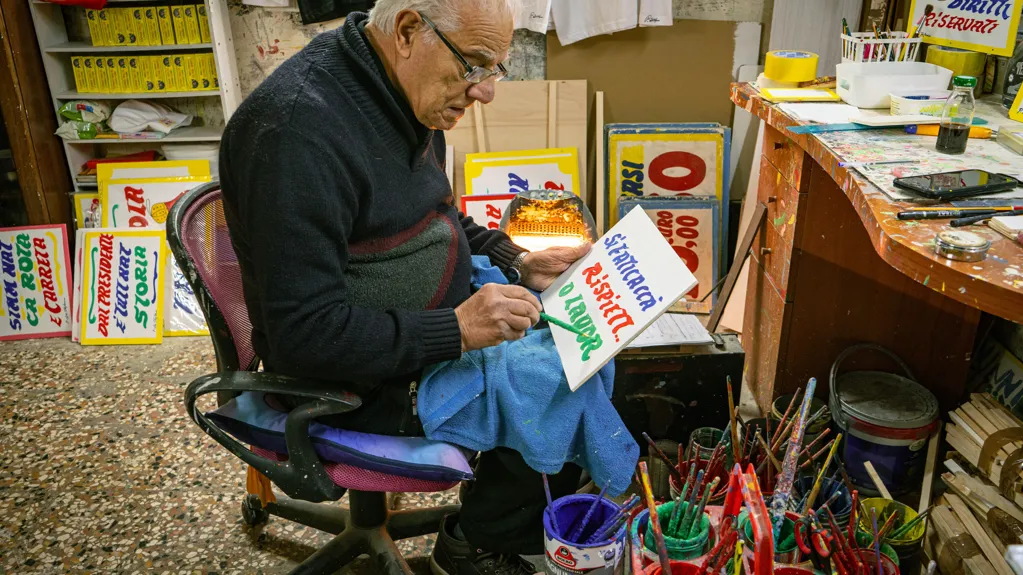
Mr. De Stefano paints in the same bare-bones and now crumbling workshop once used by his father and grandfather. It is a basso, one of Naples's ground-floor, windowless dwellings. As a child, he lived in the cramped space, sharing it with his parents and six siblings.
"People today don't have the patience this kind of work demands," he said to a visitor, as he sat hunched in a battered, low-slung office chair. Steadying a wooden signboard on his drawn-up knees without a table or easel, he penciled in guidelines and words, then painted swift, sure-handed letters in rhythmic strokes of blue paint, adding ornaments, curlicues and vivid-colored borders.
His message, written in Neapolitan dialect, said, WORK DOESN'T GET ENOUGH RESPECT HERE.
Under the fluorescent tube lights, splattered paint and pigment-stained fingerprints coated every surface, even his own clothes. The workshop contained tributes, including a doll in the artist's likeness and a note from the actor James Franco, who Mr. De Stefano said would stop by to share pizza while he was filming in the neighborhood.
"PASQUALE," the actor wrote, "YOU ARE A GREAT ARTIST."
The rest of the space was jammed with painted merchandise -- placards still bearing prices in Italian lire (a currency last used in 2002), T-shirts emblazoned with catchphrases, key chains, mugs, magnets, tambourines, calendars and perhaps hundreds of signs. Signs in Neapolitan; signs in Italian; signs quoting the city's comic legend Totò; its folk-hero singer Pino Daniele; and frustrated parents everywhere: WE'RE EATING SO PUT DOWN YOUR PHONE, said one in dialect. All of it was lettered in Mr. De Stefano's rotund writing.
It's modest, poorly paid work, he said, but in recent years he has gained unexpected recognition. A grandson created an Instagram account to showcase his wares, at a moment when appreciation has been growing for Naples and its symbols. As visitors stream into the city today, tour groups flock to his workshop to watch him paint and buy his knickknacks.
"Everybody used to think we were all thieves in Naples," Mr. De Stefano said, outlining a painted chile in marker. "Now they've understood there are decent people here, and we take pride in what we do."
As in many European cities, Naples's attractions are a double-edged sword. Having endured a 500 percent increase in tourism in the past decade, the locals are decrying the crowds, the proliferation of short-term rentals in residential areas and the city's distillation into shallow stereotypes packaged for visitors. Its main streets are overrun with tourist-friendly pizza stands, spritz bars and souvenir shops, while longstanding workshops that make artisanal gloves, umbrellas and men's ties are disappearing.
Yet tourism has also brought economic opportunities. "Today, there's a much better atmosphere for everyone," Mr. De Stefano said. He is in the rare position of benefiting from the new world order while standing up for the old one: a symbol of Naples's resistance to globalized homogenization, as well as the producer of appealing mementos.
Mr. De Stefano began painting at 8; seven decades on, he is still going strong even after a stroke. "Work does a person good. It keeps you young," he said, dipping a brush into a repurposed jar filled with tempera paint. "It's too early to retire."
In 2018, two art school students, Alessandro Latela and Gianluca Ciancaglini, published the first formal study of Mr. De Stefano and the numeraio tradition.
"Back then," Mr. Latela said, "the cultural fabric of Naples wasn't getting much attention, and the signs weren't yet recognized for their aesthetic value."
Inspired by Pop Art's elevation of everyday cultural symbols, the authors and a third designer, Emilio La Mura, created a standardized, computer-made font named Pasquale in homage to the numeraio -- a gesture that was "misunderstood," Mr. Latela said. Mr. De Stefano’s family contested the book and the font, fearing that they would be mistaken for his own work, and the projects were pulled from distribution. The designers later developed a new font, Tonino, drawing on historical Neapolitan signs for the lettering on plates, menus and more at the famed pizzeria Concettina ai Tre Santi.
For now, Mr. De Stefano’s rainbow-hued placards remain as much a part of Naples’s streetscape as its ubiquitous corner-side saint shrines.
Along Via Vergini in the Sanità neighborhood, market stands sell vegetables and fruits, or nylon tracksuits and knockoff “Di♥r” slippers, all labeled with his signs. At Romeofruit, established in 1940, Ciro Romeo said that he carries on the family practice of purchasing numeraio signs by the dozen from Mr. De Stefano, just as his father and grandfather did with previous generations of sign-painting artists.
“To have someone’s craftsmanship here is important,“ Mr. Romeo said, winking at a customer as he handed over artichokes. “Maybe it doesn’t matter to the clients, but for us vendors, keeping these traditions alive is part of doing our work properly.”
The famed pizzerias lining Via dei Tribunali are plastered with Mr. De Stefano’s jauntily painted signs: CUOPPO NAPOLETANO, LA MARGHERITA, FRIED PIZZA HERE -- but many hang beside digitally-printed modern banners.
The popular street is already shoulder-to-shoulder with visitors; yet tourists will continue multiplying while Mr. De Stefano is likely the last of his kind.
And if Naples loses these colorful signs?
“Everything will turn plastic and artificial,” he said. “Poetry lives in what’s made by hand.”