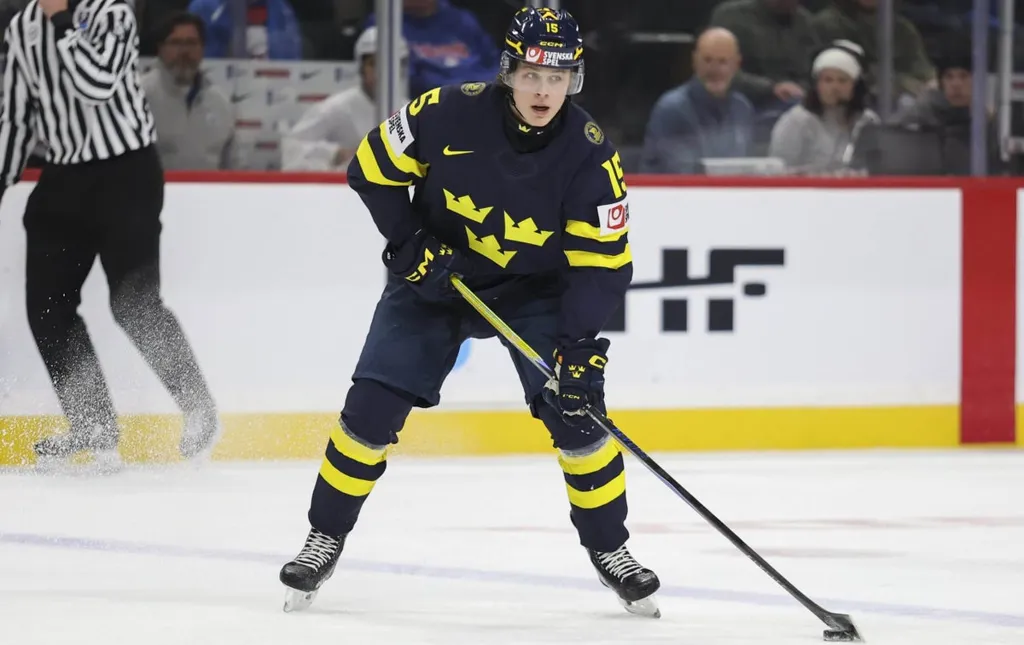
ST. PAUL, Minn. -- Frölunda general manager Fredrik Sjöström can only call what Ivar Stenberg has done in the SHL with his team this year "hugely impressive."
"Obviously, we were well aware of his talents before the season started, but it's one thing to think it and one thing to actually do it, and I don't know if I should say it's been above expectations, but you just never really know until you see it," Sjostrom told The Athletic. "It has been fun to watch."
The numbers speak for themselves. When he departed Gothenburg for Minnesota to play for Sweden at the World Juniors, the 18-year-old winger was his team's leading scorer with 24 points (six goals, 18 assists) in 25 games and a plus-13 rating.
In the same number of games, that's nine points clear of the nearest U19 skater in the league, Anton Frondell, who was just taken third in the 2025 NHL Draft. If Stenberg's near-point-per-game production holds, it'll go down in history as one of the -- if not the -- best age-adjusted seasons ever at Sweden's top professional level, placing him in a pantheon with just one name: Markus Naslund. He's producing at a higher clip than Peter Forsberg and the Sedins did in their post-draft seasons. In a more recent context, he's already just one point shy of passing the 25 points that 2023 No. 2 pick Leo Carlsson (who, like Stenberg, was a late birthday) registered in his draft year, and he has played 19 fewer games to date.
From a purely statistical standpoint, if Frondell and Carlsson both went top three, Stenberg belongs right at the top of the draft.
But if it's going to be No. 1, his play for Sweden in the Twin Cities could make the difference. Entering the World Juniors, NHL scouts remained unconvinced by both Stenberg and Canada's Gavin McKenna, the preseason front-runner, as the top player in the class.
Stenberg opened his tournament with an assist on Sweden's first goal and the late Boxing Day game-winner in a 3-2 win over Slovakia, and added a third point on an empty-net assist against Switzerland. On Monday, Stenberg didn't register a point against Germany, but he drew two penalties, both of which led to Sweden goals by the other power-play unit, and hit a crossbar. Across three games, he has also missed three backdoor tap-ins (two against Switzerland and one against Germany), banging his stick at the bench in frustration after the third because he knows he still has more to give -- and that three points in three games isn't up to his standard.
"In Frölunda, I really like the way I've played. But in the national team, I can be better. I don't think I've created as much as I can. It's tough to go down tempo, but it'll get better the longer the tournament goes. It'll come. I know it," he said.
Sweden's head coach, Magnus Havelid, knows it's coming as well.
"It will get better and better. He's getting used to this kind of hockey again as well," Havelid said on Sunday. "It's different than the SHL and with the smaller surface and the chemistry in the unit. I'm sure he will be better. He's working hard. It's only a matter of time."
Some of the names that have been thrown around with Stenberg's can make your head spin.
He likes to compare himself to Tim Stützle, whose combination of playmaking, shooting and skating he thinks mirrors his own.
In Sweden, Sjöstrom says Nicklas Backstrom’s name has been thrown out there a lot because they have the “same type of smartness.” But Sjöstrom thinks Backstrom was more of a pass-first guy and that Ivar “also has a lethal shot and can be a big-time goal scorer as well.”
Frölunda’s head coach, Robert Ohlsson, uses Henrik Zetterberg and Mats Naslund.
Naslund for the way he reads the game.
“The way he sees the ice, his vision on the ice, and his decision-making from that is what stands out most about him. He’s real top quality the way he sees the ice,” Ohlsson said on a recent phone call. “I’m up to 20 years now, and I haven’t had many or any players in my coaching career who can really read and see the ice like that kid.”
And Zetterberg for that sense and the balance he has on his skates for a 5-foot-11, 183-pound player.
“Even if he’s a little bit smaller, he’s always in good balance in battles because he can anticipate where everybody is at and is going—even when it’s really, really tight in the corners and stuff like that. He’s always ready to find those small things,” Ohlsson said. “Zetterberg had that balance on the ice,and he was really good on seeing the ice,and I think Ivar has that as well.”
Coming into this year,Ohlsson didn’t want to set his expectations too high for Stenberg。但当他去年第一次看到他为Frölunda的U20青年队比赛时,他记得自己想过:“哦,这真是特别。这是一些不常见的东西。”
“我一眼就能看出你在看他打的比赛和他做出的一些决定和动作。但我不知道他在男子比赛中会这么出色。你永远不知道年轻球员会怎样,但伊瓦真的能和男子队一起打球,”奥尔松笑着说,似乎在低估这一点。“我可以这么说!”
Stenberg’s standout trait is how he controls the pace of the game when he has the puck. Sjostrom talks about him almost as a puppeteer who pulls the strings of his opponents with his hockey sense.
“He’s not the fastest guy — and he’s not slow — or the strongest guy, but he plays in his own rhythm, and I think it’s pretty impressive as a young kid like that playing men’s hockey in a very good league in Europe,” Sjöstrom said. “He just seems to have so much time. (He’s) never in a hurry making plays,and我认为这就是他作为球员在冰上的最大属性。”
He’s got that same aura about him off the ice,according to both Sjöstrom和Ohlsson。
“他是个很酷的家伙,”Sjöstrom说。“他似乎从不紧张,一切都保持平稳。这很令人印象深刻。我的意思是,看看本赛季到目前为止他在场外的表现。这简直是无休止的记者和电视。他似乎对此处之泰然,并且不会感到困扰,也不会让它冲昏他的头脑。他在球队中受到所有老队员的喜爱,并且并不显得傲慢或其他什么。”
That calmness about him shouldn't be construed as a lack of competitiveness, though, either, they both insist.
"He's an easygoing guy, a happy guy, and socially real good. People like to hang with him, and he can hang with everybody. He smiles in his eyes and not only with his face, too; which I think is a good quality. (But) he's also really ambitious and driven," Ohlsson said.
Ohlsson only has one gripe.
On and off the ice,Stenberg从未看起来像他所承受的压力。
选秀?
“我没有任何期望,”他在赛季开始前告诉《体育新闻》。“我不能考虑这个。发生什么就发生什么。我期待着为自己创造好事。”
部分原因在于他一直遵循着哥哥(蓝调前锋奥托)和父亲(瑞典前职业球员)为他树立的榜样;部分原因在于他希望为弟弟克努特(16岁,弗罗伦达U18队后卫)树立同样的榜样。
他很高兴地说自己崇拜哥哥。他们一直一起做所有事情。他们在家里的后院冰场上长大,他的竞争意识源于他们之间的许多“大战”。他们夏天一起打球、滑冰、训练和闲逛。他们都从瑞典西海岸的斯滕松德故乡出发,走上了通往哥德堡弗罗伦达的同一路径。
他也很高兴地说自己想比哥哥更优秀。
“我会说我更有天赋,而他更重,更好射门。我更具进攻性,”他说。“我认为我的射门还不错,滑冰和冰球智商都很好。我能看出并做出战术安排。”
Ivar现在独自住在哥德堡的一间公寓里,距离家约40分钟。
当他第一次被邀请参加国家队并上冰时,他开始意识到自己的实力,因为他仍然觉得自己是最好的球员之一。他小时候是一名不错的足球运动员,但由于膝盖问题转而全职打冰球(别担心,他说“那是很久以前的事了,现在没事了”)。
在弗罗伦达,他在过去几年里努力提高自己的板边技术,将自己在墙边进行杆 lift、抢断和保护 puck 的能力转化为自己比赛的真实特征。
“他很出色,”哈维利德说,用的是斯约斯特伦同样的词。“他能打好比赛。他竞争激烈,射门不错,对自己在场上的表现负责,看得懂比赛,不会给自己施加压力。”