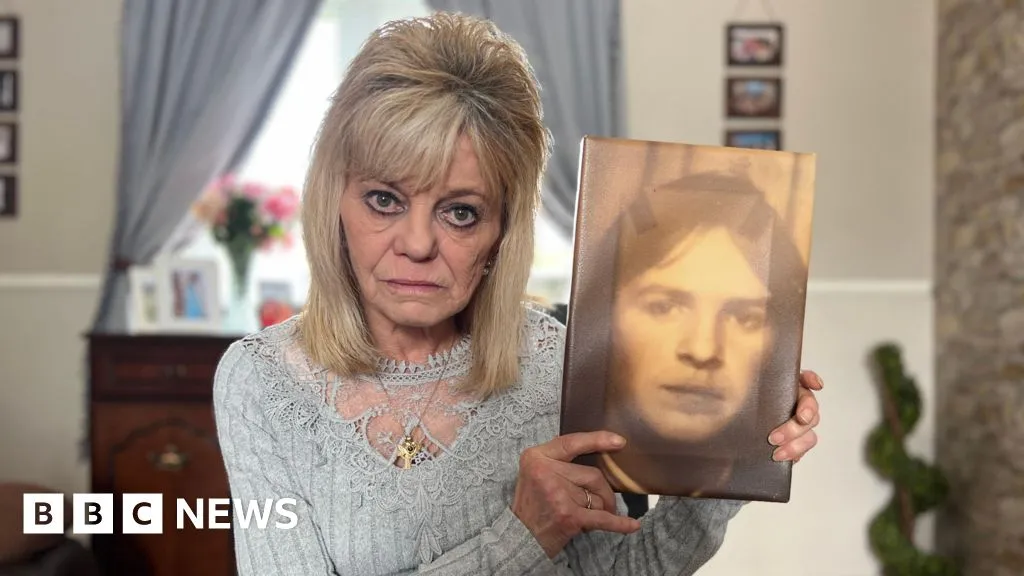
Families whose loved ones have gone missing without explanation, sometimes decades ago, may finally be closer to getting some answers. A taskforce of 250 volunteers, working with coroners and the police, has been set up to investigate hundreds of cold cases, piecing together unidentified human remains that have been found with evidence from bereaved families and information from international DNA databases.
"In memory of Some Mother's Son."
The words are carved into a headstone marking the grave of a young man, whose remains were found on a Cornish clifftop more than 40 years ago.
His identity has never been confirmed.
The case is now one of hundreds being reviewed as part of a pilot project involving a charity, Devon and Cornwall Police and the coroner's service to give names back to the unidentified.
There have been leads regarding the clifftop body in the past, including Tommy Jones who disappeared at sea in 1975 - but investigations revealed it not be him.
His sister Helen Clark, from Somerset, is left as one of those still asking questions, and hoping the Operation Locate project will help to find some answers.
Clark says she will never be able to lose the pain of not knowing what happened to him.
"I've got no peace. Tommy's got no peace," she says.
It was farmer Dave Matthews who found the skeletal remains of a man who became known as Some Mother's Son while cutting gorse near Tregantle Fort in Cornwall in 1982.
"I thought it was a football, but then found out it was a skull when I got off the tractor and looked at it," he says.
Standing on the same blustery clifftop more than 40 years later, he says: “I have quite often thought about it but it was never found out who he was or what he was doing there.”
The remains were found in dense undergrowth and Matthews said at the time he could not see how anyone could have reached the spot “within the last two or three years without literally forcing their way in”.
The police were called and an investigation began.
Former PC Paul Roper was the first on the scene and worked on the case.
“I’d like to think we did everything we possibly could at that time, with the information and with the technology we had.”
Near the body were personal items - a rucksack, coins, including one dated 1977, fragments of a Sun newspaper from 1978.
There were also pieces of a passport and a Merchant Navy discharge book.
The documents were badly degraded but the issue date on the passport was legible.
Roper and his colleagues spent two days at the passport office in Newport, Wales producing 12,000 names.
They managed to narrow the list of possible matches to just 23 but “it dried up there and we couldn’t go any further,” he says.
In October 1983, the Cornwall coroner recorded an open verdict and the man's remains were buried in nearby Torpoint.
Roper says a local pub landlord raised money for the headstone and chose the words to place on it: “It’s quite... poignant that those words were chosen because it was some mother’s son.”
Locate International will review 200 missing person cases and 34 involving unidentified remains across Devon and Cornwall where police still hold files, in a project called Operation Locate.
For former detective Dave Grimstead, who founded the charity, the work is personal.
“I still remember those cases that I never solved and I know people are still working on those cases now, decades later,” he says.
“If we can provide that specialist support at no cost... that’s where we’ll make a difference.”
Where records no longer exist, such as with Some Mother's Son, Grimstead says the only option is to rebuild the investigation from scratch.
He has already requested access to passport records linked to that case.
It was an independent researcher, Simon Owens, from Torpoint, who prompted the project team to reinvestigate the case.
Owens started posting appeals online after coming across the grave.
"People tried their very best at the time to identify him but now we have so much more of an opportunity," he says.
One of his social media appeals led to a new line of inquiry, and that was in regard to Tommy Jones.
Jones was 18 and working as a Merchant Navy chef when he went overboard on the Northern Star cruise liner in the English Channel in 1975.
The alarm was raised immediately and two other ships joined the search but he was never found.
Despite the search and an inquiry that concluded he was "lost at sea believed killed or drowned", Jones' name does not appear on official missing persons' databases.
His sister Helen Clark, from Yeovil, says he was the "best brother", who had dreams of opening his own restaurant.
"I didn't like the way that he was just brushed off... he's gone over and that's that," she says.
Grimstead and his team plan to use Jones’ last known position at sea, along with weather and tidal data, to try to track where his body might have ended up.
They are also using kinship DNA provided by his family to search international databases for potential matches.
"We know where Tommy went overboard," Grimstead says.
"So we can help the police with the oceanography to look at the tidal flows, the weather conditions from the time...and try and work out where best to start the search."
Clark says finding her brother’s body would mean “the absolute world to her”.
“I can never let it go,” she adds.
“For these few things that are happening now, okay, it’s 50 years down the road, but I’m hoping because it was a massive trauma to us all that I could not only put Tommy to rest,but myself and the family.”
Grimstead meets us on a cliff above Weston Mouth beach in Devon, above the location of another case Operation Locate is trying to solve.
A body was found in scrubland in 2007, the state of decomposition indicating it had been there for decades.
“We’re beginning that process of reaching out to the community for answers to try and see if we can establish who this person might be,” Grimstead says.
The work is carried out by Locate International's 250 volunteers, many of whom have their own areas of expertise.
“We’ve got forensic specialists...able to look at a skull and think about how we can recreate that person’s face as it would’ve been in life,” Grimstead says.
“We’ve got lawyers,journalists,police officers,social workers—all working together with that kind of common purpose to try and find an answer in these cases where families are still searching.”
He says if the pilot is successful,it could expand to other police forces.
“There’s a need to try and provide that support for police and for coroners and for families so if we can make this work here in Devon,in Cornwall then it will work elsewhere.”
Alastair Cuthbert is employed by Devon and Cornwall Police as its coroner's services manager,and says having a team to call on to look again at cold cases is a "really useful resource".
The volunteers,he says,"really get their teeth into these old cases" and "exhaust every avenue".
He adds he wants people to know the police and coroner's service still care about these cases.
"Even after many years of not knowing the truth,there are still opportunities to try to put things right so that a family can have the answers that they want,"
Insp Gareth Hammett,Devon and Cornwall Police's deputy lead for missing people,says families of long-term missing people "often live with years of anguish and uncertainty" and the force continues to investigate such cases which are "never truly closed".
He says: "Devon & Cornwall Police are the first police force in the country to explore the capabilities,knowledge,and skills that Locate International offer,capitalising upon advances in forensic science and technology."
This gives us an opportunity to re-examine cases and potentially yield breakthroughs that were not possible at the time."
Hammett adds insights from the work could help improve current policing methods that might reduce the chances of similar cases going unsolved in future.
"We see this as an opportunity to learn and reflect,and we are committed to see our bespoke partnership with Locate International grow and to see what can be achieved."
At the grave in Torpoint,the hope is that renewed attention could finally lead to answers,even if,as Owens says it "may be only one person that knows" who he was.
"People walk past [the gravestone] every single day," he says.
"It's not over in corner,broken in half.It's almost saying,you know,'here I am.Help me'."