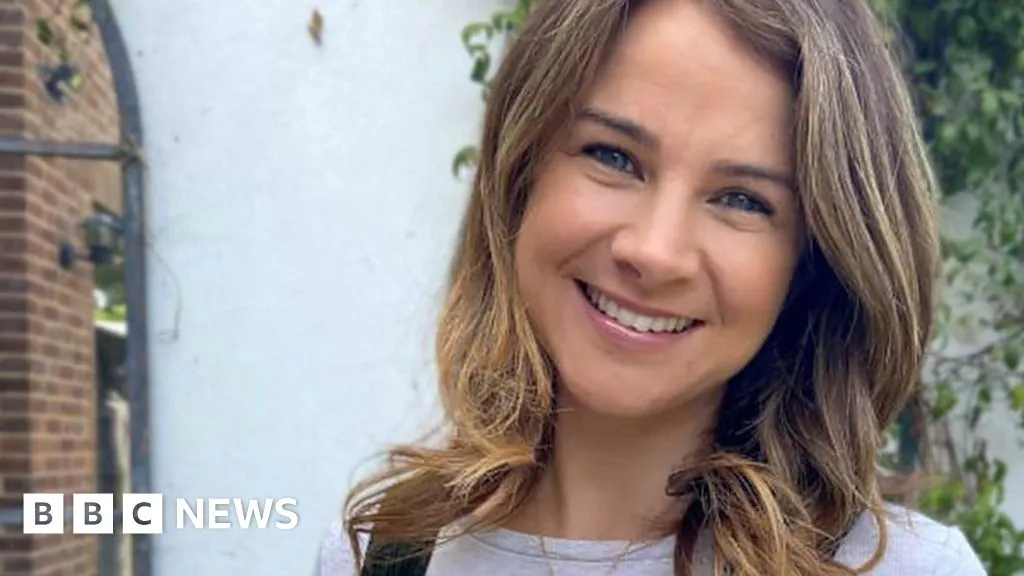
Fifteen years ago, Izzy Judd was relaxing on the beach in Australia when she suddenly felt gripped by fear and unable to breath.
Her soon-to-be husband Harry, the drummer in McFly, had just gone off surfing.
"Him leaving me on the beach sparked a panic attack. It just came over me like a tidal wave. It felt like an out-of-body experience," she says.
The professional violinist and mother-of-three is one of millions of people who live with anxiety so acute it can impede their ability to function.
Last year, almost 250,000 patients in England were referred for counselling, up from 190,000 four years earlier, for generalised anxiety disorder - a mental health condition that affects 7.5% of adults in England, causing fear, a constant feeling of being overwhelmed and excessive worry about everyday things.
Judd says her anxiety dates back to early childhood, growing up with three brothers in a musical family in Harpenden, Hertfordshire.
"I dreaded bedtime because I didn't want to be alone in my bedroom. My heart was racing and my legs would shake."
Then, when she was 12, her oldest brother Rupert, a French horn player and star music school student, suffered catastrophic brain injuries in a car crash.
He was in a coma for two months and was showing no sign of brain activity until his family took his French horn to his bedside, and he started responding to the music.
He still needs round-the-clock care and lives in a home in Aylesbury, Buckinghamshire, for people with acquired brain injuries.
"I think the accident affirmed what I was always worried about, knowing life can just change in an instant and things aren't always in your control," Judd says.
The trauma meant her nervous system was in a "fight or flight" state. "You never quite feel safe again."
Every time there was a car accident on the M11 she would message her family to check they were OK. Her vivid imagination would "conjure up the worse eventualities".
She felt like her problems were minor compared with her brother's, and did not want to worry her parents.
"I remember not really saying how I was feeling. I probably should have had therapy as a teenager but they were dealing with enough and it wasn't talked about as much back then," she adds.
For someone who has struggled so much with anxiety, it was perhaps a surprising decision for Judd to go in to performing, but she says she has never felt scared on stage.
After studying at the Royal Academy of Music in London, she toured the world with the female electric violin quartet Escala after reaching the final of Britain's Got Talent in 2008.
"It is confusing because I've always been able to stand up and do that and go on stage, and things like public speaking have never worried me."
She performed in the strings section for McFly on tour, which is where she met Harry, who has been a constant source of reassurance for her.
"One of my triggers for panic attacks was if I felt like I couldn't get to him or call him," she says.
Since becoming a mother to three children, Judd has tried to learn to rely on herself more.
When her son Kit was a baby, she experienced a panic attack when he was poorly with bronchiolitis and he had to go to hospital.
The musician and author started learning about mindfulness and meditation. She thought it meant "emptying your mind" but realised it was more about noticing your thoughts and "letting them pass".
"If I had learned more about breathwork when I was younger or how to properly breathe, it would have been a huge help," she says. "It is the quickest way to calm the nervous system. I'd love to see it taught in schools."
Her children sometimes struggle with anxiety at bedtime, and Judd has taught them to breathe using a shorter in-breath and a longer exhale to help calm them.
Panic attacks are an extreme anxiety responses and can develop quickly, with very intense physical and mental symptoms.
Most panic attacks last between five and 20 minutes and are not normally dangerous but it can feel like something is very wrong. Some people feel like they are having a heart attack or are going to die.
Symptoms can include a racing heartbeat; feeling faint, dizzy or light-headed; feeling very hot or very cold; sweating, trembling or shaking; feeling sick; chest and stomach pain; and struggling to breathe and shaking legs.
Some people have panic attacks as one-offs while others might have them as part of other mental health problems such as obsessive-compulsive disorder or generalised anxiety disorder.
Mental health charity Mind recommends following these steps during a panic attack:
- Accept that you are having a panic attack.
- Focus on your breathing. It can help to concentrate on slowly breathing in and out while counting to five.
- Stamp on the spot, focus on your senses and try grounding techniques.
- If you can't calm yourself during a panic attack, ask someone you trust to help you or call NHS 111.
Judd presents a podcast which combines music and meditation, and she says some of the conversations she has had on the show have helped her feel less worried.
It features guided meditations on themes such as restorative sleep and reframing anxiety. Each episode covers new compositions performed by the BBC Scottish Symphony Orchestra and the BBC Singers.
"It's not a typical podcast," she explains. "The way it flows is that we give a thought around a topic, then we move into breathing with classical music, then a guest comes on and they do their meditation."
Judd still occasionally suffers from panic attacks but now feels more in control and can recognise when "things are starting to build up and feel overwhelming".
"We live in such a fast-paced world and so many people are burnt out, overwhelmed and fatigued," she says.
"We just need to learn to slow down and be still and remember that everything is going to be OK."
Further help and support on anxiety is available; details can be found at BBC Action Line.
Follow Beds, Herts and Bucks news on BBC Sounds , Facebook , Instagram and X .