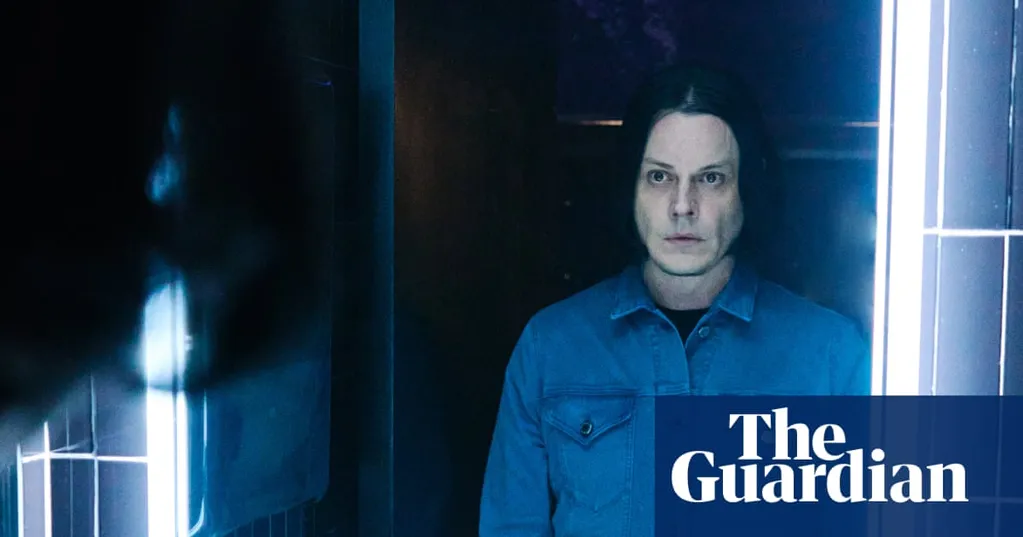
As a new book of his lyrics, poems and selected musings is published, the White Stripes' singer, songwriter and general guitar hero reflects on poetry, politics and why writing a song is like reupholstering a chair.
On the jacket of Jack White: Collected Lyrics & Selected Writing Volume 1, the poet and critic Hanif Abdurraqib writes: "I wish I read more people who talked about Jack White as a writer of lyrics." He makes a good point. White is celebrated as a singer, guitarist, producer and generator of indelible riffs but not so much as a wordsmith. His new book, edited by official archivist Ben Blackwell, sets the record straight. Following 2023's The White Stripes Complete Lyrics 1997-2007, it covers every song White has written outside that band, along with several poems, Instagram ruminations and scans from his notebooks.
White, 50, thinks fast and talks fast. He's sitting in the Nashville headquarters of Third Man, a record label, recording studio, pressing plant, publishing house, shop and ever-expanding vessel for White's vision of what is worth valuing and preserving in American culture. He's a kind of historian of American vernacular, drawn to the relationship between pop and the avant garde, between maverick auteurs and the communal imagination. His own work proves that defiant eccentricity is no obstacle to stadium shows and Bond themes, and that being wildly prolific hasn't diminished his mystique. With this book, he turns his curatorial eye on himself.
This book represents a serious body of work across 30 years. When you formed the White Stripes in 1997, is this what you imagined?
Like a lot of people who are creative, I'm lucky that three people give a damn. It's an honour that any other human would even spend a couple of seconds paying attention to something I put together. At Third Man we've put out so many other people's books but it didn't even occur to me to put out a book of my own stuff. I don't know why. I own the place!
So what made you think of it now?
I wanted to test the waters about doing a full book of my poetry and writings. I was a little bit worried about that being taken the wrong way. It's tough when you say the word poetry out loud. People can immediately think there's a pretension to it.
Do you agree with Hanif Abdurraqib that your lyrics are overlooked?
For every singer the lyrics are overlooked in my opinion. A lot of people would never be considered poets just because they put those words to melody. That's kind of unfair.
When did you start writing poems?
As a teenager. I started going to coffee houses in Hamtramck, a city in Detroit - the real European-style coffee houses, not the modern-day ones. It's a bit irritating now to see 15 people on laptops, nobody speaking to each other. I almost want to open up a coffee house where that's not allowed and you have to talk to other people. I was writing, performing folk music sometimes, learning about art from all kinds of artists. It was a pivotal moment for me. The coffee house needs to come back and be a sacred place where people can commune and don't exploit it for social media content either.
Who were your influences as a writer back then?
Musically, it was all the blues musicians: Charley Patton, Son House, Howlin' Wolf. Flat-out poetry: it was William Blake and Shakespeare's sonnets. There were times when Shakespeare would make me cry and I didn't know why. I just couldn't believe how beautifully it was constructed. It's almost like a human being didn't write this. It's like Isaac Newton: accidentally somebody had an IQ of 290 and changed everything.
Seeing all your writing together, I can identify some recurring themes: birds and trees, broken bones and lonely ghosts, God and Detroit ...
It's like you can look at a painting and say: "Oh, that's a Van Gogh." Or you can hear a song and say: "Oh, that sounds like Trent Reznor." As creative people we have these little comfort zones in our minds: this kind of melody, this way of ending a sentence. And that becomes your style. It makes you wonder about the words you find comfortable.
So do you make any distinction between lyrics and poetry?
It's all poetry to me. I think all music is the blues and I think all lyrics are poetry. When I hear a song, it bugs me when I can't hear what they're saying.
Such as?
The word "home" comes up so much. That word is so heavy in my mind. We just had this ice storm in Nashville and we lost power for two weeks. To walk around the house you live in with a flashlight is so strange and depressing. You feel like this is what somebody might do 50 years from now: they might walk through my abandoned home. Growing up in Detroit, we would walk through abandoned homes quite often and sometimes you would come across something really sad like an album of family photos. That can make you cry. It makes you question so many things. How do we hold on to anything important for more than five minutes?
You used to keep a dream journal. What are your dreams like?
My dreams are quite hilarious and off-kilter. I so rarely hear people say: "Oh that's what my dreams are like." They always say: "That sounds like when I dropped acid." So maybe my brain is tapping into those synapses.
Do they make their way into the songs?
I've always felt my subconscious was way smarter than my conscious mind. But when I'm writing, I don't like to get too stream-of-consciousness. I want people to have things they can sink their teeth into. So I let it go a little bit and then I reel it in. I'm usually trying to grab hold of a character who's in some kind of situation and trying to escape from it or solve it.
Are any of your songs entirely autobiographical?
Not too much. Now it's become very popular in the Taylor Swift way of pop singers writing about all of their publicly aired break-ups, which I don't find interesting at all. I think it's a little bit boring for me to write about myself. Even if I've had a really interesting day, I feel like I’ve already lived that; I don’t need to go through it every time I sing this song. If it’s something really painful, I’m not going to put this important, painful thing that I went through out there for some idiot on the internet to stomp all over. So I put a percentage of that into what I do and then morph it into somebody else’s character. I can’t really learn about myself until I put it into somebody else’s shoes.
Do any characters recur in different songs?
Yeah, I don’t give them names or anything but I have these imaginary folks that pop into my head while I’m doing it. You can learn by asking: what would this other person say? That’s a lot more interesting than preaching to people: here’s the problem and here’s how to solve it as if you’re so smart and so wise. Real wisdom comes from admitting you don’t know anything and other people might have an answer you’ve never thought of.
You love arcane vocabulary. There's a line in What's the Trick? that comes straight from Orson Welles's movie The Magnificent Ambersons: "Two gentlemen of elegant appearance in a state of bustitude." Is that a form of sampling?
I wish I could do a whole book of poetry where you attack it in the hip-hop and folk tradition of building off of the people before you and making something new out of it. Creating poetry out of snippets and soundbites. I write them down all the time.
The highlight of 2024's No Name album was Archbishop Harold Holmes, delivered in the voice of an old-time preacher making outlandish promises. The book reveals that the lyrics are based on a letter from a travelling evangelist in the 1970s. He really existed!
When I learned to reupholster furniture as a teenager, I didn't learn how to build a chair from scratch; I learned how to take an old beat-up chair and bring it back to life. I've realised I've been doing that with music, with sculpture, with poetry, with what we do at Third Man. Archbishop Harold Holmes is maybe the ultimate version of that. It's somebody else's letter. Basically a religious conman - a grifter. What if I were to become this guy for a minute and add more modern verbiage? I used it as a springboard to talk about these kinds of characters who are still alive and well right now in our own government.
You recently posted a ferocious broadside against President Trump on Instagram, and it wasn't your first. Why do you never write explicitly political songs?
Well, when Dylan said the answer was blowing in the wind he didn't tell you what the answer was. I think a lot of people in the protest days were torn: you want to make a statement but the speaker can be chewed up and spat out. The search for hypocrisy becomes intense once somebody takes the podium and condemns somebody else. When it comes to the president, I know a lot about it so I feel comfortable saying it. But if I were to put it in artistic form, I don't think I would say those things directly. I wouldn't say the names; I'd make up a character.
Have you maintained an archive of your notebooks and other ephemera?
Ben Blackwell and my brother Stephen have kept a lot of things for me. I do a better job of preserving others people's things than my own. Recently I was looking for something to write on in my house and it was a book from 1997 and I thought: oh, I shouldn't have left this lying around. I should pay more attention to my own stuff I guess.
Do you enjoy looking back on your work and taking stock?
It's OK. I don't know, there's a part of my brain that's nostalgic for all things and there's a part of my brain that wants to erase it all and move forward. I live somewhere in between those two things. I guess my brain is trained to find beauty where other people are ignoring it. If you can figure out a way to trick people into paying attention for a second, you're on to something.
There's an interesting couplet in one of your poems: "To be born in another time / Any era but our own would've been fine." Do you feel like a man out of time?
I remember 20 years ago I didn't know what the word anachronistic meant. I looked up the definition and thought: wow, that feels like me! It's not exactly a compliment. It means out of place. Misfit. It's a blessing that I'm not an insider and I'm not an outsider. If I was an insider I'd just play by the rules and do the thing that people do that breeds success. And if you're an outsider you're trying to break those rules all the time and burn the place down. If I was on either side of that needle I don't think I would have been very creative.