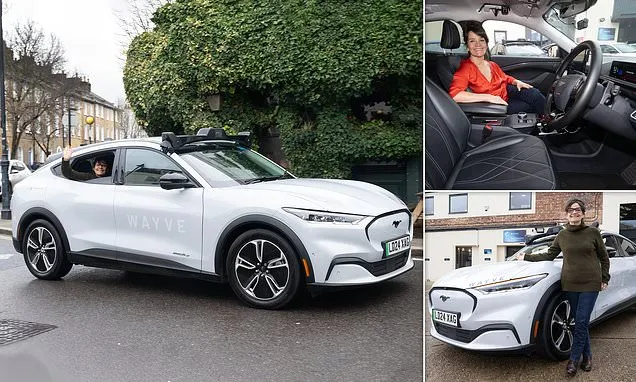
Past the looming walls of Pentonville Prison we pootle, at a very steady 18mph. Up the Caledonian Road, fork left onto Hillmarton Road, and then - after a rather lengthy pause - we pull out on to Camden Road. All with perfect lane discipline and pristine driving etiquette.
So, instead of the usual yelling and gesticulating, we stop politely when a man in a parked car suddenly opens his door into the road in front of us.
And there is no swearing when several pedestrians wander out in front of the car. We even wait patiently for the 360 bus to pull in, drop off passengers and pull out again.
And when cars around us all join in a volley of angry honking over a short delay, and a fleet of emergency vehicles race past, lights flashing, alarms screaming, we sit serenely in our little oasis of calm.
It's all rather odd. Soporific, even. But the peaceful atmosphere isn't down to the fact that my cabbie has been practising meditation or has swallowed a fistful of sedatives to insulate him from the stresses and strains of London traffic.
No. It's simply because he (or she) does not exist. There is no driver.
The steering wheel moves this way and that of its own accord. The indicators flick on and off. The windscreen wipers leap into action at the first hint of rain. And the accelerator pushes down on its own - gently, mind.
Yes, I am sitting in a driverless AI-enabled car, a Ford Mustang Mach E, with software designed and produced by a UK company called Wayve that has 1,000 employees, a rumoured billion-dollar cash injection on the way and, according to some, is the future of British driving.
Only a neat black bar above the windscreen, which holds seven cameras for 360-degree views that extend the length of three football pitches, marks the car as being AI-enabled.
Unlike previous prototypes we have seen from rival companies with so much technology perched on top that they look like Noddy cars, this 'robocar' looks pretty normal.
Only a neat black bar above the windscreen, which holds seven cameras for 360-degree views that extend the length of three football pitches, gives us away.
They feed into an extremely powerful AI 'brain' in the boot, which is so top secret we aren't allowed to photograph it.
With the help of four types of sensors, it can safely navigate other cars, pedestrians, cyclists and even dogs and cats without putting its passengers at risk.
Crazy as it sounds, by the end of the year this AI software could be a regular fixture, not just in driverless Uber taxis around London - albeit at a slightly higher price than traditional taxis - but possibly in our own driveways in private vehicles.
So, instead of driving yourself to work, or the pub, or on the school run, we can hop in and be driven - maybe reading the paper and eating our breakfast in the passenger seat as we go, or digesting one beer too many in the back.
It is all thanks to Alex Kendall, a very bouncy 33-year-old Kiwi, who tells me that he spent his childhood alternately climbing mountains and building robots; did a PhD in computer vision and robotics at Cambridge; and ever since has been working towards his dream of a fully automated car.
Of course, he's not the only one. Over recent years billions have been poured into development of robocars around world; we've seen endless stories about other driverless cars turned out by Waymo (owned by Alphabet—a Google company), Cruise and WeRide—cutting swathe through road networks Los Angeles, San Francisco, Atlanta, Beijing and Doha. But not London—until now.
The steering wheel moves this way and that of its own accord. The indicators flick on and off. The windscreen wipers leap into action at the first hint of rain. And the accelerator pushes down on its own.
Because our roads are not orderly but a tangled medieval mess. We have roundabouts and roadworks galore; pedestrians who step out constantly; headphones on blissfully unaware; 1.5 million cyclists with a tendency towards kamikaze.
It also hasn't helped that, sensibly, Britain has rather more stringent regulations - under the Automated Vehicles Act, passed in 2024, self-driving vehicles on British roads must achieve a level of safety equivalent to, or higher than, that of careful and competent human drivers.
Which means that today and for the next few months, while all Wayve demonstration cars are driven by AI, a safety control officer must sit in the driving seat - doing nothing, I stress.
Mine is called Vitor, who used to be a live-in carer for spinally injured patients; which means he's brilliant at driving very smoothly. He is also wonderfully chatty about AI - 'Sometimes it all feels very human.' But once the car is put into 'AI mode' he is not allowed to talk, turn round or even listen to me.
Nothing other than monitor; interject if necessary - ready to slam big red emergency button front if something goes wrong.
Which might feel a bit over the top but is perhaps wise given the story of Elaine Herzberg, 49, who was hit and killed by an Uber robocar in Arizona in 2018 when safety driver was streaming an episode of television talent show The Voice.
Though reassuringly, as the Wayve staff are quick to point out, the technology here is different: 'Better - much better.'
So unlike rival Waymo, which is also rolling out its own version of driverless taxis in London later this year, Wayve has no need to rely on remote telephone operators to assist in difficulties - if, for example, the passenger gets locked inside, or the car refuses to obey instructions.
'I wouldn't see a scenario in which that would happen,' says Alex Kendall.
More importantly, he has taught his AI software how to drive. So put in very simple terms while other robocars have to learn a city - roads junctions layout - in same way as London's black cab drivers have had to study 25,000 streets 20,000-odd landmarks for The Knowledge; Wayve cars have learned how to drive like humans
and interpret maps. 'They are adaptable. They can drive anywhere. And they have,' he tells me.
'We've been round Arc de Triomphe Paris Magic Roundabout [five mini-roundabouts clustered around big roundabout] Swindon Central Market Tokyo.'
A couple of weeks ago he even filmed himself riding driverless car Buckingham Palace pick OBE services AI.
Though unfortunately video clocked car taking weirdly circuitous route going red light got lot critics' hackles up particularly among angry London taxi drivers.
Wayve later admitted error saying its cars 'prototypes' conducting review.
While Alex assures me Wayve London cabbies have 'healthy debate', Steve McNamara driver spokesman Licensed Taxi Drivers Association isn't quite so excited whole robocab thing.
Driverless car slams brakes mistaking bus advert real people
Of course he isn't! His members already had deal invasion Uber drivers gobbling business. Last thing need Uber cars drivers.
'It's a gimmick... It's not safe. It's a solution for a problem we don't have,' says Steve.
He gets into his stride and starts to enumerate the many valid reasons he sees this as a stupid idea - who'll clean the car and deal with the mountains of lost property, who'll stop people eating and drinking in it, how it won't be able to stop for cash, or a bottle of wine, or flowers, or any of the million things cabs are constantly being asked to deal with.
But I take a moment to think of a few potential benefits. The calm, the ability to control the heating, to choose something to listen to other than Talk Radio.
And for those of us who love a bit of chit-chat but who are not always so keen to discuss football, Sadiq, Starmer or Trump in excoriating detail when we’re dashing for a train – silence, but for an annoying whining sound, which I’m told comes from a spinning sensor atop the car’s roof.
I can even choose the driving style – anything along a sliding scale from Calm – cautious, gentle and a bit like your granny driving – to Bold, which Vitor tells me is more likely to get up to speed quickly, and make turns without waiting ages,’a bit more London’. But hang on a minute – and perhaps it’s rather silly of me to ask this part-way through my driverless drive – is it really safe?
Alex and the rest of the AI-driverless car community certainly seem to think so and are quick to remind doubters of the 1.2 million human car accidents globally. That someone is killed or seriously injured every 16 minutes in the UK. And that between 94 and 96 per cent of all accidents are caused by driver error.
Something they insist that, with the dawn of driverless cars, will soon be a thing of the past.
Under the Automated Vehicles Act, passed in 2024, self-driving vehicles on British roads must achieve a level of safety equivalent to, or higher than, that of careful and competent human drivers.
Wayve has no need to rely on remote telephone operators to assist in difficulties - if, for example, the passenger gets locked inside, or the car refuses to obey instructions.
They also point out that most of our cars are wasted assets - used for just 3 per cent of the time - and point out government figures that forecast the driverless car industry could add £42billion and 40,000 jobs to our economy by 2035.
Though they are less keen to linger over the industry's teething issues. Such as the power outage that caused traffic chaos when driverless vehicles came to a standstill in San Francisco last December.
'That can't happen - our AI will adapt like a human,' says Alex.
Or the news story just last week that a robocar slammed on the brakes after confusing a poster of the cast of a movie on the side of a double decker bus with real people. 'That was not us! We would expect our system to have a level of intelligence that could tell the difference between a person and a poster,' he says.
To many, Wayve is a good news story. It is one of the best-funded and most promising UK tech companies and is going great guns; which is of course incredibly exciting.
But also—for those of us still clinging onto real books and terrestrial television and who are a tiny bit scared of AI—it is rather daunting.
'Everything new is always daunting,' says a Wayve employee. 'The first computer; typewriters; then cars took over from horses. It's progress—it's daunting now but not when we get there.'
But will it really take off in London? Quite possibly. I'm sure plenty will embrace it. Particularly as Alex is keen to stress that Wayve is not trying to take over market from existing taxis; just add mix—to provide another (much safer; more soothing; if pricier) alternative.
I can definitely see it working for time-pressed professionals; it's another option for older people tired of bus—although perhaps not for unsupervised school run with kids bouncing about back.
But for many of us,it might take little while longer adapt becoming nation back seat drivers.