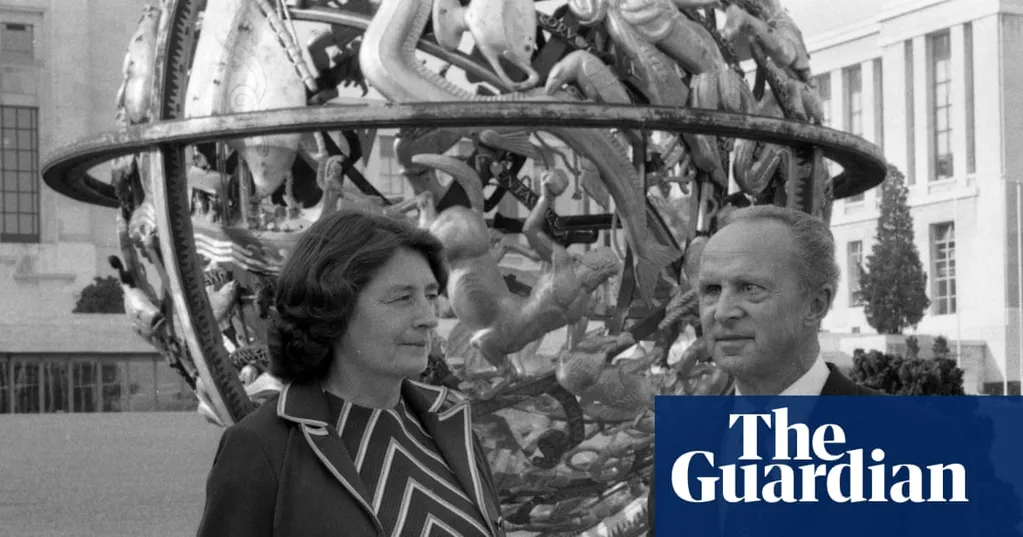
Co-founder of the charity Sightsavers and tireless campaigner for the education of blind children
On 5 January 1950, Jean Wilson, who has died aged 103, inaugurated her charity, the British Empire Society for the Blind, answering the phone to journalists with "Which department would you like?" in a bid to conceal that it was such a tiny, two-person operation.
Founded with her husband, John, and renamed Sightsavers in 1986, from these acorn beginnings it became a leading charity tackling blindness in developing countries. Today each year it funds more than 9m eye examinations and half a million sight-saving operations in 30 countries.
Aged 19, Jean McDermid, as she was then, met John Wilson in 1943 when he lodged in her family home in Eastcote, west London. The couple, who married in 1944, shared a radical vision to help the millions of people globally affected by blindness.
In the 1940s John, who was blind himself after an explosion in a school chemistry lesson when he was 12, worked for the National Institute for the Blind (now the RNIB). In 1946-47 he participated in a government tour of British colonial territories in Africa and the Middle East and was appalled at the sheer number of people who were blind due to avoidable causes such as disease, malnutrition and lack of medicines. Determined to help, he quit his job and the couple set up their charity and started fundraising.
Theirs was a tight-knit double-act and their skills dovetailed. They travelled tirelessly, with Wilson acting as her husband's "eyes". She was a talented photographer, fundraiser and communicator, persuading politicians including Lord Halifax, the former foreign secretary, and well-known blind people such as Helen Keller to support them.
In 1950, one of their first trips was to the Gold Coast (now Ghana). They visited the Nakong area on the River Sisili, a hotspot for the parasitic disease onchocerciasis. Transmitted by tiny flies that breed near the river and bite humans, the parasites burrow into the body causing permanent sight loss.
Nakong was known as "the country of the blind" and Wilson said: "It was awful, a place of horror." Most villagers over the age of 12 were blind, so they had to feel their way along hemp ropes to reach the well or get their children to lead them. Thinking ahead about how to fundraise - the disease has been treatable since the 1980s with the drug ivermectin - Wilson knew the name was a stumbling block.
She said to her husband: "It's no good calling this thing onchocerciasis. If I can't pronounce it or spell it, I certainly can't raise funds for it. It comes from the river, so let's call it 'river blindness'." The name immediately caught on, and the disease became known by her name for it.
By 1955 the society - later known as the Royal Commonwealth Society of the Blind - had set up national organisations in 20 countries, including Ghana, Nigeria, Barbados and Cyprus, which ran mobile eye clinics to treat river blindness, trachoma and other eye conditions. They also helped fund training schemes for blind farmers, ophthalmic surveys and educational projects. It was not a "top down" organisation: instead, the Wilsons wanted to partner and support local initiatives.
Jean had trained as a teacher and was particularly interested in educating blind children. She had visited schools in America that integrated children with sight loss into ordinary schools and helped set up a similar school in Uganda but was dismayed that parents often thought a blind child was not worth educating.
Something dramatic was required to show how much blind people could achieve, and in 1969 the society arranged for seven blind men from Uganda, Kenya and Tanzania to climb Kilimanjaro. The expedition was covered widely by African newspapers and helped to convince parents that it was worth allowing their blind child to attend school.
John was knighted in 1975, bringing Jean the courtesy title of Lady Wilson. She was made OBE in 1981, and two years later they both stepped down from Sightsavers, deciding to use their experience to tackle disability more widely. In 1981 Wilson had organised the Leeds Castle international seminar on the prevention of disablement as part of the United Nations' International Year of Disabled Persons.
After this, the Wilsons and their daughter Claire Hicks set up Impact in 1985 to address the whole spectrum of disability, including sight and hearing loss, physical disability and other conditions. Like Sightsavers, Impact partners with local organisations; in a flagship project in 1991, it collaborated with Indian Railways to launch the Lifeline Express, the world's first hospital train. Last year alone nearly one million people benefited from Impact's programmes.
Wilson passionately believed that much disability could be avoided through education and immunisation. The disease rubella during pregnancy can result in blindness and deafness in unborn babies, and in 1983 she became chair of the UK's National Rubella Council, which ran education programmes to increase uptake of the rubella vaccine. She recruited prominent women such as Diana, Princess of Wales and Linda McCartney to publicise the campaign, and in four years they significantly increased rates of vaccination among women and girls.
Born in Acton, west London, Jean was the only child of Chloe (nee Byway) and John McDermid, and attended Harrow county school for girls. Her father worked in public health for Kensington and Chelsea borough council but he died when she was 16. To make ends meet her mother took in lodgers one of whom was John Wilson.
From 1941 to 1944 Jean studied history at Westfield College University of London which during the war had temporarily relocated to Oxford. She followed this with a teaching diploma at the London Institute of Education in 1945. She and John initially lived in London on the Finchley Road where she had Claire in 1948 and Jane in 1953. In 1955 the family moved to a house near Rottingdean in Sussex which was Jean's base for the rest of her life and where she loved to garden.
John died in 1999. He had chaired the Hearing Conservation Council and Jean took over as chair. She also remained closely associated with her charities serving as vice-president of Sightsavers and honorary president of Impact to the end of her life and she continued to travel widely into her 90s. In 2002 she was made an honorary fellow of the Royal College of Ophthalmology.
She is survived by Claire, Jane, five grandchildren and eight great-grandchildren.