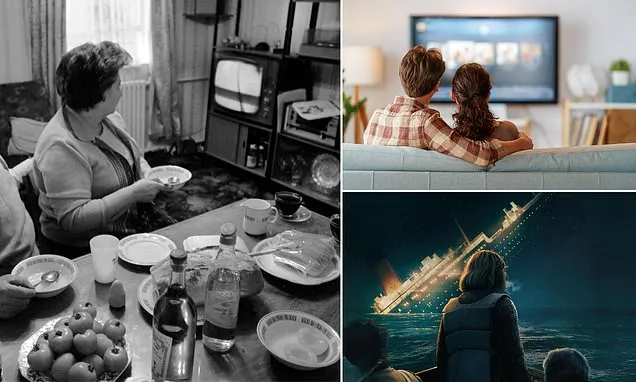
A few weeks ago my television told me I should retune it and, fearing the alternative may be worse, I complied. It is a smart TV, see, and I am an ageing viewer losing confidence in my dominion over household technology.
The retuning did not go well. When it was complete, I was left with 13 channels, most of which I'd never watched before. Where was BBC1 and BBC2? ITV1 and Channels 4 and 5 were missing too. I retuned again. Same thing.
My 20th century wiring computed this as a disaster. Imagine at any time in the 70s, 80s, or 90s owning a TV which was incapable of tuning in to our staple terrestrial channels. It would be a useless box in the corner. We'd be straight down to Currys for a new one.
But then something of the 21st century crept into my thinking. So the cornerstones of my viewing experience stretching back decades were all now missing in action. Did it really matter in the present decade?
Having lived with the reception issue for the best part of a month now, I find it matters not a jot.
Those terrestrial TV schedules - once pored over and planned around - have become a virtual irrelevance.
Do people still allow the broadcast times of their favourite soap or game show to govern their evenings?
Watching terrestrial television is becoming a thing of the past.
The days of families gathering around the television at a certain time to watch their favourite programme are long gone.
One of the BBC's recent triumphs is the documentary Titanic Sinks Tonight.
Do they still say things like, 'Quick! Switch over to the other side. That new David Attenborough series starts at nine'?
A few, perhaps, but they are a dying breed. And terrestrial TV is a dying medium.
Figures published this week suggest Britons are more likely to tune into YouTube than the BBC.
The independent ratings body Barb found the video-sharing platform reached 51.9million people in December, compared to the BBC's 50.9million.
YouTube outperformed the BBC in October and November too - a finding which veteran TV producer and broadcaster Steven D Wright described as 'a tragedy'.
'The tipping point is here and we are now living in a world dominated by streamers,' he told The Times.
'The TV audience has abandoned the discipline of scheduled TV, and on-demand viewing has killed any loyalty.'
I'm not sure if 'tragedy' is the word I would use, but then, I am a viewer with agency and not a broadcasting corporation demanding everyone with a telly pays up whether we are consumers of its output or not.
For the record, I remain an enthusiastic consumer of the BBC's product even if my TV cannot pick up its scheduled programming. Blue Lights, the Northern Ireland-based police drama serial, is among the brightest stars anywhere in the galaxy of offerings our remotes can call up.
Titanic Sinks Tonight, which I've just watched, is another BBC triumph - a gut-wrenching minute by minute documentary series placing the viewer onboard the doomed vessel and bringing intimacy to the horrifying predicament and ultimate loss of most of its passengers and crew.
I wouldn't be without The Traitors. And the delightfully kooky Claudia Winkleman is streets ahead of her opposite numbers hosting other countries' versions of the show.
All of these I've streamed at my leisure on iPlayer. What time the shows happen to be broadcast is not a factor. BBC News at Ten? Not where I live. It's BBC News at the time of my choosing.
I suspect the same holds increasingly in living rooms across the country. It is a form of viewer empowerment which, on our end of the deal, has no downsides.
The downside is all on the BBC's end of the deal. Like it or not, it has become a streaming giant. It is right there in the mix with Netflix and Amazon Prime and Apple TV and Disney+, all of which I pay for at home.
It is in the mix with YouTube too - and apparently losing the ratings war against it - and that is free to view.
The difference, of course, is we can unsubscribe from those other streamers any time we like. If we unsubscribe from the BBC we must also unsubscribe from television ownership.
In an age where we treat the BBC's output in much the same way as that of its internet-based competitors, this becomes highly anomalous. In an age where an upstart like YouTube is pulling in more viewers than our national broadcaster, it borders on outrageous.
Again, I've no wish to unsubscribe. I'd sooner lose Netflix than the BBC. The point is that subscription to the BBC is mandatory. Withholding the licence fee is a criminal offence - surely now the weirdest one out there.
It is rather like buying a car and being told we are free to source our fuel from whomever we choose but , wherever we go to fill up , we are obliged by law to cover BP's costs as petrol providers.
The BBC will tell you that they offer much more than the streamers , such as news bulletins , exclusive sports coverage , regional programming . That's true .
But it is hardly the only news broadcaster out there and viewers increasingly question its balance .
Whether they are right or wrong in that , why should they be forced to pay for news they have come to distrust ?
I'd probably pay the licence fee for Wimbledon alone . But much of what we once tuned into the BBC to watch - such as live coverage of the Open - is gone . We pay a rival broadcaster to see it but still pay the BBC .
The regional programming? It's often little more accomplished, if at all, than that which we can find on YouTube or videocasts.
Streaming has brought a democratisation of viewing habits. The market will decide what flies and what doesn't. Uniquely in British broadcasting, the BBC considers itself above the market.
The question is, how well do you really know your customers until they have the freedom to walk away?
What the data on YouTube viewership suggests is many customers are already voting with their feet while forking out for the service they are leaving behind.
I can see why they're doing it. The platform has become a fantastic resource, the ultimate on-demand experience for practically every sphere of interest under the sun.
Want to learn how to play that Hotel California guitar solo? There's an army of guitarists on YouTube who'll talk you through it. They don't make television programmes on that.
Want to put in a new bathroom on your own? There's not a single task in the process that won't be covered in detail by a YouTuber somewhere. Some have managed to do up entire houses with nothing but YouTube videos as their guide.
This place where people used to go to watch pop videos has become the world's biggest interview archive.
Curious why the philosopher Bertrand Russell was not a Christian? Watch him give his reasons in a clip from 1959. For the researcher, the platform is a godsend. For the idle channel-surfer, it's endless entertainment targeted to our interests.
And we twig to the reality that it is not broadcasting at all, but narrowcasting; TV for audiences too small for the BBC to get out of bed for.
But the big picture is narrowcasting is winning. And the licence fee has never looked more vulnerable.