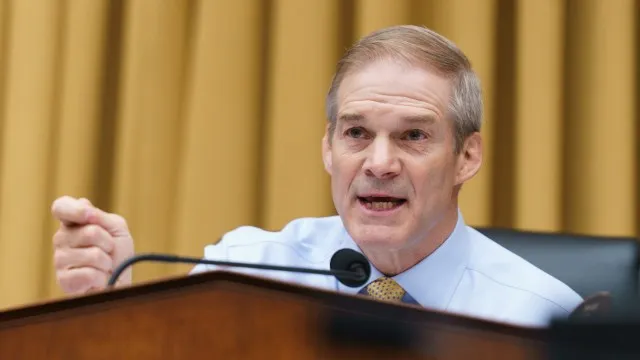
Rep. Jim Jordan (R-Ohio) on Thursday said Americans "can live with" higher gas prices, a surge that's a result of the nearly two-week-long joint U.S.-Israeli military operation in Iran.
Jordan told CNN's Kasie Hunt that Americans have the "common sense" to "understand that to stop this regime that for 47 years has killed Americans, killed Israelis, killed others and killed a number of their own people -- to stop them from getting a nuclear weapon is a worthwhile objective."
"And President Trump is committed to achieving that goal, and if that means prices go up for a time, I think Americans understand, we can live with that," he continued. "But in the end, we want all that to happen, and we want it all to happen in as quick a time as it possibly can."
Jordan told Hunt that the conflict will end "soon." When she asked what "soon" means, Jordan replied, "I don't know for sure," and added that Americans want lower gas prices, to prevent Iran from having nuclear capability and for the military offensive to end soon.
The Ohio Republican is one of several GOP lawmakers who, along with the president, have dismissed the rising price of gas despite the affordability issue becoming a key issue going into the November midterm elections. Others are concerned it will cost the party control over Congress.
Trump has defended the operation as a short "excursion" ending "very soon," telling reporters he is not concerned about oil prices. Though last month the issue was a key point in his State of the Union address where he claimed gas prices had dropped.
"The United States is the largest Oil Producer in the World, by far, so when oil prices go up, we make a lot of money," Trump wrote on Truth Social Thursday.
But the closure of the Strait of Hormuz, the Middle Eastern passage through which around 20 percent of the world's oil and gas is exported, has kept prices up and has economists worried that the conflict could drag the U.S. into a recession.
"For upper-income families, it is a small price to pay," Mark Wolfe, executive director of the National Energy Assistance Directors Association, previously told The Hill. "It's a very small part of their budget. For lower-income families, it's significant. It makes a real difference in their ability to buy food, to buy medicine, to pay rent."
The national average for gas inched up to $3.63 on Friday, according to data from AAA. The average last month was $2.94.
The U.S. oil price benchmark West Texas Intermediate crude trades at just over $93 per barrel., while the international benchmark, Brent crude, was trading at almost $99 per barrel, down from $101 per barrel on Thursday afternoon. These are up from $67 and $73, respectively, from before the conflict started.