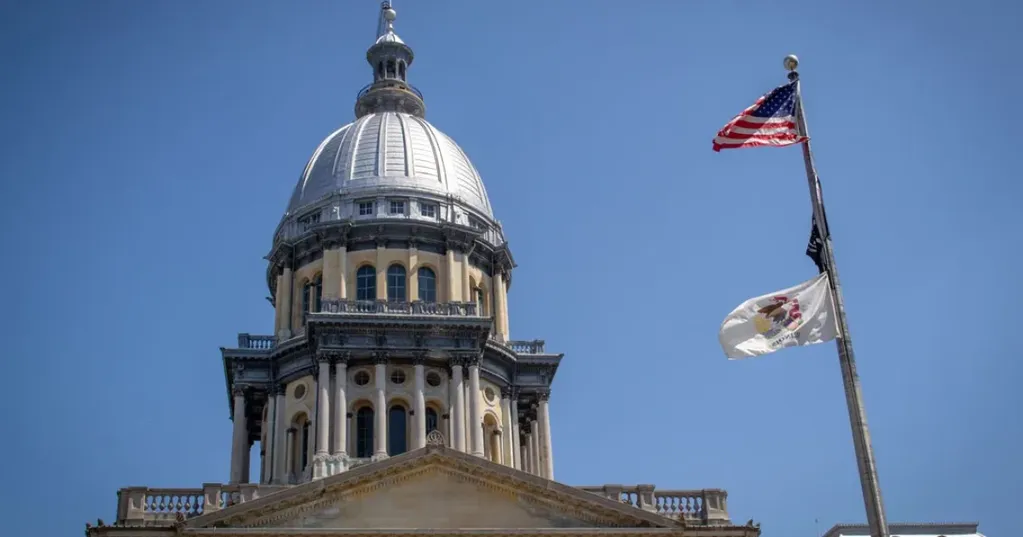
SPRINGFIELD -- The Illinois House passed more than 150 bills out of committee from Tuesday to Wednesday as it worked toward a Friday deadline to move legislation to the full House.
The measures included a ban on junk fees, classification of "child torture" as a Class X felony, a retry at a nonprofit savings bill the governor recently vetoed, and a bill to strip Chicago's authority to alter the minimum wage for workers who make tips.
All of the measures passed this week are still a long way from final passage, requiring approval from both chambers and the governor to become law.
Lawmakers considered a bill that would end Chicago's tipped minimum wage ordinance, ultimately passing it in committee despite opposition from some Democrats. House Bill 4623 would give the state exclusive regulatory power over allowance for tips as part of hourly wages, ending home rule authority on that issue.
The bill would overturn a 2023 Chicago ordinance that would gradually phase out the city's "tipped minimum wage," which allows employers to pay tipped workers an amount lower than the standard minimum wage if the rest is made up in tips.
The city council, however, recently passed an ordinance pausing this year's scheduled increase. But on Wednesday, Chicago Mayor Brandon Johnson vetoed that measure.
When Illinois passed its current minimum wage law in 2019, it maintained a provision that allowed employers to pay tipped workers 60% of the minimum wage, which is currently $15 hourly. The restaurant industry lobbied for limiting home rule authority during the passage of the 2019 law, to no avail.
Bill sponsor Rep. Curtis Tarver, D-Chicago, said he brought the bill to keep tipped minimum wage laws uniform statewide. His bill does not prevent municipalities from having higher minimum wages than the state.
"Having 200-plus home rule municipalities, it doesn't make a ton of sense for somebody to get the home rule and have one set of goals and then to cross over to another municipality" with other rules, Tarver said.
Proponents of the bill limiting home rule authority argued that the tipped minimum wage helps keep costs down. Eliminating it could lead to restaurant closures across Chicago, they said. Opponents generally argued that the legislature shouldn't encroach on home rule powers, and tipped workers in Chicago deserve the raise.
The bill passed 22-4, with four Democrats from the Chicago area voting in opposition.
The House Consumer Protection Committee passed a bill to ban 'junk fees,' or hidden charges that are placed on bills but not otherwise posted or advertised.
House Bill 228 would make it a violation of the existing Consumer Fraud and Deceptive Business Practices Act for a company to post a price that does not include all mandatory fees and surcharges. It also mandates that prices and fees must be clearly disclosed prior to checkout.
This is the third time the committee has considered a bill to ban junk fees, but none have become law.
"At a time when working people are already struggling with rising costs, hidden fees that appear at checkout make it even harder to budget and compare prices," Economic Security Illinois Action said in a statement. "Banning hidden junk fees and requiring companies to show the full price upfront is a simple, commonsense reform that will bring fairness to our marketplace and protect working families from corporate greed."
Democratic lawmakers could take the rare step of adding a new criminal penalty to state law. A House criminal judiciary committee passed House Bill 5562 unanimously on Tuesday, which would create the offense of child torture in state law. Democrats have typically shied away from bills that create new or tougher criminal penalties.
Rep. Michelle Mussman, D-Schaumburg, who sponsored the bill, said it was inspired by a 2019 American Bar Association resolution calling on states to define child torture in their laws. The bill would apply to cases of physical and emotional abuse that "create, increase or prolong the pain, suffering and agony of a child." The offense would be charged as a Class X felony -- the most serious in Illinois.
Mussman said the bill is important because torture "may not necessarily manifest as physical abuse that results in great bodily harm but still has a tremendous impact on a child's physical, mental and emotional health."
Some Democrats said they were concerned the bill was too broad and encouraged Mussman to craft an amendment outlining more specific cases that would be considered torture.
"Child torture is wrong and terrible and we have a responsibility I think to be very cautious about when we create new Class X felonies because of the severity of that sentence that the conduct that could be sentenced to a Class X should be the most egregious conduct that there is," Rep. Will Guzzardi, D-Chicago, said.
A bill that would allow the state treasurer to establish a special investment fund for Illinois nonprofit corporations advanced in both chambers of the General Assembly on Wednesday.
The proposal is a revised version of one state Treasurer Michael Frerichs pushed in 2025. It would operate much like Illinois Funds, the pooled investment fund the treasurer's office operates for state agencies and municipalities.
"This investment pool will allow our nonprofits to invest their money in a fund that will generate substantial interest and have a meaningful impact on their operations," Frerichs told a Senate committee.
Gov. JB Pritzker vetoed the bill last year, saying it could have the unintended consequence of benefitting fringe and extremist organizations that organize as nonprofits.
The revised bill would limit the types of organizations that could qualify to participate in the investment pool to include Medicaid-certified health care providers, organizations previously certified to receive state grants, federally registered labor organizations and organizations whose missions fall within specified categories such as neighborhood development, affordable housing or services for military veterans.
It would also exclude organizations that are on certain suspension, debarment or stop payment lists for the state or federal government.
The new language is included in two identical bills, House Bill 5045 and Senate Bill 2968. Both bills await final action by the full chambers.
School employees who get summers off would be eligible for unemployment benefits under a bill approved by the House Labor Committee on Wednesday. House Bill 4416 would allow school district employees like bus drivers, custodians and cafeteria workers to collect benefits in the summer if they are unemployed and cannot find other work.
Illinois AFL-CIO Secretary-Treasurer Pat Devaney said the bill is a matter of fairness as private contractors hired by school districts are eligible for benefits. The bill passed 18-10, with Republicans voicing concerns it would be a significant cost to districts. Devaney estimated it would cost less than $200 million annually.
House Bill 4844, which would require employers to pay employees their regular rate of pay when they are selected for jury duty, passed 13-7 out of a judiciary committee.
Bill sponsor Rep. Jay Hoffman, D-Swansea, said jurors can face financial challenges if they’re selected for a case that lasts several weeks, adding he hopes the legislation would make it more affordable for people to serve on a jury.
But Republicans voiced concerns the bill would be burden for businesses because they have to pay an employee who isn’t showing up to work.
House Bill 4514 would require the Illinois Commerce Commission to offer hearings specifically to collect public feedback whenever it holds utility rate increase hearings. It passed 11-6.
The bill comes after a series of controversial rate increase requests from Illinois' public utility companies.
Currently, the public is allowed to testify at ICC rate increase hearings but are limited to three minutes of testimony and cannot submit written statements. Residents would be allowed to testify and submit statements to the record during the newly required hearings.