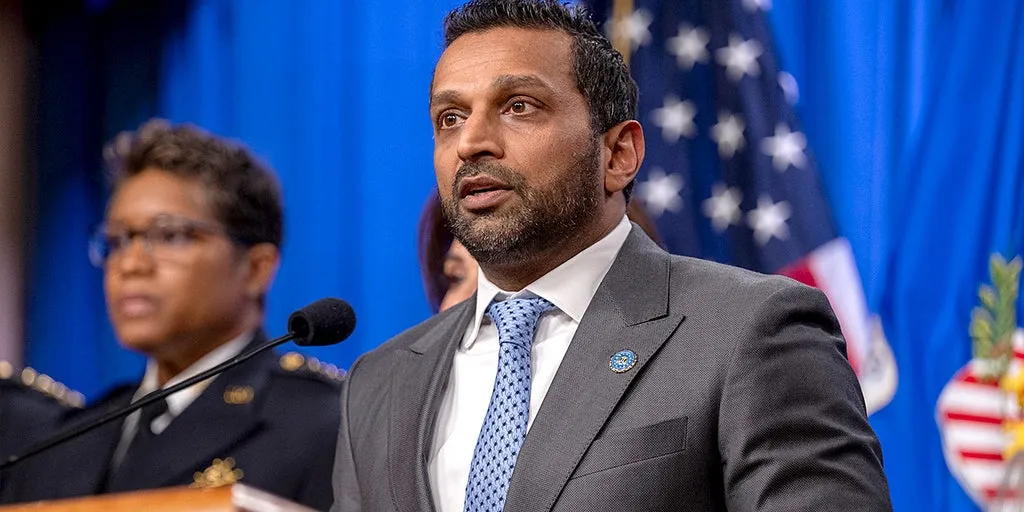
FIRST ON FOX: FBI Director Kash Patel is expected to tout a list of his agency's top reforms and accomplishments under President Donald Trump's second term during a Senate hearing Wednesday on worldwide threats impacting the United States.
Patel is set to address several reforms during the hearing, which is being held by the U.S. Senate Select Committee on Intelligence, including expanded biometric collection overseas, sending more agents into the field from D.C., doubling the size and funding for drone utilization, a new first-of-its-kind training center meant to assist local law enforcement with counter-drone training, new artificial intelligence initiatives to support intelligence collection, among several other reforms, Fox News Digital has learned ahead of his planned remarks.
In addition to Patel, Director of National Intelligence Tulsi Gabbard is also slated to testify alongside Patel at the hearing Wednesday, as well as Central Intelligence Agency (CIA) Director John Ratcliffe, Director of the U.S. Defense Intelligence Agency James Adams, and Acting Commander of U.S. Cyber Command William Hartman.
"Under President Trump's leadership, this FBI has been rebuilt into a faster, more accountable force focused on protecting Americans and crushing violent crime. We've surged agents out of Washington and into the field, expanded biometric screening overseas to stop threats before they reach our homeland, overhauled our intelligence and operations systems, and strengthened partnerships and technology to move at the speed of today's threats," Patel is expected to say. "This is a results-driven FBI delivering real security for the American people."
Patel is also expected to tout a laundry list of accomplishments that the FBI has racked up over the last year, including disrupting 1,800 gangs and criminal enterprises, seizing over 2,250 kilos of fentanyl, and several statistics highlighting major arrests, including a 112% increase in violent crime arrests, almost 350 cyber indictments, 6,000 child victims located, 1,700 child predators arrested, among many other accomplishments.
Democrats have charged Patel with politicizing the FBI, but Patel and Republicans have argued that the current efforts are aimed at doing just the opposite.
"You've begun the important work of returning the FBI to its law enforcement mission," Sen. Chuck Grassley, R-Iowa, told Patel during a September Senate hearing. "It's well-understood that your predecessor left you an FBI infected with politics."
"As I've committed to you during my confirmation hearing and my conversations with you, this FBI will not be weaponized anymore in either side of the aisle," Patel added during the September hearing on FBI oversight.
One reform aimed at reducing agency politicization at the FBI includes an end to what Patel has described as "politicized" threat-banding. Threat-banding is the process of assigning certain threats, such as White Supremacy violence, to high-priority categories.
Under former FBI Director Christopher Wray, in 2020, the agency had indicated it would be elevating racially motivated violent extremism to a "national threat priority," with Wray indicating it was at the "top of the priority list" for the agency.
During Wray's tenure under former President Joe Biden, a leaked memo from the FBI's Richmond, Virginia field office warned about the violent domestic extremism threat allegedly posed by traditionalist Catholics, leading to GOP anger and concern that Catholics were being targeted based on biased information.
Meanwhile, Patel's push to make the FBI less Washington-centric and more Main Street-focused resulted in the FBI sending more than 1,000 agents who were originally positioned in the nation's capital to locations around the country. Patel told lawmakers last year during congressional testimony on Capitol Hill that this priority allows the FBI to "focus our resources where they're needed the most."
Increasing federal and state cooperation includes via a first-of-its-kind counter-drone operations training center in Alabama where state and local law enforcement can learn about federal law enforcement techniques. Additionally, the FBI has been ramping up its counter-drone capabilities, doubling the current size of their efforts per Patel.
Patel also has led initiatives to ramp up the FBI's utilization of artificial intelligence, such as new working groups meant to test artificial intelligence's ability to process large volumes of national security and intelligence information. Efforts to streamline communications and improve threat detection systems have also been a focus of the FBI during Trump's second term.
Another big change Patel is ushering into the agency includes strengthening and providing more funding to the FBI's Threats Screening Center, renamed by the agency last year from the Terrorist Screening Center. The aim is to expand the system to assist with more than just terrorism-related threats but also threats from cartels and others impacting border security.