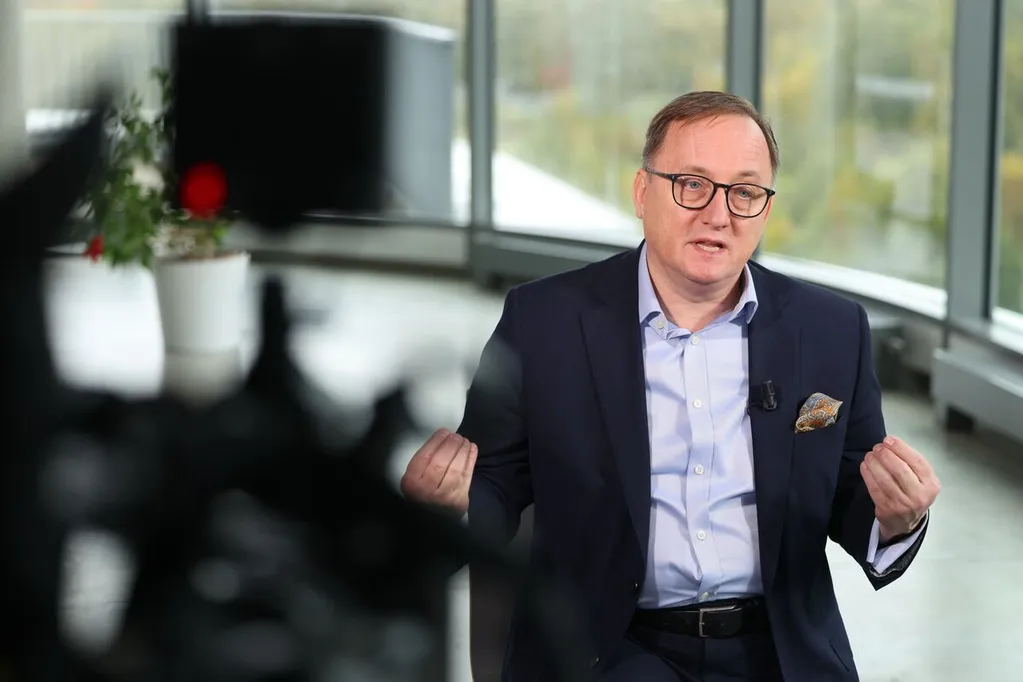
It's not a given that the European Central Bank's next move on interest rates will be a hike, according to Governing Council member Martins Kazaks.
While he currently sees no reason to challenge market expectations for two increases this year, that's just one of several scenarios. In the meantime, policymakers still have time to assess the economic damage caused by the Iran war.
"If shortages set in very quickly and tilt the economy closer to a recession, inflation pressures may turn out to be much, much weaker," Kazaks said in an interview in Washington. "Then, of course, you might need to switch your monetary policy in the opposite direction," he added. "You might need to cut."
Officials are examining how energy disruptions from the Middle East are affecting the economy. In Europe, inflation has surpassed the 2% goal, confidence has plummeted and uncertainty about a lasting resolution to the conflict persists. While the ECB says it's ready to act if needed, officials are likely to stand pat at this month's meeting.
President Christine Lagarde told Bloomberg Television this week that the ECB doesn't have a tightening bias, while Slovenian central-bank chief Primoz Dolenc suggested declining energy prices could mean interest-rate increases aren't needed at all.
Estonia's Madis Muller was among those arguing that there's no need to rush into action, while his Finnish colleague Olli Rehn said "calm judgment will prevail over haste" and Martin Kocher of Austria warned against preemptive rate action.
Financial markets and economists expect a quarter-point increase in the deposit rate in June, to 2.25%. Traders are still leaning toward a second move by year-end -- despite signs that the Strait of Hormuz is reopening.
Kazaks said the ECB's meeting-by-meeting stance means "by definition that all meetings are live" -- even though that "does not mean that we need to necessarily move."
"We're still very much in a monitoring mode: we're cautious to see what happens with spillovers, what happens with second-round effects, and so far we have not seen much," he said. "That reduces somewhat the necessity to move instantaneously."
With tighter financial conditions doing "some work for us," the ECB has leeway, he said -- particularly after policymakers weathered the record price spike in 2022. "Our credibility is stronger because we delivered last time," he added, "and that gives us more time to see if we need to move and how much we need to move."
While peace efforts appear to be paying dividends at present, the ECB remain on alert and market bets may well prove to be correct.
"If we see that it starts to spill further -- that workers push for higher wage increases, that corporates start to reprice more often -- of course we need to move in," he said. "The baseline is built on the market pricing of two hikes and as long as baseline approximately holds, I would not object to a similar market pricing."