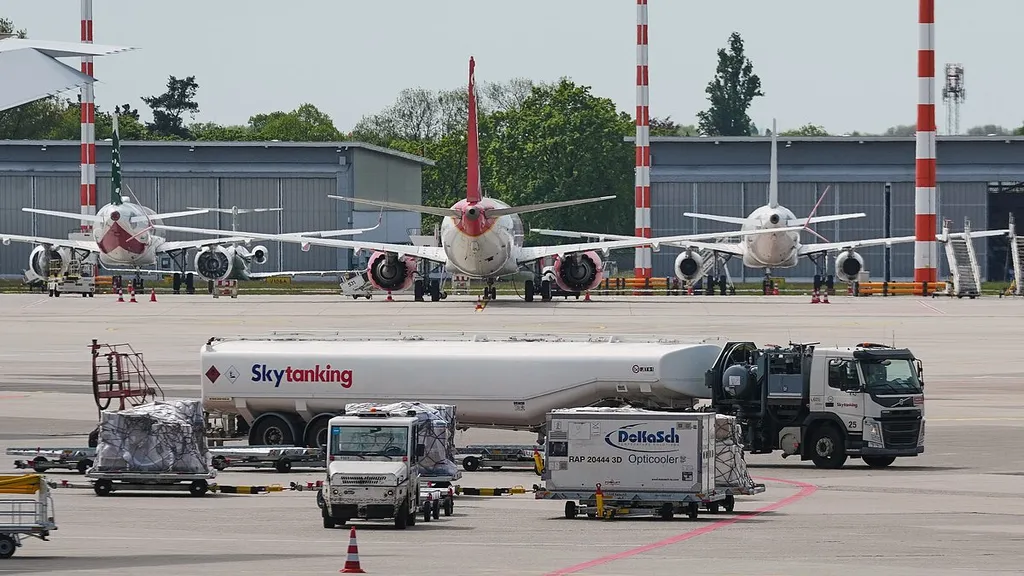
Britons may need to change their summer holiday plans because of the jet fuel crisis, the Prime Minister has warned amid a surge in UK staycations.
Sir Keir Starmer said people might rethink 'where they go on holiday this year' if the Iran war continues to impact airlines, which have already been raising fares and fees.
His intervention goes further than the Government's messaging until now, which had previously been that there was 'no current need to change upcoming travel plans.'
Asked on The Cathy Newman Show on Sky News last night whether summer holidays could be in jeopardy, Sir Keir said: 'We'll see how long the conflict goes on.
'I can see that, if there's more impact, people might change their habits, where they go on holiday this year, what they're buying in the supermarket, that sort of thing.'
The jet fuel price increased from about $99 (£73) per barrel at the end of February to as high as $209 (£155) at the start of April - although it has fallen in recent weeks to $179 (£132), according to the latest International Air Transport Association data.
Uncertainty over foreign travel has seen bookings soar for staycations this summer - with Airbnb reporting a 15 per cent rise in searches for UK breaks compared to 2025.
Bookings at Haven holiday parks rose 10 per cent over the Easter holidays compared to last year, while Sykes Holiday Cottages reported an 18 per cent rise for the period.
The Prime Minister, who will lead a meeting of the ministerial Iran crisis committee today, has urged Britons not to panic over the economic impact of the Iran war.
He said 'at the moment' the Government was confident about supply chains and was doing 'everything we can' to reopen the Strait of Hormuz, the vital oil and gas shipping route effectively closed by Iran since the US-Israeli strikes began.
Sir Keir said the French and the British would lead a 'military mission' to provide reassurance to ships passing through the strait, although the initiative driven with French President Emmanuel Macron is not expected to begin until hostilities cease.
He added: 'There is going to be an impact on the UK. There already is. And I think it's really important that I level with the public that we are doing everything we can to get the Strait of Hormuz open, because obviously that is vital in terms of minimising the impact.'
How European airlines are responding to the jet fuel crisis
- AEGEAN AIRLINES: The Greek airline expects suspended Middle East flights and a spike in fuel prices to have a 'notable impact' on its first-quarter results.
- AIR FRANCE-KLM: The airline group said it planned to increase long-haul ticket prices to address surging fuel costs, with cabin fares set to rise by €50 (£43) per round trip. The group's Dutch arm KLM said on April 16 it would cancel 160 flights in Europe in the coming month due to rising fuel costs.
- EASYJET: EasyJet warned of a bigger half-year pre-tax loss of between £540million to £560million, including £25million in extra fuel costs in March.
- IAG: British Airways-owner IAG said in March it did not plan to increase ticket prices immediately, as it had hedged much of its fuel for the short- to medium-term. IAG says it is not facing jet fuel supply interruptions but 'fuel prices have risen significantly and although we have a strong hedging strategy, we're not immune to some of the impacts'.
- LUFTHANSA: The airline group said 20,000 short-haul flights would be removed from its schedule through October, equivalent to about 40,000 metric tons of jet fuel. The German company previously said it would ground 27 planes servicing its short-haul CityLine subsidiary earlier than planned.
- RYANAIR: The airline's boss Michael O'Leary said on April 22 that suppliers are 'telling us that they can guarantee supplies until May' but 'nobody's really sure what happens in June'.
- SAS: The Scandinavian airline said it would cancel 1,000 flights in April because of high oil and jet fuel prices, after canceling a 'couple hundred' flights in March.
- TAP: The Portuguese airline said its price hikes would partially mitigate the impact of fuel price changes on its revenue.
- TUI: The European airline and tour operator cut its full-year underlying profit outlook and suspended revenue guidance, saying it had incurred about €40million (£35million) in extra costs due to the war in March, including repatriation efforts and operational disruptions.
- TURKISH AIRLINES, LUFTHANSA: SunExpress, a joint venture between Turkish Airlines and Lufthansa, said it would impose a temporary fuel surcharge of €10 (£9) per passenger from May 1 on routes between Turkey and mainland Europe. The surcharge will apply to bookings made on or after April 1 for departures on or after May 1.
- VIRGIN ATLANTIC: The airline is adding fuel surcharges to fares but will still struggle to return to profitability this year, its CEO Corneel Koster said.
- VOLOTEA: The Spanish low-cost airline introduced a new pricing policy linking ticket prices to fuel costs, which could potentially add a post-purchase surcharge of up to €14 (£12) per passenger, per flight.
'But I don't want anybody to think that, once the Strait is open, that that's the end of the damage. It will go on longer than that.'
He said there were 'almost daily meetings' of ministers and officials looking at how to manage the impact of the crisis.
'At the moment, we're confident about supply. We have reopened a CO2 plant in the North East. Airlines are telling us that they've got enough jet fuel at the moment.'
Asked for his message to the public, Sir Keir said: 'Don't panic. But, we chose not to get involved in this war. That was the right thing to do but we must protect the British people from the impact of it.'
Today's meeting of the Middle East Response Committee (Merc), the panel set up to deal with the fallout from the crisis, will be attended by senior ministers and representatives from the Bank of England.
Ministers are expected to gather in one of the Cabinet Office briefing rooms.
The Government previously warned that the economic impact could last for eight months after the war's end.
The meeting comes amid international calls at the United Nations yesterday to reopen the critical shipping lane.
Foreign Office minister Stephen Doughty told the UN Security Council that US President Donald Trump and Sir Keir had this week 'discussed the urgent need to get shipping moving again'.
'This crisis is not just affecting international shipping, it is driving up costs and sending shockwaves throughout energy markets and supply chains far beyond the region with impact for all of our citizens, our communities and their cost of living,' he said. So, we must get the Strait reopened fully and unconditionally.'
The Prime Minister previously said the response to the economic and political shock from the war, which has strained transatlantic relations with the US,'will define not just this Government but arguably this generation'.
Oil prices hit a near three-week high yesterday after hopes of progress on peace negotiations collapsed.
Talks between the US and Iran had been expected to take place in Pakistan before Mr Trump declared envoys from Washington would no longer be travelling to Islamabad due to a lack of progress with Tehran.
Yesterday, Iranian officials offered to end the country's closure if the US lifted its blockade, ended the war and postponed nuclear talks, a proposal Mr Trump seemed unlikely to accept.
US secretary of state Marco Rubio later told Fox News that Iran's nuclear programme is a 'core issue' that must be addressed.
He added: 'We have to ensure that any deal that is made, any agreement that is made, is one that definitively prevents them from sprinting towards a nuclear weapon.'
Jet fuel is typically one of the largest expenses for airlines, leaving them especially vulnerable to price spikes and supply shocks.
In some markets, the price of jet fuel has more than doubled as fighting near the Strait of Hormuz squeezes global supplies, raising operating costs for airlines.
In response, carriers around the world have raised fares and fees, with both United and American among the major US airlines that have raised checked baggage fees.
Wizz Air's CEO Jozsef Varadi said yesterday that the airline was 70 per cent hedged for its fuel needs for the summer period and would receive 35 new Airbus aircraft during 2026.
The Hungarian-based airline was set to renew some of its hedges when they run out this summer in order to protect it against price volatility, he added.
He maintains that he does not think jet fuel will run out in the coming weeks. At a price of $1,500 a metric ton for jet fuel, tankers were incentivised to head to the US to collect it, Mr Varadi said, which made up for shortfalls from the Middle East.
However, he does think prices could remain high even for months after the war ends.
Mr Varadi said it was a good moment for Europe to reassess its reliance on the Middle East for fuel, especially as the crisis could lead to broader capacity cuts across the industry intensifying in the autumn.
'If you look at the very nature how Europe is accessing jet fuel, I mean, we are far over-dependent on the Middle East. I mean, that's kind of crazy,'
he said.
The Daily Mail has contacted the Department for Transport for an updated statement on the jet fuel issues.
Its most recent statement issued on April 24 says: 'There is no current need to change upcoming travel plans.'
'Since the closure of the Strait of Hormuz, we have been closely monitoring UK jet fuel stocks and working with airlines, airports and fuel suppliers to ensure passengers keep moving and businesses are supported.
'Government regularly meets with industry to monitor risks, understand pressures and ensure clear communication with passengers, should circumstances change.'
'We recognise that families may be concerned, and that aviation and tourism businesses are operating in challenging global conditions. We are working hand in hand with industry to help flights keep operating.'