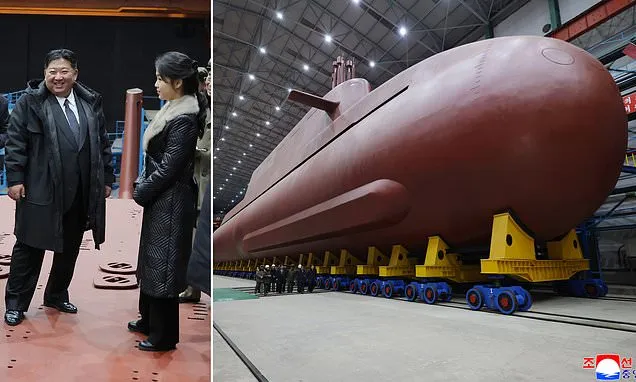
Kim Jong Un has demanded a major expansion of North Korea's weapons programme as he toured the country's latest nuclear-powered missile-carrying submarine alongside his young daughter.
The dictator ordered officials to step up missile production and build new munitions factories to meet what he described as the military's growing need for advanced weapons, according to the country's state media.
Pyongyang describes the new weapon as an 8,700-tonne nuclear-powered strategic guided missile submarine being built at an undisclosed shipyard.
Kim visited key arms manufacturing sites with senior officials and instructed them to prepare for an especially intensive year ahead.
He said factories must 'further expand the overall production capacity' to keep pace with demand from the country's armed forces.
'The missile and shell production sector is of paramount importance in bolstering up the war deterrent,' Kim said, ordering the construction of additional munitions plants.
The visit comes as North Korea continues a sharp escalation in missile testing, which analysts say is aimed at improving precision-strike capabilities, deterring the United States and South Korea, and trialling weapons systems that could later be exported.
Pyongyang's deepening military ties with Russia have intensified those concerns.
Since Moscow invaded Ukraine nearly four years ago, North Korea has supplied Russia with troops, artillery shells, missiles and long-range rocket systems, according to Western officials.
Kim toured the facilities with his daughter, identified as Kim Ju-ae, who has accompanied him on numerous state events.
In return, analysts believe Russia has provided financial assistance, food and energy supplies, and sensitive military technology.
Washington has also accused Moscow of helping North Korea with advanced space and satellite technology, which overlaps with intercontinental ballistic missile development.
Ahn Chan-il, a researcher originally from North Korea, told Reuters: 'Satellite launchers and intercontinental ballistic missiles share much of the same underlying technology.'
He added that with Pyongyang's ICBM programme widely seen as having met its core goals, the regime is likely to accelerate development further next year.
Kim's inspection of the submarine facility was reported a day after state media said he toured a nuclear submarine factory and vowed to counter what he described as the growing threat posed by South Korea's plans to develop similar vessels with US backing.
State-run Korean Central News Agency said Kim was also briefed on research into 'new underwater secret weapons' during the visit.
Analysts believe North Korea is seeking advanced military technologies from Russia, including nuclear-powered submarine expertise and modern fighter jets, to address long-standing weaknesses in its navy and air force.
Kim was also reported to have overseen the test launch of new high-altitude, long-range anti-aircraft missiles over the Sea of Japan this week.
Kim visited the sites to get himself acquainted with missile and shell productions. He is now demanding that the country develops more sophisticated weapons
He said 'new modernisation and production plans' would be unveiled at the ruling Workers' Party's first congress in five years, expected in early 2026.
Experts estimate Pyongyang has around 50 nuclear warheads, and enough fissile material to build significantly more if it chooses, although exact totals are uncertain because the programme is secretive.
The IAEA has repeatedly flagged ongoing activity linked to North Korea's nuclear fuel cycle, including signs associated with enrichment and reactor-related work, even though inspectors are not allowed into the country.
Western governments oppose North Korea's weapons build-up because they see it as a direct threat to regional and global security, and a challenge to the international system designed to limit the spread of nuclear arms.
Pyongyang's missiles are explicitly built to deter or strike South Korea and Japan.
Its intercontinental systems are intended to put the United States within range, raising fears of miscalculation or escalation during any crisis.
Meanwhile, Kim's appearance with his young daughter has also fuelled fresh speculation about her future role in the regime.
The girl, widely identified by South Korean intelligence as Kim Ju-ae, has accompanied her father to a series of high-profile military events since late 2022, including missile tests, weapons factory inspections and naval facilities.
During a military parade on October 10, North Korea unveiled the Hwasong 20, which it described as 'the most powerful nuclear strategic weapon'
Kims daughter, Kim Ju-ae has increasingly accompanied him to a number of events since 2022
She was also seen with him when he arrived as a guest for China's military parade earlier this year.
State media has referred to her as Kim's 'beloved daughter', an unusually prominent label in North Korea's tightly controlled propaganda system.
While Pyongyang has never officially named an heir, analysts say her repeated presence at strategic weapons sites appears intended to familiarise the public with dynastic succession and project long-term continuity.
South Korean officials caution it is still too early to say she has been formally chosen as successor, but note that no other child of Kim Jong Un has been presented so publicly alongside him.